Situation Summary
Montenegro remains a low-threat country globally (rank #150; composite score 9) with no tracked major events this week. However, urban crime—particularly violent assault, robbery, and theft—has shown a sustained presence in Podgorica and Nikšić, while northern municipalities continue to pose elevated risk due to weapons trafficking, narcotics, and organized-crime activity. The security environment is stable but fragmented: coastal and central areas experience street-level crime, whereas remote northern border zones remain associated with smuggling networks and illicit weapons caches.
Key Developments
- Violent assault arrest, Nikšić (15 Sept): Police arrested three men, including a known person of interest, on suspicion of causing grievous bodily harm to a 34-year-old; case treated as serious violent crime.
- Knife-point taxi robberies, Podgorica (7, 13 Sept; arrest 13–14 Sept): A 41-year-old man arrested for two separate armed robberies of taxi drivers; suspect threatened drivers with a knife and stole cash on both occasions.
- Repeat-offender juvenile theft ring, Podgorica (10 Sept): A 17-year-old with multiple prior offences arrested for six serious thefts (burglaries, retail theft) committed in August–September; ordered detained pending trial.
- Petty theft detention, Podgorica (13 Sept): Woman detained 72 hours on suspicion of stealing €250; illustrates continued low-level urban property crime.
- Border convoy transit with Albanian symbols, Nikšić–Kosovo route (11–12 Sept): Police stopped 13 vehicles with 20 foreign nationals (predominantly Albanian) displaying Albanian national symbols; markings removed per law; convoy escorted through country without incident—managed public-order event with transit-security implications.
- Weapons and narcotics seizure, Bijelo Polje (12 Sept): Police searched properties of a known interest person in Medovići and Potrk, seizing 145 rounds of ammunition, automatic-rifle frame, and 20 tablets of Lorazepam; confirms active weapons trafficking in northern region.
- Immigration violations and bribery, Cetinje (10–11 Sept): Five Azerbaijani nationals detained for breaches of foreigners' law and bribery; indicates foreign-national compliance and anti-corruption enforcement activity.
- Attempted aggravated murder, Budva (8 Sept, reported 9 Sept): A 22-year-old Serbian citizen entered a café with a loaded, cocked 9 mm pistol intending to kill a local resident; intended victim overpowered attacker; police arrested suspect and seized weapon and forged ID document.
Highest-Risk Areas
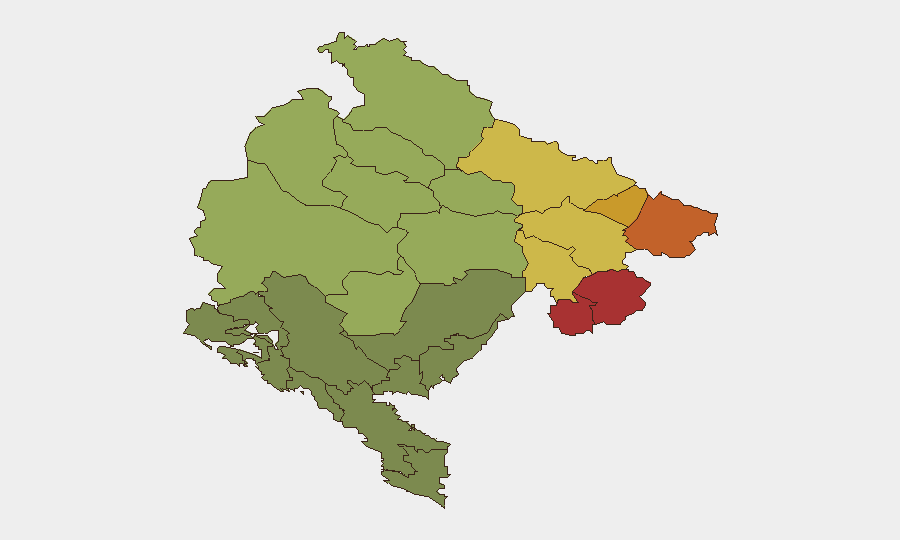
Northern municipalities (Plav, Gusinje, Rožaje, Petnjica, Andrijevica—risk scores 68–78) dominate Montenegro's sub-national threat profile, driven by persistent organized-crime activity, weapons smuggling, and border-transit vulnerabilities along the Serbia–Kosovo corridor. Bijelo Polje's score (65) reflects recent police operations targeting illicit ammunition and drug caches. Central urban zones (Podgorica, Nikšić, Budva) show elevated street-level violent and property crime, though these remain manageable through standard policing. Risk is dispersed rather than concentrated in any single flashpoint.
How GeoBit Would Assist
Security teams should deploy AOI Monitoring & Early Warning on high-risk municipalities (Plav, Gusinje, Bijelo Polje) to detect weapons-trafficking activity and cross-border movement anomalies in real time. Border & Disputed-Territory Search capabilities combined with Network & Actor Analysis would help identify organized-crime actors and trafficking networks operating across the Serbia–Kosovo–Albania triangle. Intel Sweep with multi-language OSINT and Telegram/X intelligence would provide early signals of protest, criminal enterprise shifts, or foreign-national security incidents before police reports surface.
7-Day Outlook
Crime momentum in urban areas (Podgorica, Nikšić, Budva) is likely to persist at current levels; police enforcement appears responsive and capable. Northern border-region weapons and narcotics seizures suggest sustained law-enforcement pressure on smuggling networks, which may reduce operational tempo but not eliminate underlying supply chains. No indicators of civil unrest, large-scale organized violence, or infrastructure threats; Montenegro's trajectory remains stable.
Highest-Risk Areas — Ranked
| # | State / Region | Risk |
|---|---|---|
| 1 | Plav Municipality | 78 |
| 2 | Gusinje Municipality | 76 |
| 3 | Rožaje Municipality | 74 |
| 4 | Petnjica Municipality | 72 |
| 5 | Andrijevica Municipality | 68 |
| 6 | Bijelo Polje Municipality | 65 |
| 7 | Berane Municipality | 62 |
| 8 | Plužine Municipality | 58 |
| 9 | Pljevlja Municipality | 55 |
| 10 | Šavnik Municipality | 52 |
| 11 | Žabljak Municipality | 50 |
| 12 | Kolašin Municipality | 48 |
Sources
Previous Weekly Briefs
A new Montenegro brief is written every Monday, covering the week — each with its own risk map and downloadable CSV. Use the calendar to go further back.
- September 8, 2026
- September 3, 2026
- August 31, 2026
- August 29, 2026
- August 26, 2026
- August 24, 2026
- August 22, 2026
📅 Browse past briefs by calendar →
Highlighted days have a brief. Tap a day for that day's map & analysis, or “csv” for that day's dataset ($5).
Atlas — our AI intelligence desk — emails them this snapshot personally. Nothing else, no list.