Situation Summary
Samoa maintains a stable security baseline with no verified incidents of violent conflict, civil unrest, major crime spikes, or infrastructure disruption during the reporting week. A politically sensitive court case in Apia—involving false allegations against the former Prime Minister—concluded with a guilty plea, and routine regional security cooperation saw four Samoa Police officers deployed to the Pacific Islands Forum in Palau. Overall threat trajectory remains low, with petty crime in urban Apia as the primary residual risk and no indicators of organized violence or political instability.
Key Developments
- Apia (Mulinu'u Courthouse), 1–3 September 2026: Woman pleaded guilty to nine counts of misleading police and one count of conspiracy to defeat the course of justice after making false allegations involving Samoa's then–Prime Minister to the Police Commissioner and Head of State. Case treated as touching national security due to involvement of sitting head of government and high-profile homicide investigation.
- Apia, 2–3 September 2026: Four Samoa Police officers confirmed deployed as part of multinational Pacific Police Support Group (≈120 officers total) providing security for the 55th Pacific Islands Forum Leaders Meeting in Koror, Palau. Temporary diversion of domestic policing capacity for regional security cooperation.
- Apia, 4 September 2026: Exercise Longreach conducted—joint Samoa–Australia disaster-response and civil-protection exercise reinforcing regional resilience and emergency-management preparedness for natural hazards.
- Koror, Palau (regional), 1–3 September 2026: Samoa's delegation to the Pacific Islands Forum led by Deputy Prime Minister rather than Prime Minister; no indicators that domestic political instability drove the absence.
- National (Samoa), 2–3 September 2026: Daily threat assessment confirmed no active security, crime, unrest, infrastructure, or travel-risk incidents in preceding 24–48 hours and no alerts from national police, disaster management, aviation, or maritime authorities.
- Apia, 1 September 2026: New fuel prices effective; diesel and kerosene adjusted. While not a security incident, fuel pricing is an early economic pressure point relevant to future social risk. No associated unrest or protests reported.
- Pago Pago Harbor, American Samoa, 2 September 2026: Greenpeace USA activists and community leaders conducted non-violent protest against NOAA research vessel over perceived deep-sea mining risks; no arrests, clashes, or major disruption. Located in U.S. territory, not independent Samoa.
- Apia, late August / early September 2026: OFC Under–19 Men's Championship football match (New Caledonia vs. Samoa) played without security incidents, illustrating normal public-gathering conditions.
Highest-Risk Areas
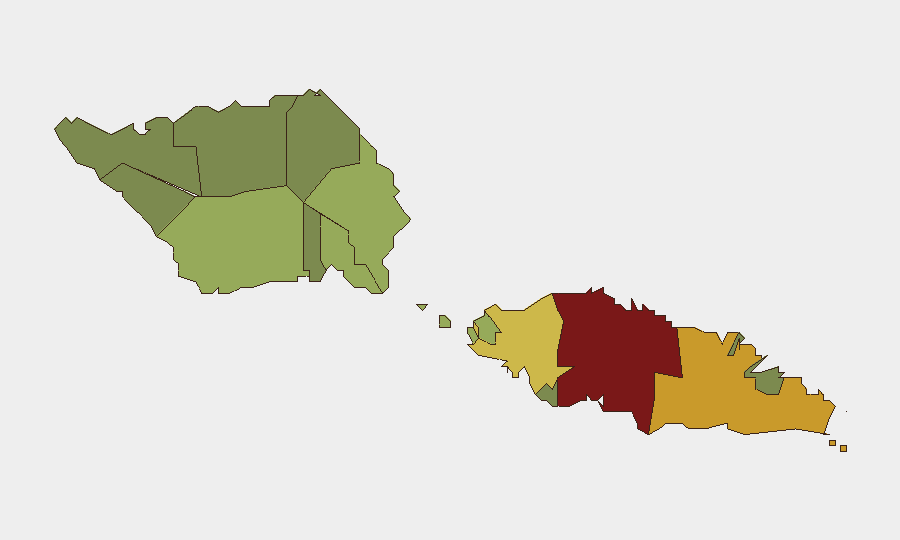
Tuamasaga district (composite risk 85), home to Samoa's capital Apia and primary government, commercial, and tourism infrastructure, drives the national risk ranking and reflects urban concentration of policing demands, petty crime, and diplomatic activity. Secondary risks in Ātua (71) and Aʻana (62) districts remain notably lower, with rural and outer-island districts (Vaʻa-o-Fonoti, Vaisigano, Gagaʻifomauga at 23–32) presenting minimal acute security concern. Risk concentration in Tuamasaga reflects standard patterns for capital regions rather than indicators of emerging instability.
How GeoBit Would Assist
Security teams monitoring Samoa would deploy AOI Monitoring & Early Warning to track Tuamasaga and Ātua districts for emerging civil unrest, crime upticks, or political activity; Intel Sweep and OSINT fusion to corroborate local media, court proceedings, and police statements; and Economic & Trade monitoring to flag fuel-price, inflation, and employment pressures that may precede social friction. Sentiment & temporal analysis on regional forums and social media would provide early signals of activist or opposition organizing before incidents materialize.
7-Day Outlook
No acute security triggers are visible on the near-term horizon. Samoa's participation in regional forums and disaster-preparedness exercises reflect normal bilateral and multilateral engagement. Petty crime in Apia will likely remain the primary routine risk; monitoring of fuel-price impacts on household economics and any spillover activism from neighboring American Samoa's environmental movement is prudent.
Highest-Risk Areas — Ranked
| # | State / Region | Risk |
|---|---|---|
| 1 | Tuamasaga | 85 |
| 2 | Ātua | 71 |
| 3 | Aʻana | 62 |
| 4 | Aiga-i-le-Tai | 55 |
| 5 | Faʻasaleleaga | 48 |
| 6 | Palauli | 42 |
| 7 | Satupaʻitea | 38 |
| 8 | Gagaʻemauga | 35 |
| 9 | Gagaʻifomauga | 32 |
| 10 | Vaisigano | 28 |
| 11 | Vaʻa-o-Fonoti | 23 |
Sources
Previous Weekly Briefs
A new Samoa brief is written every Monday, covering the week — each with its own risk map and downloadable CSV. Use the calendar to go further back.
- September 2, 2026
- August 31, 2026
- August 29, 2026
- August 27, 2026
- August 25, 2026
- August 23, 2026
- August 21, 2026
📅 Browse past briefs by calendar →
Highlighted days have a brief. Tap a day for that day's map & analysis, or “csv” for that day's dataset ($5).
Atlas — our AI intelligence desk — emails them this snapshot personally. Nothing else, no list.