Situation Summary
The United Arab Emirates remains operationally stable with no confirmed domestic security incidents in the last 24–48 hours. However, regional tensions have intensified following renewed Iranian threats against UAE interests on 2 August, coinciding with broader US–Iran escalation affecting Gulf aviation and shipping. Dubai carries elevated composite risk (31.3) relative to other emirates, though the underlying drivers—commercial concentration, tourism volume, and regional exposure—remain structural rather than acute. Current trajectory shows a calm domestic environment shadowed by interstate rhetoric and indirect regional spillover.
Key Developments
- 2 August, Iran/IRANIAN entity: Repeated threats directed at United Arab Emirates per event signals; specific targeting, scale, and response mechanism remain unconfirmed in available reporting.
- 2 August, Baghdad: Public statement directed at UAE; context and substance not detailed in current brief data.
- 1 August, UAE Government: Rejection and disapproval statements issued domestically; specific policy or incident driver not confirmed.
- Regional aviation impact (last 48 hours): UAE carriers and regional routes affected by US–Iran escalation; some flight cancellations and rerouting reported, but no airspace closure or domestic UAE disruption confirmed.
- UAE official diplomacy: Condemnation of hostile attacks on Saudi Arabia, Jordan, Kuwait, and Egypt issued; reflects regional alignment but no new UAE-specific incident.
Note: No terrorist attacks, bombings, protests, curfews, or major security incidents confirmed within UAE territory in the observation window.
Highest-Risk Areas
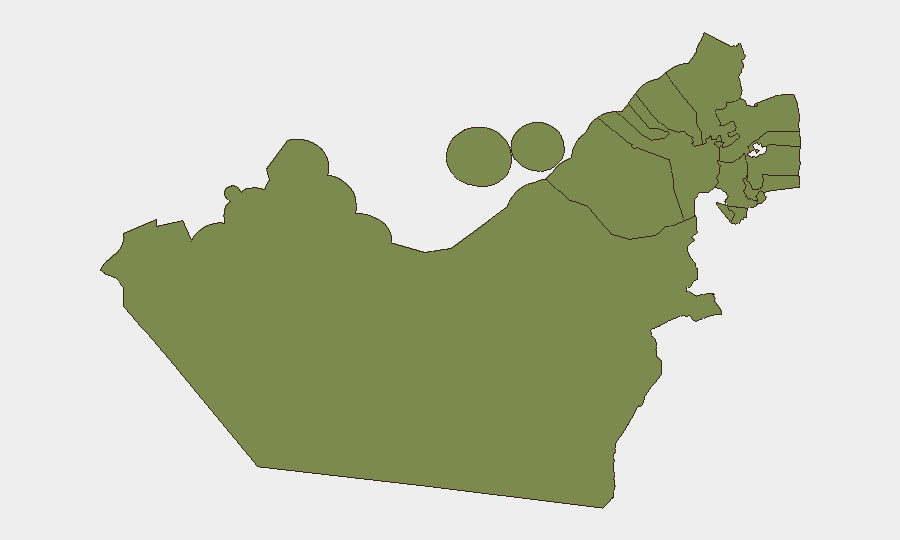
Dubai dominates the sub-national risk profile at 31.3, a significant outlier compared to all other emirates (1.3 each). This gap reflects Dubai's role as the region's primary commercial, aviation, and tourism hub—concentration of international traffic, multinational corporate presence, and financial infrastructure elevate exposure to both direct and indirect threats. The remaining emirates (Sharjah, Abu Dhabi, Ajman, Ras al-Khaimah, Fujairah, Umm al-Quwain) show uniform baseline risk, indicating either equivalent underlying conditions or data saturation at lower thresholds. For duty-of-care purposes, organizations with personnel or assets in Dubai warrant enhanced monitoring and contingency planning; other emirates present routine Gulf baseline risk.
How GeoBit Would Assist
Security teams would employ AOI (Area-of-Interest) Monitoring & Early Warning with persistent watches on Dubai, Abu Dhabi, and Jebel Ali port to detect protest activity, security force posture changes, or maritime anomalies before they affect operations. Intel Sweep and multi-language OSINT fusion (X, Telegram, regional media) would corroborate Iranian threat rhetoric, distinguish posturing from operational intent, and surface any targeting of specific sectors or facilities. Aviation & Maritime tracking combined with Routing & Network Analysis would enable real-time alternative routing for personnel movement and cargo flows in response to any further regional escalation or airspace restrictions.
7-Day Outlook
Iranian rhetoric is likely to persist through the near term given broader regional tensions; however, absence of kinetic escalation in the UAE over the past 24–48 hours suggests operational restraint. Expect continued diplomatic statements, potential secondary impacts on aviation schedules, and heightened commercial vigilance around sensitive infrastructure (ports, energy facilities, financial centers). No imminent domestic threat event is indicated, but contingency activation thresholds should remain low given the confluence of state-level rhetoric and regional instability.
Highest-Risk Areas — Ranked
| # | State / Region | Risk |
|---|---|---|
| 1 | Dubai | 31.3 |
| 2 | Sharjah Emirate | 1.3 |
| 3 | Ajman Emirate | 1.3 |
| 4 | Ras al-Khaimah | 1.3 |
| 5 | Fujairah Emirate | 1.3 |
| 6 | Umm al-Quwain | 1.3 |
| 7 | Abu Dhabi Emirate | 1.3 |
Sources
Previous Daily Briefs
A new United Arab Emirates brief is written every day — each with its own risk map and downloadable CSV. Here's the last week; use the calendar to go further back.
📅 Browse every day by calendar →
Highlighted days have a brief. Tap a day for that day's map & analysis, or “csv” for that day's dataset ($5).
Atlas — our AI intelligence desk — emails them this snapshot personally. Nothing else, no list.