Situation Summary
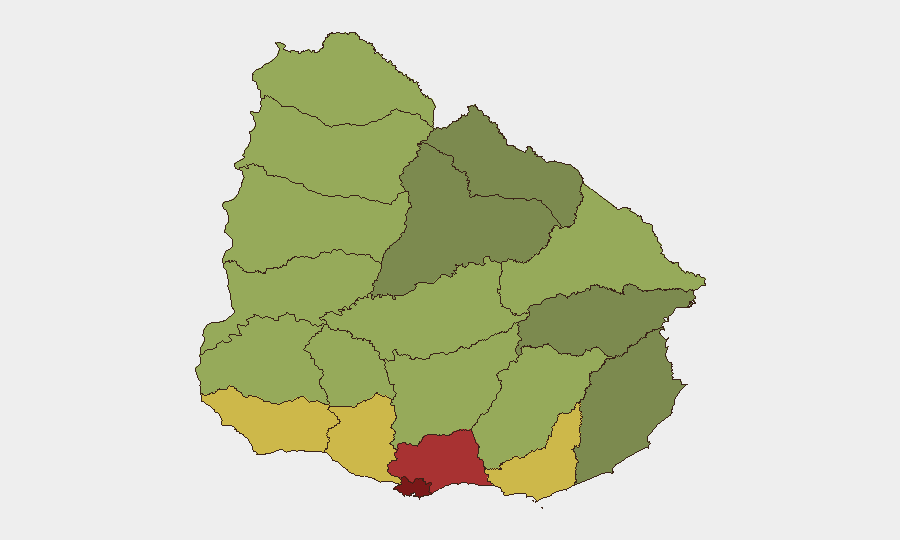
Uruguay maintains a stable security environment with no verified acute incidents—terrorism, civil unrest, major crime surges, or infrastructure disruptions—reported in the past 24–48 hours. Composite national threat ranking remains minimal (5/100), reflecting the country's low baseline for large-scale conflict or organized violence relative to regional peers. However, sub-national risk concentration in Montevideo and surrounding departments (Canelones, Maldonado) warrants continued monitoring for localized crime and gang activity. Current trajectory is steady with no indicators of near-term escalation.
Key Developments
- No acute incidents confirmed in the past 24–48 hours. Open-source monitoring and law-enforcement reporting indicate routine policing activity without emergency-level events across all departments.
- Montevideo (2026-08-02, baseline): The capital remains the highest-risk jurisdiction (score 92) but shows no incident-driven spike or new disruption in the current reporting window; risk is structural rather than event-driven.
- Canelones Department (2026-08-02, baseline): Elevated risk profile (78) persists in this Montevideo-proximate zone; no new discrete incidents reported in the last 48 hours.
- Northern Frontier Regions (Artigas, Salto, Paysandú; 2026-08-02, baseline): These departments retain moderate risk scores (50–52) associated with historical cross-border smuggling and organized-crime transit routes; no current surge or new violence reported.
- Durazno Department (through 2026-08-02): Flagged as structurally elevated risk but confirms no new incident-driven escalation or notable events in the last 24–48 hours.
- Historical context (not current development): Armored vehicle deployments in Montevideo and frontier-region homicides in Rivera and Chuy were reported days to weeks prior and do not constitute current developments.
Highest-Risk Areas
Montevideo and Canelones account for the largest share of sub-national risk, driven by gang activity, property crime, and organized-crime rivalry in densely populated urban corridors. Maldonado (risk 68), a coastal tourism and commercial hub, presents secondary concentration. Northern frontier departments (Artigas, Salto, Paysandú) carry moderate persistent risk tied to contraband trafficking, money laundering, and organized-crime logistics rather than armed conflict. Risk is localized and crime-driven; no zone exhibits state-collapse, civil-war, or terrorism-level dynamics.
How GeoBit Would Assist
Security teams with personnel or assets in Uruguay should employ AOI Monitoring & Early Warning to track Montevideo and Canelones for emerging crime or gang-activity spikes; Intel Sweep and multi-language OSINT (X, Telegram, local news feeds) to detect organized-crime messaging or violence escalation; and Network & Actor Analysis to map gang and trafficking-network evolution in high-risk departments. Routing & Network Analysis can identify secure alternative transit corridors in frontier zones during periods of increased smuggling or cartel activity. These tools enable duty-of-care teams to maintain situational awareness and adjust operational posture ahead of localized disruptions.
7-Day Outlook
No indicators suggest material near-term escalation in Uruguay's security posture. Baseline risks in Montevideo and Canelones will persist; monitoring for seasonal crime trends (winter/early spring patterns) and organized-crime rivalry is advisable. Personnel and asset-protection protocols should remain consistent with current sub-national risk profiles; no urgent adjustment is warranted at this time.
Highest-Risk Areas — Ranked
| # | State / Region | Risk |
|---|---|---|
| 1 | Montevideo | 92 |
| 2 | Canelones | 78 |
| 3 | Maldonado | 68 |
| 4 | San José | 64 |
| 5 | Colonia | 62 |
| 6 | Soriano | 58 |
| 7 | Río Negro | 56 |
| 8 | Salto | 54 |
| 9 | Artigas | 52 |
| 10 | Paysandú | 50 |
| 11 | Florida | 48 |
| 12 | Flores | 46 |
Sources
Previous Daily Briefs
A new Uruguay brief is written every day — each with its own risk map and downloadable CSV. Here's the last week; use the calendar to go further back.
📅 Browse every day by calendar →
Highlighted days have a brief. Tap a day for that day's map & analysis, or “csv” for that day's dataset ($5).
Atlas — our AI intelligence desk — emails them this snapshot personally. Nothing else, no list.