Situation Summary
Uzbekistan remains a stable, low-incident security environment as of 2 July 2026, with no verified violent incidents, civil unrest, terrorism, or infrastructure disruption reported in the last 24–48 hours. The national composite threat score stands at 2 globally (rank #199), reflecting long-standing structural governance and economic issues rather than acute security deterioration. Current open-source monitoring across news, social media, and regional security assessments confirms steady conditions with routine political and economic activity dominating reporting. No new travel advisories or alerts from international organizations indicate elevated risk.
Key Developments
- Nationwide, 6–7 July 2026: Multi-source regional security monitoring covering Central Asia reports zero verified violent incidents, terrorism, civil unrest, or major infrastructure disruption in Uzbekistan; comparative coverage notes stability in Uzbekistan while separately documenting incidents in Kazakhstan.[2]
- Nationwide, 6–7 July 2026: Open-source election and political-risk monitoring for Central Asia shows no indicators of immediate political instability, protest mobilization, or unusual security force deployments in Uzbekistan; governance and economic topics dominate policy and think-tank coverage.[2][9]
- Nationwide, 6–7 July 2026: Major international and regional news outlets and X/Twitter monitoring show no corroborated reports of terrorism, cross-border clashes, large-scale demonstrations, or significant criminal incidents affecting foreign nationals or travel corridors.[1][3][5][9]
- Tashkent and urban centers, 6–7 July 2026: Social-media keyword monitoring for protests, explosions, shootings, and riots yields no credible, multi-source confirmations; visible content remains routine (cultural, sports, local news) with no verified imagery of unrest or security operations.[3][5][6]
- Nationwide, 6–7 July 2026: No new advisories issued by major international organizations in the last 24–48 hours warning of elevated travel risk or newly emerged threats in Uzbekistan.[7][8][9]
Highest-Risk Areas
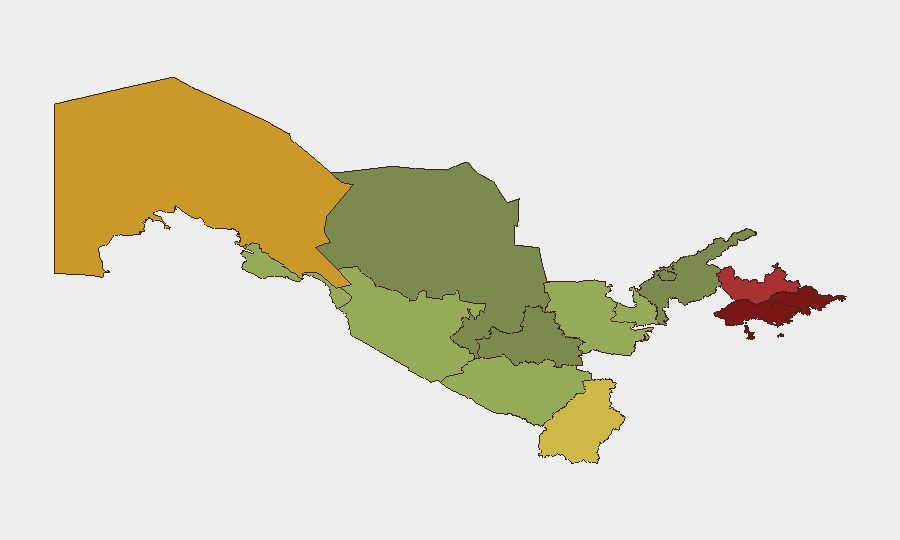
Andijan, Fergana, and Namangan regions in the Fergana Valley (composite scores 88, 82, and 78 respectively) drive the majority of national risk, reflecting longstanding historical tensions, ethnic heterogeneity, and cross-border proximity to Tajikistan and Kyrgyzstan. Karakalpakstan (score 72) and Surxondaryo (score 65) present secondary concerns linked to water scarcity, socioeconomic strain, and remote border areas. These northern and southern periphery zones concentrate institutional fragility, border friction, and demographic pressures; western and central regions (Samarqand, Bukhara, Navoiy) show substantially lower risk profiles. Current elevated sub-national scores reflect structural vulnerability rather than imminent acute threats.
How GeoBit Would Assist
Security teams monitoring Uzbekistan should employ AOI Monitoring & Early Warning to track Andijan, Fergana, and Namangan regions for escalation signals; Election Monitoring and Sentiment & Temporal Analysis (X/Twitter, Telegram OSINT) to detect early mobilization of civil unrest or political friction; and Intel Sweep with multi-language and regional-source fusion to maintain awareness of cross-border incidents in adjacent Tajikistan and Kyrgyzstan that could spill into Uzbek territory. Routing & Network Analysis supports alternative journey planning for personnel transiting high-risk northern regions.
7-Day Outlook
Uzbekistan's security trajectory is expected to remain stable over the next 7 days absent external shocks (e.g., major Tajik–Kyrgyz escalation or domestic political crisis). Routine governance, economic activity, and diplomatic engagement will likely continue. Teams should maintain standard vigilance in Fergana Valley operations and monitor regional border developments.
Highest-Risk Areas — Ranked
| # | State / Region | Risk |
|---|---|---|
| 1 | Andijan Region | 88 |
| 2 | Fergana Region | 82 |
| 3 | Namangan Region | 78 |
| 4 | Republic of Karakalpakstan | 72 |
| 5 | Surxondaryo Region | 65 |
| 6 | Qashqadaryo Region | 58 |
| 7 | Sirdaryo Region | 55 |
| 8 | Jizzakh Region | 48 |
| 9 | Xorazm Region | 45 |
| 10 | Bukhara Region | 42 |
| 11 | Navoiy Region | 38 |
| 12 | Samarqand Region | 35 |
Sources
Previous Daily Briefs
A new Uzbekistan brief is written every day — each with its own risk map and downloadable CSV. Here's the last week; use the calendar to go further back.
📅 Browse every day by calendar →
Highlighted days have a brief. Tap a day for that day's map & analysis, or “csv” for that day's dataset ($5).
Atlas — our AI intelligence desk — emails them this snapshot personally. Nothing else, no list.