Situation Summary
Belarus remains stable with no verified major security incidents, civil unrest, or infrastructure disruptions reported in the last 24–48 hours. However, the national security environment is defined by ongoing border militarization, regional airspace restrictions, and Belarus's balancing act between Moscow and Kyiv—a posture President Lukashenko reaffirmed on June 25 through public messaging but has not yet translated into direct military involvement. Risk is concentrated in Minsk Region and Minsk city, while peripheral regions show minimal acute threat. The trajectory remains one of managed tension rather than escalation or destabilization.
Key Developments
- Minsk, June 25 – President Lukashenko met representatives of President Zelensky and warned against attempts to "drag Belarus into war," reaffirming intent to avoid direct combat participation while maintaining alignment with Russia. No associated protests or unrest were documented.
- Minsk, June 25 – At the Forum of Regions, Lukashenko met senior Russian officials and reiterated that Belarus would "stand with Russia," reinforcing dual messaging of loyalty to Moscow and resistance to direct military engagement. No security incidents followed the statement.
- Gomel & Brest Regions (Belarus–Ukraine border), June 22–25 – Russian signal-repeater sites used to guide long-range drone strikes into western Ukraine went offline on June 22 and remained non-operational through June 25, following Zelensky's ultimatum to disable them by June 26. This represents a reduction in Belarus-based technical support to Russian operations, not an internal Belarusian incident.
- Belarus–Ukraine border (multiple sites), June 25 – Following a Ukrainian Foreign Intelligence Service briefing, Zelensky stated that construction of military infrastructure—roads, ammunition and fuel storage bases—along the border is "nearing completion," signaling heightened militarization. No cross-border clashes or attacks were reported in the last 24–48 hours.
- Lithuania–Belarus border (airspace), June 25 – Lithuania extended airspace restrictions for six months due to ongoing balloon incursions and drone-related incidents originating from or near Belarusian territory. This measure affects aviation and UAV operations in the border zone but does not reflect a new discrete incident inside Belarus.
Highest-Risk Areas
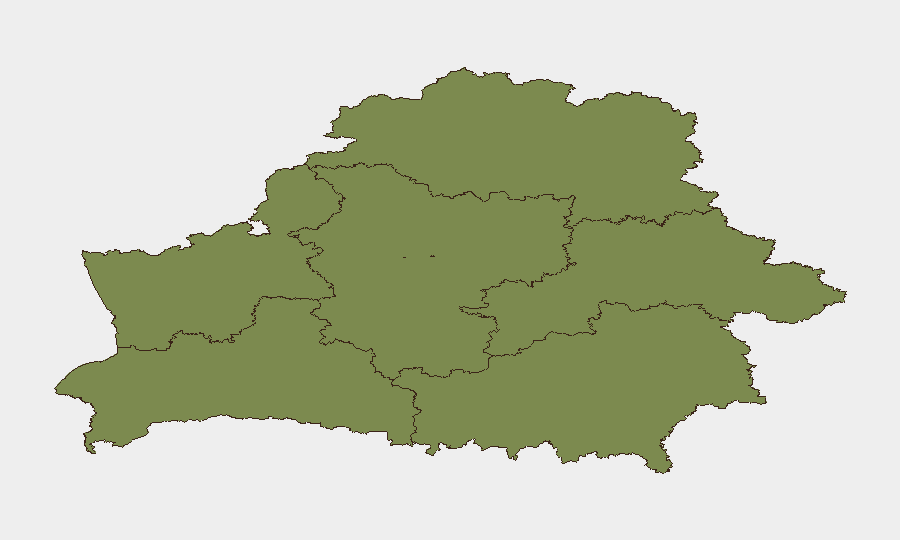
Minsk Region (31.4) and Minsk city (20.9) account for the majority of composite risk and dwarf all other administrative divisions. This concentration reflects Minsk's role as the political and administrative capital, where government institutions, state media, and security apparatus are headquartered, and where any political messaging, policy shifts, or rare civil unrest would emerge first. Brest Region (8.8) follows at considerably lower risk, likely reflecting its proximity to the Ukraine border and exposure to cross-border military activity, though no acute incidents have materialized. The five remaining regions each score below 2.0, indicating minimal tracked event activity and low near-term threat.
How GeoBit Would Assist
Security teams with personnel or assets in Belarus should employ AOI Monitoring & Early Warning to track Minsk and Minsk Region for early signals of political instability, protest activity, or security service actions. OSINT fusion (X/Telegram monitoring, multi-language search, sentiment analysis) would detect emerging civil unrest or policy announcements ahead of mainstream reporting. Border & disputed-territory search combined with satellite & imagery analysis can monitor the Belarus–Ukraine border for military infrastructure changes, cross-border movements, or airspace incidents that may increase regional risk.
7-Day Outlook
No imminent escalation or destabilization inside Belarus is anticipated in the next seven days. Lukashenko's reaffirmed balancing act and the stabilization of signal-repeater sites suggest short-term management of the border environment. Risk remains contingent on maintaining his stated posture of loyalty to Russia without direct combat participation; any shift in that calculus or external pressure to enter the conflict would rapidly alter the trajectory.
Highest-Risk Areas — Ranked
| # | State / Region | Risk |
|---|---|---|
| 1 | Minsk Region | 31.4 |
| 2 | Minsk | 20.9 |
| 3 | Brest Region | 8.8 |
| 4 | Vitsebsk Region | 1.4 |
| 5 | Hrodna Region | 1.4 |
| 6 | Mahilyow Region | 1.4 |
| 7 | Homyel Region | 1.4 |
Sources
Previous Daily Briefs
A new Belarus brief is written every day — each with its own risk map and downloadable CSV. Here's the last week; use the calendar to go further back.
📅 Browse every day by calendar →
Highlighted days have a brief. Tap a day for that day's map & analysis, or “csv” for that day's dataset ($5).