Situation Summary
Brazil's overall security posture remains moderately elevated at rank #44 globally, with 706 tracked events and a composite threat score of 37. The country faces a fragmented risk landscape, with critical vulnerabilities concentrated in agricultural frontier states (Mato Grosso), major urban centers (São Paulo, Rio de Janeiro), and border regions. A significant cyber incident affecting national emergency alert infrastructure—disclosed on 22 June—has exposed weaknesses in critical public safety systems and prompted federal investigation.
Key Developments
- National Civil Defense Alert System Breach (20–22 June) – Brazil's Defesa Civil Alerta platform was compromised via unauthorized remote access, resulting in at least ten false "Extreme Alert" messages containing the word "misanthropy" sent to mobile phones across São Paulo, Rio de Janeiro, Paraná, and the Federal District. The system was taken offline at 01:30 on 20 June; the Ministry of Integration and Regional Development and Federal Police opened formal investigations on 22 June.
- Anatel Confirms Infrastructure Compromise (22 June) – Brazil's National Telecommunications Agency (Anatel) publicly confirmed that the rogue alerts did not originate from authorized civil defense bodies and that the national alert distribution system had suffered a security breach. The agency announced a nationwide review of cyber defenses and temporary suspension of routine alert operations.
- Multi-State Coordination and Investigation (22 June) – Civil defense authorities in São Paulo, Rio de Janeiro, and Paraná coordinated dismissals of the false alerts and confirmed cooperation with federal authorities. SEDEC (National Secretariat for Civil Protection and Defense) in Brasília confirmed remote access and unauthorized dispatch of alerts before system shutdown.
- No Underlying Physical Emergency Confirmed (20–22 June) – All state-level civil defense units emphasized that no weather, geological, or security emergency corresponded to the false alerts, reducing immediate public safety risk but underscoring control-system vulnerabilities.
- Public and Judicial Attention (23 June) – Recent signal activity includes public statements from investors, judges, and criminal actors, as well as neighborhood-level investigations, indicating heightened scrutiny and potential secondary consequences (financial, legal, reputational) from the incident.
Highest-Risk Areas
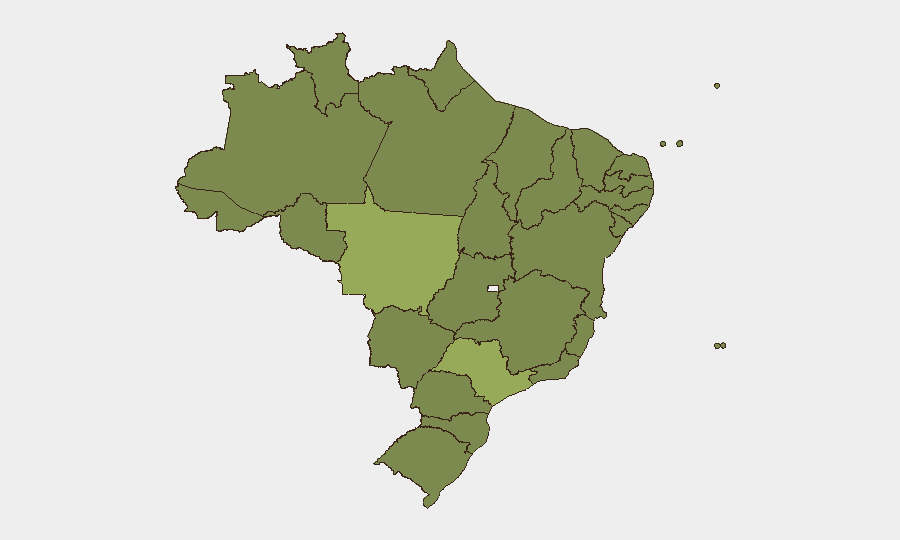
Mato Grosso (risk 53) and São Paulo (46.5) drive the national threat profile, reflecting agricultural frontier instability and organized crime activity in the former and dense urban criminal networks, gang competition, and now critical infrastructure vulnerability in the latter. Rio de Janeiro (33) remains a persistent hotspot due to entrenched gang violence and police-community tensions. The cyber incident affecting São Paulo, Rio de Janeiro, Paraná, and the Federal District has exposed a shared systemic vulnerability in national-level emergency infrastructure, elevating risk perception across multiple populous states.
How GeoBit Would Assist
Teams operating in Brazil should deploy AOI Monitoring & Early Warning on critical infrastructure sites (Anatel facilities, SEDEC operations centers, state civil defense dispatch hubs) to detect unauthorized access patterns or system anomalies. Network & Actor Analysis can map relationships between criminal, activist, and state-sponsored groups potentially capable of executing the observed breach. Intel Sweep and OSINT fusion across X/Twitter, Telegram, and criminal forums will track attribution claims, threat actor communication, and downstream political/commercial fallout as federal investigation progresses.
7-Day Outlook
Federal investigation into the cyber incident is expected to intensify, with potential announcements on attribution and remediation by 25–27 June. Secondary impacts—including temporary disruption to emergency services, investor concern about infrastructure resilience, and political pressure on Anatel and SEDEC—are likely to dominate messaging through end of June. Risk remains elevated in São Paulo and Rio de Janeiro pending system restoration and public confidence recovery.
Highest-Risk Areas — Ranked
| # | State / Region | Risk |
|---|---|---|
| 1 | Mato Grosso | 53 |
| 2 | São Paulo | 46.5 |
| 3 | Rio de Janeiro | 33 |
| 4 | Bahia | 31.7 |
| 5 | Amazonas | 31.1 |
| 6 | Rio Grande do Norte | 31.1 |
| 7 | Minas Gerais | 28.1 |
| 8 | Maranhão | 26.6 |
| 9 | Paraná | 26.3 |
| 10 | Pernambuco | 25.4 |
| 11 | Acre | 23.9 |
| 12 | Piauí | 23.9 |
Sources
Previous Daily Briefs
A new Brazil brief is written every day — each with its own risk map and downloadable CSV. Here's the last week; use the calendar to go further back.
📅 Browse every day by calendar →
Highlighted days have a brief. Tap a day for that day's map & analysis, or “csv” for that day's dataset ($5).