Situation Summary
Eswatini remains a low-incident environment with a composite threat score of 9 (#143 globally) and no discrete security events recorded in the past seven days. However, a significant diplomatic development—China's Ministry of Foreign Affairs issuing a formal travel advisory and evacuation guidance on 2 September—signals international concern about the country's cyber-fraud and organized-crime environment, potentially affecting corporate risk perception and duty-of-care assessments. Law-enforcement activity continues to target weapons proliferation, with police announcing ongoing firearms seizures and intensified operations during September's African Union Amnesty Month.
Key Developments
- Country-wide – 2 September: China's Ministry of Foreign Affairs issued a public advisory characterizing Eswatini's security situation as "complex," citing rampant online fraud and illegal gambling. The statement urged Chinese citizens and institutions to evacuate or relocate to South Africa and discouraged new visits. This represents a formal, high-visibility risk-environment signal from a major trading partner and carries implications for corporate travel policies and third-party due diligence.
- Country-wide – 3 September (reporting period ending 31 August): The Royal Eswatini Police Service announced seizure of 58 illegal firearms and 509 rounds of ammunition, with 87 arrests for illegal weapons possession during an 11-month operation (October 2025–August 2026). The force signaled intensified crackdown activity throughout September as part of the AU Firearm Surrender Amnesty Month, indicating sustained law-enforcement focus on organized-crime weapons networks.
- Country-wide – 1–5 September: Commercial threat assessments covering early September reported no verifiable discrete security incidents (protests, attacks, civil unrest) as of 1 September, with the national security trajectory characterized as broadly low outside elevated regional organized-crime and cyber-fraud zones. No fresh civil instability or public disorder was documented in the assessment window.
- External/Regional – 4 September: Swazi labor unions and solidarity movements conducted a support march in Pretoria, South Africa, focusing on democracy, workers' rights, and education investment in Eswatini. While held outside Eswatini's territory, the activity reflects ongoing political-risk discourse and international attention to the kingdom's governance and labor conditions.
- Country-wide – Ongoing: No protests, politically motivated attacks, infrastructure disruptions, or high-profile violent crime were documented in open-source reporting for the 2–8 September window. The absence of reported incidents aligns with Eswatini's historically low event frequency but does not preclude localized or non-reported security concerns.
Highest-Risk Areas
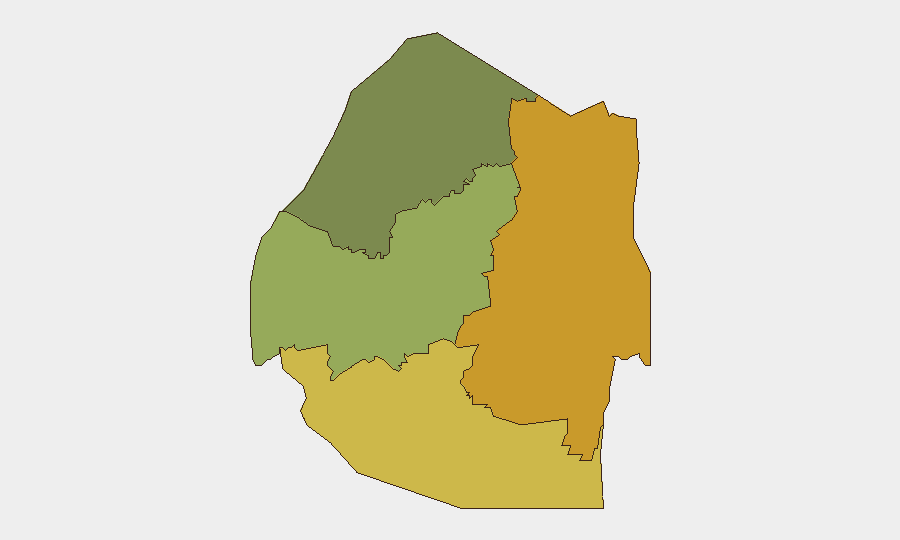
Lubombo Region (risk score 72) and Shiselweni (68) are the primary risk drivers, with exposure to organized crime, weapons proliferation, and cross-border smuggling activity linked to regional trafficking networks. Manzini Region (55) carries moderate risk, while Hhohho (35) remains comparatively lower-risk. These gradients reflect both organized-crime operational prevalence and limited state capacity in remote and border zones; they do not indicate active conflict or civil unrest but rather persistent criminality and law-enforcement operation intensity.
How GeoBit Would Assist
Security teams should deploy AOI Monitoring & Early Warning on high-risk regions (Lubombo, Shiselweni) to detect organized-crime activity and weapons movements, pair this with Intel Sweep and OSINT fusion (X/Twitter, local news, police announcements) to track law-enforcement operations and advisory updates from partner nations, and use Network & Actor Analysis to map trafficking and cyber-fraud networks operating in and from Eswatini. These capabilities support early warning on travel risk, third-party vetting, and incident-response triggers.
7-Day Outlook
No discrete security incidents are forecast for the coming week. Monitoring should focus on outcomes of intensified police firearms operations during September and any escalation or international response to cyber-fraud targeting foreign nationals and businesses. The China advisory may prompt similar statements from other nations, warranting sustained watch on diplomatic channels and corporate evacuation/relocation announcements.
Highest-Risk Areas — Ranked
| # | State / Region | Risk |
|---|---|---|
| 1 | Lubombo | 72 |
| 2 | Shiselweni | 68 |
| 3 | Manzini Region | 55 |
| 4 | Hhohho Region | 35 |
Sources
Previous Weekly Briefs
A new Eswatini brief is written every Monday, covering the week — each with its own risk map and downloadable CSV. Use the calendar to go further back.
- September 1, 2026
- August 30, 2026
- August 28, 2026
- August 26, 2026
- August 24, 2026
- August 22, 2026
- August 20, 2026
📅 Browse past briefs by calendar →
Highlighted days have a brief. Tap a day for that day's map & analysis, or “csv” for that day's dataset ($5).
Atlas — our AI intelligence desk — emails them this snapshot personally. Nothing else, no list.