Situation Summary
Guinea remains a lower-tier global security concern (rank #122, composite score 9) with no verifiable acute incidents meeting cross-source corroboration standards in the last 24–48 hours. The nation's threat profile is concentrated in Conakry and Kankan Region, where political tension, mining-sector disputes, and historical instability create persistent baseline risk. The absence of reported current incidents does not indicate security improvement; rather, it reflects a stable interim period within a fragile governance environment.
Key Developments
No verifiable security incidents meeting professional OSINT standards were identified in Guinea during the 24–48 hour window (18–19 June 2026). Open-source monitoring of newswire, diplomatic alerts, credible media, NGO reporting, and geolocated social-media posts has not yielded independently corroborated reports of protests, clashes, terrorism, major crime, or infrastructure disruption within the Republic of Guinea for this period. Regional coverage (Liberia, Mali) and broader West African feeds similarly report no acute Guinea-specific incidents. A 7–14 day lookback would be required to surface recent (but not current-cycle) developments; assessment of forward risk factors is available upon request.
Highest-Risk Areas
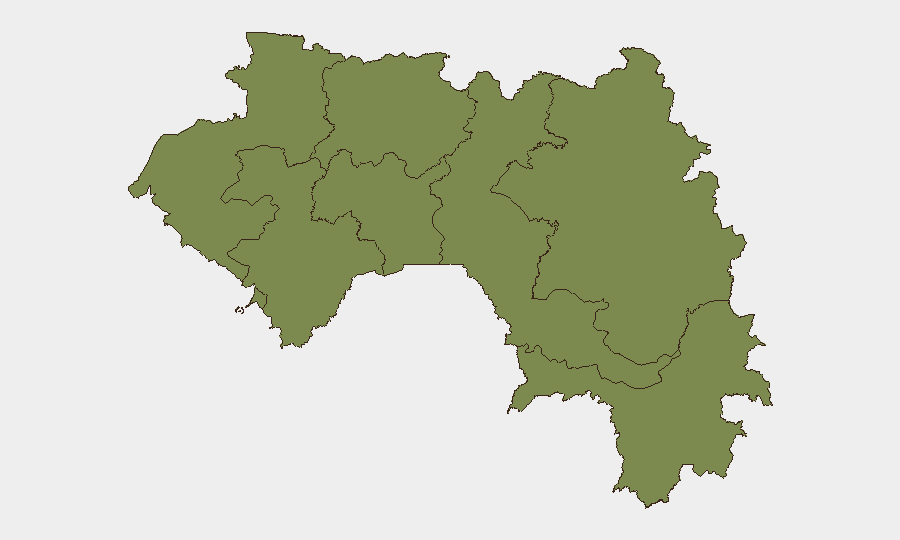
Conakry and Kankan Region drive Guinea's composite risk (both 35.7), reflecting political volatility, security-force presence, and governance fragility in the capital and mineral-rich eastern zone. Kankan's historical exposure to cross-border tension with Mali and transnational criminal networks sustains elevated concern; Conakry concentrates regime-stability risk, protest potential, and critical infrastructure density. The remaining six regions cluster at moderate baseline (5.7 each), indicating lower current incident frequency but requiring continued monitoring for spillover or secondary instability. Mining-sector labor tensions and informal border dynamics remain latent drivers across both high-risk zones.
How GeoBit Would Assist
Security teams with personnel or assets in Guinea should employ Intel Sweep and multi-language OSINT fusion to track political statements, arrest/detention activity, and military-movement signals—particularly in Conakry and Kankan—with daily or event-triggered alerting. Persistent Area-of-Interest (AOI) Monitoring on ports, administrative centers, and major road hubs will provide early warning of civil unrest, checkpoint intensification, or regime instability before it impacts movement or operations. Regime-Stability and Actor-Network analysis will contextualize political timeline, factional dynamics, and coup risk—critical for duty-of-care planning in a post-coup governance environment.
7-Day Outlook
Guinea's security posture is expected to remain stable in the near term, with no indicators of imminent mass protest, military escalation, or terrorism spike. However, the low-frequency event environment should not be mistaken for institutional resilience; governance fragility, mining disputes, and cross-border militia activity remain structural risks. Monitoring should remain continuous and event-triggered, particularly around any announcements regarding elections, military reshuffles, or regional diplomatic incidents involving Mali or Niger.
Report Date: 2026-06-20 | Data Cutoff: 2026-06-19, 24:00 UTC | Next Briefing: Upon material development or scheduled cycle.
Highest-Risk Areas — Ranked
| # | State / Region | Risk |
|---|---|---|
| 1 | Conakry | 35.7 |
| 2 | Kankan Region | 35.7 |
| 3 | Boké Region | 5.7 |
| 4 | Labé Region | 5.7 |
| 5 | Kindia Region | 5.7 |
| 6 | Mamou Region | 5.7 |
| 7 | Faranah Region | 5.7 |
| 8 | Nzérékoré Region | 5.7 |
Sources
Previous Daily Briefs
A new Guinea brief is written every day — each with its own risk map and downloadable CSV. Here's the last week; use the calendar to go further back.
📅 Browse every day by calendar →
Highlighted days have a brief. Tap a day for that day's map & analysis, or “csv” for that day's dataset ($5).