Situation Summary
Liberia remains in a stable security posture with no acute incidents recorded in the past 24–48 hours. The country ranks #140 globally on composite threat, reflecting low overall risk despite persistent vulnerabilities in governance, maritime security, and drug enforcement. Risk is geographically concentrated in the northern border counties—Nimba, Lofa, and Grand Gedeh—where porous frontiers, weak institutional capacity, and historical armed group presence create elevated baseline threat. The security environment is being actively shaped by presidential anti-narcotics directives and border-management efforts rather than by immediate unrest or violence.
Key Developments
• No confirmed new security, conflict, or major crime events in Liberia over the past 24–48 hours (2026-08-14 to 2026-08-16), per multiple security briefings and web research. Current risk drivers remain institutional and historical rather than time-critical.
• Presidential intensification of counter-narcotics operations (2026-08-13). President Boakai directed security forces to escalate anti-drug campaigns, framing organized crime and corruption as existential threats and signaling sustained pressure on trafficking networks and enforcement agencies.
• LDEA leadership instability (2026-08-10–11). The Liberia Drug Enforcement Agency faced public allegations of corruption involving its Officer-in-Charge; President Boakai initiated an ethics investigation and appointed a new Director General, reflecting internal capacity and integrity challenges within a key security institution.
• Sorlumba border checkpoint tensions resolved (2026-08-11–12). Guinean military personnel moved toward the Liberian checkpoint at Sorlumba; Liberia Immigration Service officers held position, talks ensued, and calm was restored within 24 hours with no violence. The incident underscores border management frictions but demonstrated de-escalation capability.
• Maritime security gap exposed (published 2026-08-10, incident 2026-08-02). The Comoros-flagged *IB Atlantic IV Moroni* evaded Liberian Coast Guard interception near York Island and was later arrested by Ivorian authorities, highlighting surveillance and enforcement gaps in Liberia's exclusive economic zone.
• Prison security concerns in major narcotics case (2026-08-09–10). A suspended prison official publicly urged transfer of detainees from the US$317 million cocaine case to a more secure facility, citing detention-integrity risks. No confirmed escape attempt was reported; the matter remains under investigation.
Highest-Risk Areas
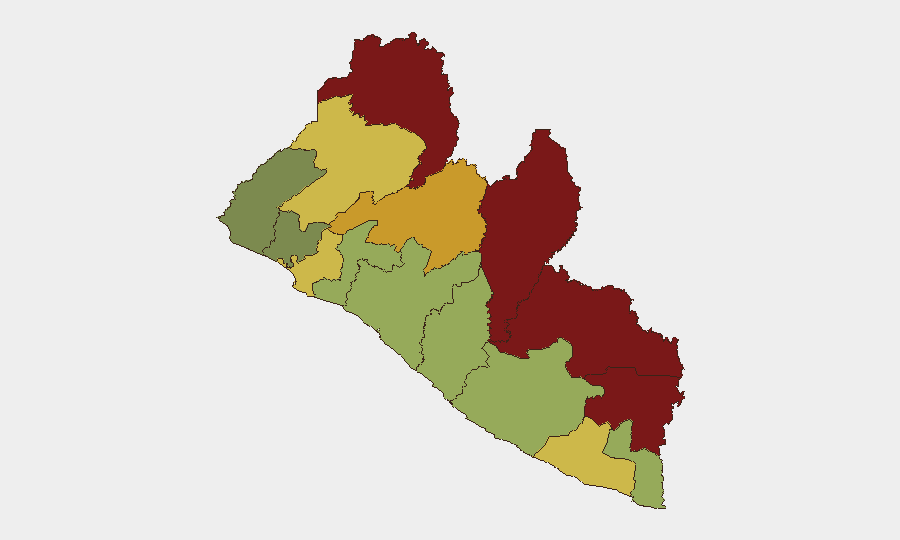
Northern border counties—Nimba (92), Lofa (88), Grand Gedeh (85), and River Gee (83)—drive the country's risk profile. These zones are marked by limited state presence, porous borders with Guinea and Ivory Coast, historical armed-group activity, and minimal institutional capacity for law enforcement or conflict prevention. Montserrado County (64), home to the capital, registers elevated risk tied to drug trafficking, organized crime, and governance challenges, while central and coastal counties score lower. Border security, not internal unrest, remains the primary concern.
How GeoBit Would Assist
Teams with operations in Liberia should employ AOI Monitoring & Early Warning on Nimba, Lofa, and Grand Gedeh counties to detect trafficking movements, armed-group activity, or border incursions. Maritime & Aviation tracking coupled with Satellite & Imagery analysis would expose gaps in customs and EEZ enforcement, enabling better supply-chain and asset routing. Intelligence Sweep and multi-language OSINT on governance and enforcement agencies will track internal security-sector stability and institutional shifts affecting duty-of-care obligations.
7-Day Outlook
No acute deterioration is expected in the next week. Liberia's security agenda will remain focused on border management, anti-narcotics enforcement, and institutional reform rather than large-scale conflict or unrest. Teams should maintain passive monitoring for any sudden border activity or maritime anomalies, particularly in the north, and track LDEA and prison-sector developments for signal of institutional fragility.
Highest-Risk Areas — Ranked
| # | State / Region | Risk |
|---|---|---|
| 1 | Nimba County | 92 |
| 2 | Lofa County | 88 |
| 3 | Grand Gedeh County | 85 |
| 4 | River Gee County | 83 |
| 5 | Bong County | 72 |
| 6 | Gbarpolu County | 68 |
| 7 | Grand Kru County | 65 |
| 8 | Montserrado County | 64 |
| 9 | Rivercess County | 58 |
| 10 | Sinoe County | 55 |
| 11 | Margibi County | 52 |
| 12 | Grand Bassa County | 48 |
Sources
Previous Daily Briefs
A new Liberia brief is written every day — each with its own risk map and downloadable CSV. Here's the last week; use the calendar to go further back.
- August 14, 2026
- August 12, 2026
- August 10, 2026
- August 8, 2026
- August 6, 2026
- August 5, 2026
- August 4, 2026
📅 Browse every day by calendar →
Highlighted days have a brief. Tap a day for that day's map & analysis, or “csv” for that day's dataset ($5).
Atlas — our AI intelligence desk — emails them this snapshot personally. Nothing else, no list.