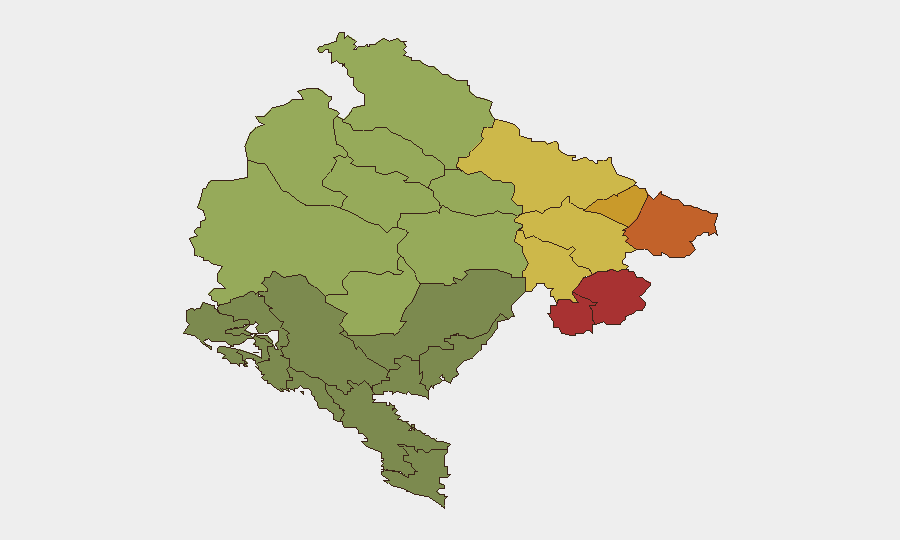
Situation Summary
Montenegro remains a low-threat country globally (rank #104, composite score 18) but faces elevated localized risk in its northeastern municipalities, where organized crime, smuggling networks, and loose weapons control create persistent vulnerabilities. The past week produced routine law-enforcement activity—a major narcotics arrest, weapons seizures, and border interdictions—consistent with ongoing efforts to disrupt trafficking and organized-crime supply chains. Overall security posture is stable; no direct threats to corporate operations or mass-casualty events were recorded.
Key Developments
- Podgorica (September 30): Police arrested a Swedish national wanted internationally on suspicion of brokering large-scale narcotics transactions (marijuana, cocaine, ~15,000 controlled tablets); forged documents recovered. Reflects continued pressure on transnational drug-trafficking networks.
- Tivat, Adriatic Highway near EKO roundabout (September 30): Municipal authorities began construction of pedestrian ramp as road-safety infrastructure; 30-day project timeline. Routine civic work; no security impact.
- Barutana, Podgorica–Cetinje road (September 30): Traffic collision reported with no injuries. Standard incident.
- Montenegro–Bosnia and Herzegovina border (September 30): Balkan Investigative Reporting Network published investigation on active cigarette-smuggling routes through eastern Bosnia; case documents activity from 2019–March 2021 but reflects *ongoing* smuggling infrastructure and border-police vulnerability to monitoring by criminal actors.
- Podgorica/Montenegro (September 30–October 1): Agency for Prevention of Corruption ruled that former prime minister Milo Đukanović violated conflict-of-interest rules by accepting travel and accommodation in Dubai financed by businessman Duško Knežević. Governance/transparency issue; no direct security impact.
- Montenegro (October 1): Montenegro extradited an Iranian-Turkish dual national to the United States in connection with alleged cyberattacks against 150+ U.S. universities (attacks alleged from 2013 onward). Reflects law-enforcement cooperation; cyberattack activity documented is historical, not current.
Highest-Risk Areas
The northeastern corridor—Plav, Gusinje, Rožaje, Petnjica, and Andrijevica municipalities (composite risk scores 68–78)—accounts for the majority of sub-national threat concentration. This region is characterized by terrain-enabled smuggling networks (narcotics, tobacco, weapons), weak state capacity, and proximity to Kosovo and Albania, which facilitate transnational organized crime. Bijelo Polje (risk 65) and Berane (62) also register elevated risk. Western and central municipalities (Kolašin, Žabljak, Plužine) show materially lower risk but remain monitored. Corporate assets or personnel in the northeast should expect elevated exposure to organized-crime activity and contraband trafficking.
How GeoBit Would Assist
Security teams operating in Montenegro would benefit from AOI Monitoring & Early Warning on high-risk northeastern municipalities to detect emerging trafficking, weapons, or violence signals in real time. Network & Actor Analysis and multi-language OSINT (including Telegram and regional reporting) enable continuous tracking of organized-crime node activity, weapons seizures, and border-police operations. Routing & Network Analysis supports secure travel planning around known smuggling corridors and unstable border zones. These capabilities together provide early warning of localized threats and inform safe-passage decisions for personnel and supply chains.
7-Day Outlook
Near-term risk trajectory is stable with low probability of escalation. Law-enforcement activity will likely continue targeting trafficking networks and weapons hoarding, particularly in the northeast. No organized political instability, civil unrest, or mass-casualty events are indicated. Corporate risk remains manageable in coastal and central regions but requires sustained awareness in the northeastern municipalities.
Highest-Risk Areas — Ranked
| # | State / Region | Risk |
|---|---|---|
| 1 | Plav Municipality | 78 |
| 2 | Gusinje Municipality | 76 |
| 3 | Rožaje Municipality | 74 |
| 4 | Petnjica Municipality | 72 |
| 5 | Andrijevica Municipality | 68 |
| 6 | Bijelo Polje Municipality | 65 |
| 7 | Berane Municipality | 62 |
| 8 | Plužine Municipality | 58 |
| 9 | Pljevlja Municipality | 55 |
| 10 | Šavnik Municipality | 52 |
| 11 | Žabljak Municipality | 50 |
| 12 | Kolašin Municipality | 48 |
Sources
Previous Weekly Briefs
A new Montenegro brief is written every Monday, covering the week — each with its own risk map and downloadable CSV. Use the calendar to go further back.
- September 29, 2026
- September 22, 2026
- September 15, 2026
- September 8, 2026
- September 3, 2026
- August 31, 2026
- August 29, 2026
📅 Browse past briefs by calendar →
Highlighted days have a brief. Tap a day for that day's map & analysis, or “csv” for that day's dataset ($5).
Atlas — our AI intelligence desk — emails them this snapshot personally. Nothing else, no list.