Situation Summary
Portugal remains a low-threat environment (global rank #null, composite score 14) with localized security challenges concentrated in Lisbon and Vila Real. Recent events include street violence, airport security incidents, wildfire response, and organized crime enforcement operations across multiple regions. The national security posture is characterized by active police reinforcement at transportation hubs and coordinated law-enforcement action against vulnerable-person crime and cybercrime, indicating responsive rather than systemic instability.
Key Developments
- Lisbon – Aeroporto Humberto Delgado, 6 July 2026 – An Irish national assaulted two PSP officers and airport staff in the baggage hall, seriously injuring at least one officer; the suspect was detained and placed in pre-trial detention.
- Porto – Rua da Cidade de Recife (Viso neighborhood), early 6 July 2026 – A street brawl involving dozens of people resulted in three injuries, including a neck stabbing and a hit-and-run incident; all casualties hospitalized.
- National airports (Lisbon, Porto, Faro, others), 7 July 2026 onwards – PSP deployed approximately 360–367 additional officers to strengthen border control, immigration processing, and security in response to passenger volumes and new EU border procedures.
- Algarve (Olhão and Faro), operations early July 2026 – GNR arrested six suspects (aged 19–46) in coordinated operations targeting elderly and vulnerable persons in a series of robberies and thefts; part of a dismantled local criminal network.
- Évora district – Valverde, afternoon 6 July 2026 – Improperly discarded ashes ignited a fire spreading to agricultural land, mobilizing 141 firefighters, 44 vehicles, and 4 aerial assets; treated as a significant wildfire and infrastructure-risk incident.
- Tocha (Coimbra district), late July 2026 – Polícia Judiciária arrested a suspect in flagrante delito on child pornography charges; substantial pedopornographic material seized in a cybercrime/sexual-exploitation enforcement action.
- Aveiro and Porto, late July 2026 – PJ detained two foreign nationals wanted internationally: one convicted of drug trafficking (Brazil) and another suspected of criminal association and computer sabotage (Angola); both in pre-trial detention pending extradition.
- Santarém city, early July decision announcement – Municipal authorities and PSP advanced plans to expand the CCTV network from 26 to 327 cameras, prioritizing schools, high-density zones, and main access routes for crime prevention.
Highest-Risk Areas
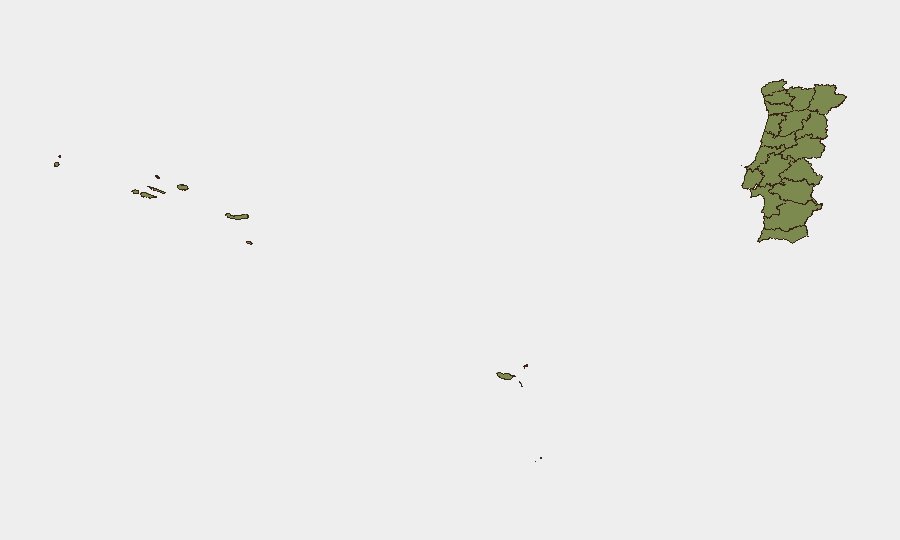
Lisbon (31.3) and Vila Real (25.3) are the primary drivers of Portugal's composite risk score, reflecting urban crime concentration, transportation-hub vulnerability, and organized-crime enforcement activity in the capital and its hinterland. The remaining ten districts cluster at substantially lower risk (1.3–3.3), indicating that security concerns are geographically concentrated rather than nationally distributed. Lisbon's airport, urban neighborhoods, and cross-border crime networks account for most recent incident density; Vila Real's elevation likely reflects organized-crime or agricultural/wildfire factors. Corporate and residential security operations should prioritize Lisbon metro-area protocols and situational awareness.
How GeoBit Would Assist
Security teams operating in Portugal would deploy AOI Monitoring & Early Warning to track Lisbon's high-frequency crime hotspots (port, airport, bairros) and alert on emerging patterns in street violence or airport incidents. Network & Actor Analysis would map the Algarve robbery networks and cross-border extradition cases to identify related threats to corporate assets or personnel. Environmental & Health monitoring would provide early warning of wildfire risk and secondary disruptions (transport, utilities) during fire season, complementing national GNR and firefighter resources.
7-Day Outlook
Portugal's security trajectory remains stable at the national level, with tactical law-enforcement responses (police deployments, arrests, CCTV expansion) addressing localized crime rather than systemic instability. Lisbon and Vila Real will continue to generate the majority of incident reports; wildfire season (July–September) poses secondary infrastructure and public-safety risks. No indicators suggest escalation to broader civil or political instability.
Highest-Risk Areas — Ranked
| # | State / Region | Risk |
|---|---|---|
| 1 | Lisbon | 31.3 |
| 2 | Vila Real | 25.3 |
| 3 | Bragança | 3.3 |
| 4 | Madeira | 1.3 |
| 5 | Azores | 1.3 |
| 6 | Viana do Castelo | 1.3 |
| 7 | Braga | 1.3 |
| 8 | Porto | 1.3 |
| 9 | Aveiro | 1.3 |
| 10 | Viseu | 1.3 |
| 11 | Guarda | 1.3 |
| 12 | Leiria | 1.3 |
Sources
Previous Daily Briefs
A new Portugal brief is written every day — each with its own risk map and downloadable CSV. Here's the last week; use the calendar to go further back.
📅 Browse every day by calendar →
Highlighted days have a brief. Tap a day for that day's map & analysis, or “csv” for that day's dataset ($5).
Atlas — our AI intelligence desk — emails them this snapshot personally. Nothing else, no list.