Situation Summary
Serbia faces elevated short-term political instability following President Vučić's 29 June announcement that he will resign and pivot to campaign leadership for his ruling party, triggering expectations of early elections. Large anti-government protests in Belgrade and other cities continued through 30 June, driven by long-standing corruption and authoritarianism grievances, with police presence visible but no major violence reported. The political transition coincides with a severe regional heatwave (40°C+) creating infrastructure strain, while underlying organized-crime penetration of state institutions (evidenced by the May police-chief corruption case) remains a structural risk factor. Overall threat composite remains moderate (rank #83 globally), but the near-term trajectory is one of sustained political turbulence and protest activity.
Key Developments
- Belgrade, 29 June 2026 – Large anti-government protest following Vučić resignation announcement. Thousands gathered in central Belgrade on Saturday to demonstrate against the government. Protesters expressed skepticism that the resignation would lead to substantive change and pledged to continue demonstrations in coming days.
- Belgrade, 29–30 June 2026 – Continued rally and police deployment around National Assembly and central boulevards. Follow-on protests reported through late 29 June into 30 June near parliament and key central streets, with sizable crowds visible and police cordons in place; no major clashes reported to date.
- Serbia nationwide, 29–30 June 2026 – Political uncertainty and early-election expectation following Vučić's pivot to party-campaign role. Vučić's announced shift from presidency to ruling-party leadership has been characterized as a "political earthquake" creating short-term instability risk, with analysts warning of potential intra-elite conflict and prolonged protest cycles across Serbian cities.
- Serbia–Kosovo border area, late June 2026 – Reported Serbian military force movements near frontier. Open-source commentary notes recent military movements near the Kosovo border in the context of broader political turmoil; exact unit and location details remain sparse, but flagged as a security-risk indicator given concurrent domestic unrest.
- Serbia (multiple regions), 29–30 June 2026 – Heatwave conditions (40°C+) creating infrastructure and travel disruption risk. High-level heat warnings issued across Serbia and neighboring regions; conditions pose strain on power supply, elevated wildfire risk, and public-transport stress for residents and travelers.
- Belgrade, May–June 2026 – Organized-crime–police corruption case driving ongoing security and integrity debate. The May underworld killing and alleged police-chief involvement in crime-figure mediation continue to dominate public and official discussion, reinforcing perceptions of state-structure penetration by organized crime.
Highest-Risk Areas
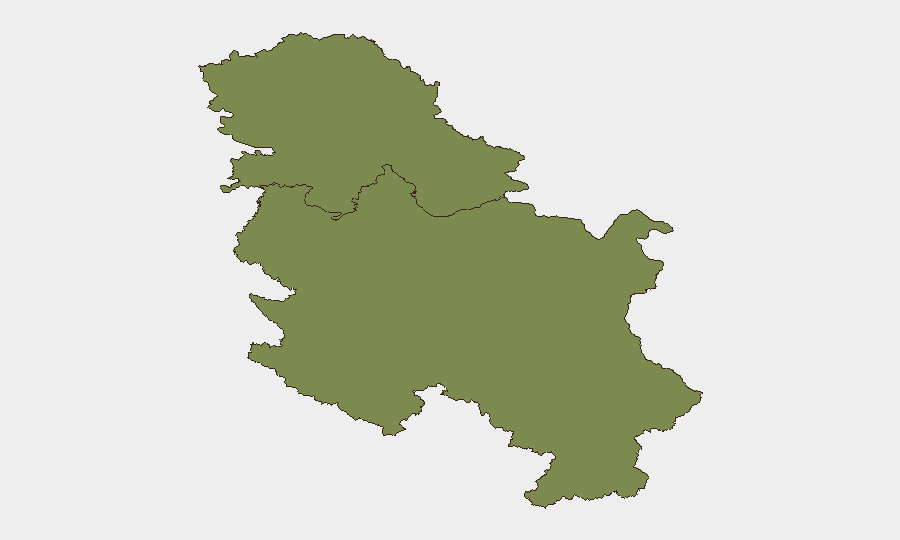
Central Serbia (composite risk 31.9) is the dominant driver of current risk, with Belgrade and the capital region at the epicenter of protest activity, political uncertainty, and security-force deployment. Vojvodina (risk 1.9) shows significantly lower acute threat. The concentration of political power, media, state institutions, and protest mobilization in Belgrade means that the ongoing political transition and demonstration cycle directly affect the capital's security posture and corporate/diplomatic operations. The Kosovo border area, while lower in composite ranking, warrants contingency attention given concurrent military movements and regional sensitivities.
How GeoBit Would Assist
Security teams would use AOI Monitoring & Early Warning to track protest activity, police deployments, and political statement changes in Belgrade and other major cities in real time. Network & Actor Analysis and Intel Sweep capabilities would map elite fractures, protest-organizer networks, and potential violence escalation signals across social platforms and local sources. Routing & Network Analysis would support contingency planning for staff movement during peak protest hours and heatwave conditions affecting transportation and power infrastructure.
7-Day Outlook
Protest activity is expected to persist through the first week of July as Vučić's formal resignation timeline unfolds and early-election mechanics are clarified. Political uncertainty will likely remain elevated; organized-crime–state-integrity concerns will continue to shape public confidence and security debate. The heatwave will gradually ease but may strain infrastructure and public services through mid-week.
Highest-Risk Areas — Ranked
| # | State / Region | Risk |
|---|---|---|
| 1 | Central Serbia | 31.9 |
| 2 | Vojvodina | 1.9 |
Sources
Previous Daily Briefs
A new Serbia brief is written every day — each with its own risk map and downloadable CSV. Here's the last week; use the calendar to go further back.
📅 Browse every day by calendar →
Highlighted days have a brief. Tap a day for that day's map & analysis, or “csv” for that day's dataset ($5).