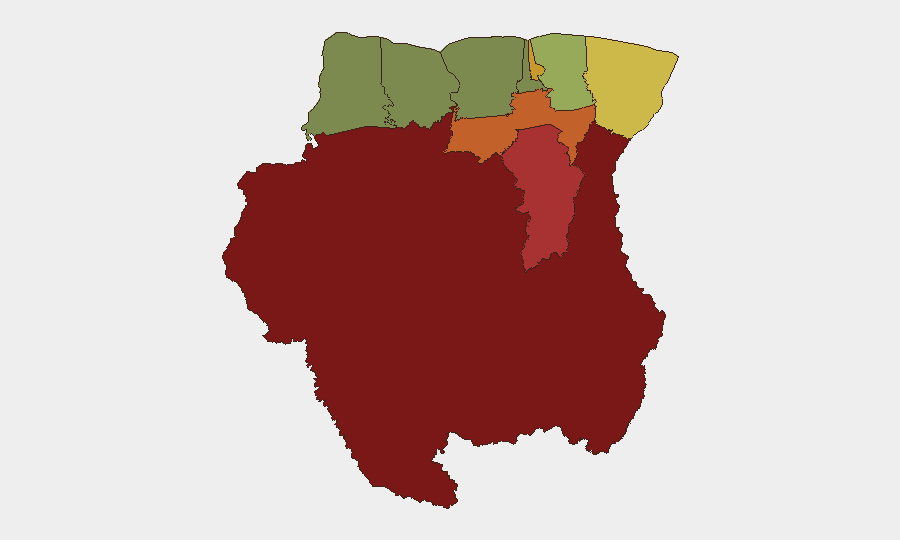
Situation Summary
Suriname remains a low-intensity, regionally fragmented security environment with persistent street crime and organized trafficking activity but no acute national crisis. Urban armed robbery has seen elevated reporting in Paramaribo this past week, and federal-level trafficking enforcement (U.S.–Suriname axis) continues to disrupt logistics chains. The interior—Sipaliwini district in particular—remains significantly more volatile than coastal urban centers and warrants separate assessment protocols for any personnel or asset exposure there.
Key Developments
- Paramaribo, Tourtonne 5 and Maretraite 5 — September 17: Residents reported a spike in armed robbery incidents, including an early-morning mugging in which three armed men relieved a pedestrian of jewelry. Local police issued public warnings of heightened criminal activity in these neighborhoods.
- Paramaribo, Frederikshoopweg (Riosiestraat) — September 20: Four men were arrested by the Paramaribo Regional Support Team following an armed robbery. Police indicated further arrests remained possible.
- Wanica District — September 16: Police arrested three employees of a water-production company suspected of forging delivery notes and Chinese signatures, causing material financial loss to their employer. The case reflects emerging vulnerability in supply-chain integrity.
- Miami–Suriname smuggling route — September 17: A Miami resident remained in federal custody in connection with alleged concealment of firearms and ammunition in a shipment destined for Suriname, indicating sustained transnational trafficking infrastructure.
- Suriname (location undisclosed) — September 17–18: The Public Prosecution Service requested an Interpol Red Notice for Ryan Kenneth Torilal, described as armed, violent, and a flight risk. Interpol's review status remained unresolved as of September 18.
Highest-Risk Areas
Sipaliwini (interior, risk 92) and Brokopondo (east-central, risk 78) substantially outrank all other districts and together account for the nation's most volatile security profile. Both regions are geographically remote, have limited state police presence, and are historically associated with smuggling, illegal mining, and trafficking networks. Paramaribo (risk 71) and surrounding Commewijne and Wanica districts experience volume-driven street crime and organized fraud but remain accessible to law enforcement and corporate security response. The western and northern coastal districts (Nickerie, Coronie, Saramacca) show markedly lower risk trajectories and are suitable for standard duty-of-care protocols.
How GeoBit Would Assist
Security teams with Suriname exposure should deploy AOI Monitoring & Early Warning on Paramaribo and high-traffic commercial corridors to detect emerging robbery clusters in near-real time, and Intel Sweep (X/Twitter OSINT, web feeds, multi-language search) to track public safety announcements and supply-chain fraud indicators. For personnel in interior zones, Conflict & Military network analysis and Routing & Network Analysis capabilities enable identification of smuggling corridors and safer alternative transit routes; persistent satellite & imagery analysis of remote Sipaliwini and Brokopondo access roads provides early warning of trafficking concentration.
7-Day Outlook
Paramaribo street crime is likely to remain episodic and localized to specific neighborhoods rather than escalate into systemic violence. Transnational firearms smuggling will continue to operate beneath the headline threshold but should be assumed as baseline risk. No indicators suggest imminent political instability or large-scale civil unrest; security attention should remain concentrated on area-specific crime prevention and supply-chain due diligence in Wanica and Paramaribo.
Highest-Risk Areas — Ranked
| # | State / Region | Risk |
|---|---|---|
| 1 | Sipaliwini | 92 |
| 2 | Brokopondo | 78 |
| 3 | Para | 74 |
| 4 | Paramaribo | 71 |
| 5 | Marowijne | 68 |
| 6 | Commewijne | 42 |
| 7 | Wanica | 38 |
| 8 | Saramacca | 29 |
| 9 | Coronie | 12 |
| 10 | Nickerie | 8 |
Sources
Previous Weekly Briefs
A new Suriname brief is written every Monday, covering the week — each with its own risk map and downloadable CSV. Use the calendar to go further back.
- September 15, 2026
- September 8, 2026
- September 1, 2026
- August 29, 2026
- August 26, 2026
- August 23, 2026
- August 20, 2026
📅 Browse past briefs by calendar →
Highlighted days have a brief. Tap a day for that day's map & analysis, or “csv” for that day's dataset ($5).
Atlas — our AI intelligence desk — emails them this snapshot personally. Nothing else, no list.