Situation Summary
Montenegro remains a low-threat environment globally (rank #104, composite score 18) with zero tracked security events during the reporting week, yet significant internal instability has emerged in the security sector. A high-profile foreign-interference operation and an expanding investigation into security-force trade unions have created uncertainty within law-enforcement and intelligence leadership. The country's EU integration trajectory and geographic position within the Western Balkans continue to shape geopolitical tensions, particularly involving Russian state actors.
Key Developments
- Risan, 9 October 2026: Montenegrin police and the National Security Agency (ANB) detained Russian military blogger Mikhail Zvinchuk, his wife, and three associates in a joint operation targeting suspected foreign-influence and destabilization activity. Authorities confiscated drones, cameras, phones, and digital equipment from the group.
- Risan/National, 9 October 2026: Authorities revoked residency rights for all five Russian nationals and ordered their immediate expulsion on national- and internal-security grounds. Prime Minister Milojko Spajić characterized the action as countering hybrid interference and reaffirming Montenegro's European integration path.
- Podgorica, 10 October 2026: Mladen Šuškavčević, president of the Police Administration trade union, was arrested as part of an investigation into alleged irregularities and misconduct within security-sector unions.
- Podgorica, 10–13 October 2026: The investigation expanded to encompass unions affiliated with the Police Directorate, National Security Agency, Police Academy, and Interior Ministry. Multiple union representatives were detained, including Dragoljub Milović and Žarko Mrdović.
- Podgorica, 13 October 2026: Dragoljub Milović, president of the ANB (National Security Agency) trade union, was arrested as authorities continued the expanding security-union probe.
Highest-Risk Areas
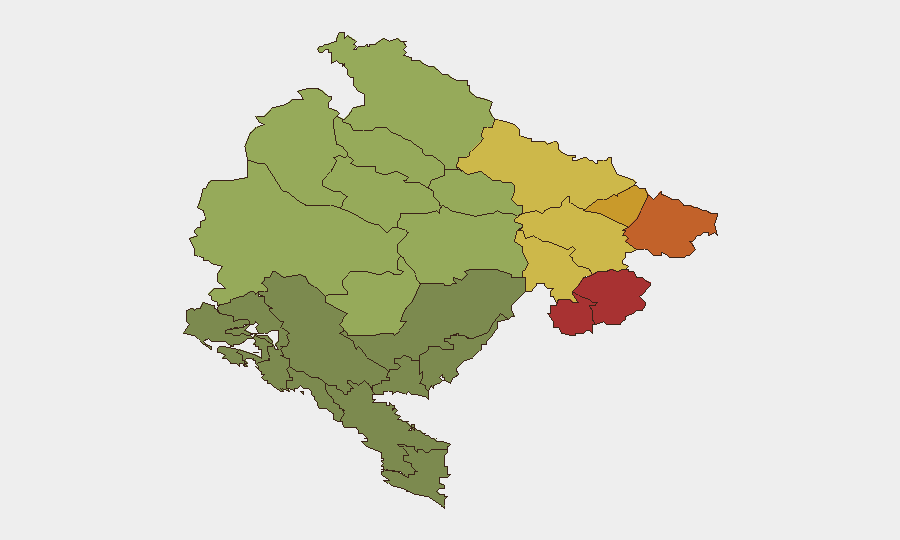
The northeastern municipalities—Plav, Gusinje, Rožaje, Petnjica, and Andrijevica—comprise the country's highest-risk tier (scores 68–78) and are driven primarily by proximity to Kosovo and Albania, persistent organized-crime activity, and weak institutional capacity. The second tier (Bijelo Polje, Berane, Plužine, and Pljevlja, scores 55–65) reflects ongoing criminal networks and trafficking corridors. These mountain and border regions have historically served as transit points for narcotics, weapons, and irregular migration; the 2026 arrests of a Swedish national (narcotic procurement) and extradition of Amir Barati (cyber-fraud) in Podgorica illustrate that organized crime and financial crime extend beyond the periphery into the capital.
How GeoBit Would Assist
Security teams with personnel or assets in Montenegro should prioritize OSINT Fusion & Corroboration, Intel Sweep, and X/Twitter & Telegram OSINT to track ongoing developments in the security-sector investigation and monitor Russian state-actor communications for follow-up hybrid operations. AOI Monitoring & Early Warning with persistent coverage of Plav, Gusinje, and Rožaje municipalities would provide early signals of trafficking escalation or transnational criminal activity affecting supply chains or personnel movement. Network & Actor Analysis applied to Montenegrin organized-crime and security-force structures would map institutional vulnerability and inform duty-of-care posture adjustments.
7-Day Outlook
The security-sector union investigation is likely to continue expanding through mid-October, potentially creating temporary institutional friction or delays in law-enforcement responsiveness. Russian hybrid-interference activity may shift tactics following the Zvinchuk expulsion; monitoring of Russian state media, Telegram channels, and proxy actors should remain elevated. Overall threat to foreign nationals and corporate assets remains low, but supply-chain and border-crossing delays should be anticipated if police operations widen.
Highest-Risk Areas — Ranked
| # | State / Region | Risk |
|---|---|---|
| 1 | Plav Municipality | 78 |
| 2 | Gusinje Municipality | 76 |
| 3 | Rožaje Municipality | 74 |
| 4 | Petnjica Municipality | 72 |
| 5 | Andrijevica Municipality | 68 |
| 6 | Bijelo Polje Municipality | 65 |
| 7 | Berane Municipality | 62 |
| 8 | Plužine Municipality | 58 |
| 9 | Pljevlja Municipality | 55 |
| 10 | Šavnik Municipality | 52 |
| 11 | Žabljak Municipality | 50 |
| 12 | Kolašin Municipality | 48 |
Sources
Previous Weekly Briefs
A new Montenegro brief is written every Monday, covering the week — each with its own risk map and downloadable CSV. Use the calendar to go further back.
- October 6, 2026
- September 29, 2026
- September 22, 2026
- September 15, 2026
- September 8, 2026
- September 3, 2026
- August 31, 2026
📅 Browse past briefs by calendar →
Highlighted days have a brief. Tap a day for that day's map & analysis, or “csv” for that day's dataset ($5).
Atlas — our AI intelligence desk — emails them this snapshot personally. Nothing else, no list.