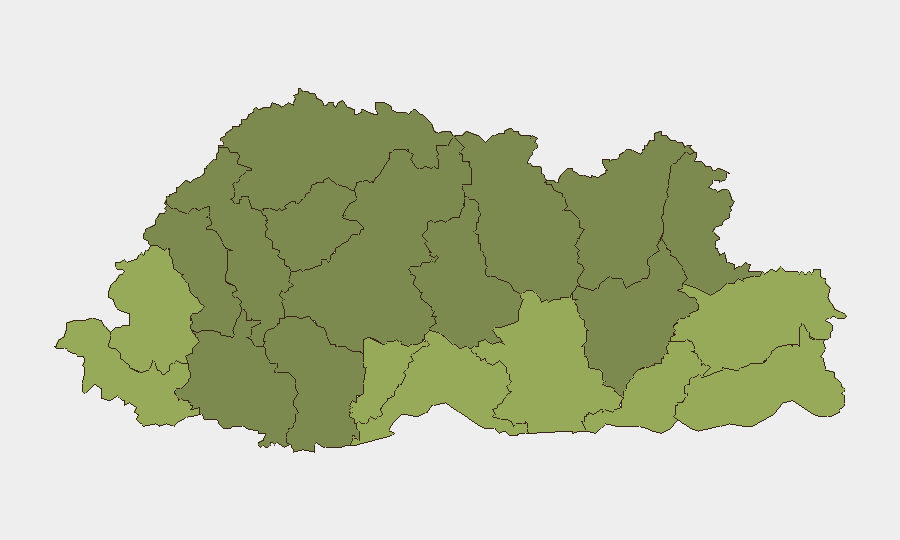
Situation Summary
Bhutan remains a low-threat environment with a composite national threat score of 2 and no confirmed security incidents, civil unrest, crime events, or infrastructure disruptions reported in the past 24–48 hours. The most recent signals relate to administrative and electoral activity rather than security threats, specifically record-low voter turnout (33.92%) in Thimphu's local elections on 20 July. Border districts including Samtse, Sarpang, Haa, and Pemagatshel maintain elevated sub-national risk scores owing to cross-border dynamics with India and Tibet, but no new escalations or specific incidents have been confirmed in the current monitoring window.
Key Developments
- Thimphu, 20 July 2026 – Local Thromde elections recorded 33.92% voter turnout, signaling civic engagement friction but assessed as non-security-threat administrative activity rather than a security incident.
- Samtse District, southern Bhutan, 22 July 2026 (monitoring update) – Highest sub-national risk area (score 58) remains under routine border-activity watch; no new confirmed conflicts, crime, or infrastructure events in the past 24–48 hours.
- Nationwide, 21–22 July 2026 – Multi-source web and event-feed monitoring across Bhutan confirms absence of security incidents, civil unrest, crime, or infrastructure disruptions in the 24–48 hour window ending 22 July 2026.
- Border districts (Samtse, Sarpang, Haa, Pemagatshel), 22 July 2026 – These four highest-risk districts remain under enhanced monitoring for cross-border activity but show no newly escalated tensions or reported incidents in the current period.
Highest-Risk Areas
The four border districts—Samtse (risk 58), Sarpang (55), Haa (52), and Pemagatshel (50)—drive Bhutan's sub-national risk hierarchy, primarily due to proximity to India–Bhutan and Tibet–Bhutan borders and historical signals of cross-border tension. Samtse, in particular, carries the highest composite risk score and warrants continued watch for cross-border activity, though no fresh incidents have materialized in the past 24–48 hours. Southern districts dominate the elevated-risk tier; central and northern districts (Wangdue Phodrang, Gasa, Lhuntse) carry materially lower risk. The concentration of risk in border zones reflects geographical exposure rather than current active threats.
How GeoBit Would Assist
A corporate security team with personnel or assets in Bhutan should leverage GeoBit's AOI Monitoring & Early Warning capability to set persistent watch on Samtse, Sarpang, and other high-risk border districts, with real-time alerting configured for cross-border incidents, civil unrest, or infrastructure disruption. Intel Sweep and multi-source OSINT fusion—combining global event feeds, X/Twitter monitoring, and web research—provides continuous corroboration of the absence of threats, reducing false-alarm risk and enabling confidence in routine operations. GIS & Spatial Analysis and Routing & Network Analysis support alternative journey planning should conditions shift, and Election Monitoring capabilities allow early tracking of any administrative friction that could escalate to broader unrest.
7-Day Outlook
Bhutan's threat trajectory over the next seven days is forecast to remain stable and low-threat, with no anticipated escalation. Electoral and civic signals are expected to normalize. Continued routine monitoring of border districts is warranted as a precaution, but no acute security events are anticipated in the near term.
Highest-Risk Areas — Ranked
| # | State / Region | Risk |
|---|---|---|
| 1 | Samtse District | 58 |
| 2 | Sarpang District | 55 |
| 3 | Haa District | 52 |
| 4 | Pemagatshel District | 50 |
| 5 | Samdrup Jongkhar District | 48 |
| 6 | Tsirang District | 45 |
| 7 | Zhemgang District | 42 |
| 8 | Trashigang District | 40 |
| 9 | Mongar District | 38 |
| 10 | Gasa District | 35 |
| 11 | Lhuntse District | 32 |
| 12 | Wangdue Phodrang District | 30 |
Previous Daily Briefs
A new Bhutan brief is written every day — each with its own risk map and downloadable CSV. Here's the last week; use the calendar to go further back.
📅 Browse every day by calendar →
Highlighted days have a brief. Tap a day for that day's map & analysis, or “csv” for that day's dataset ($5).
Atlas — our AI intelligence desk — emails them this snapshot personally. Nothing else, no list.