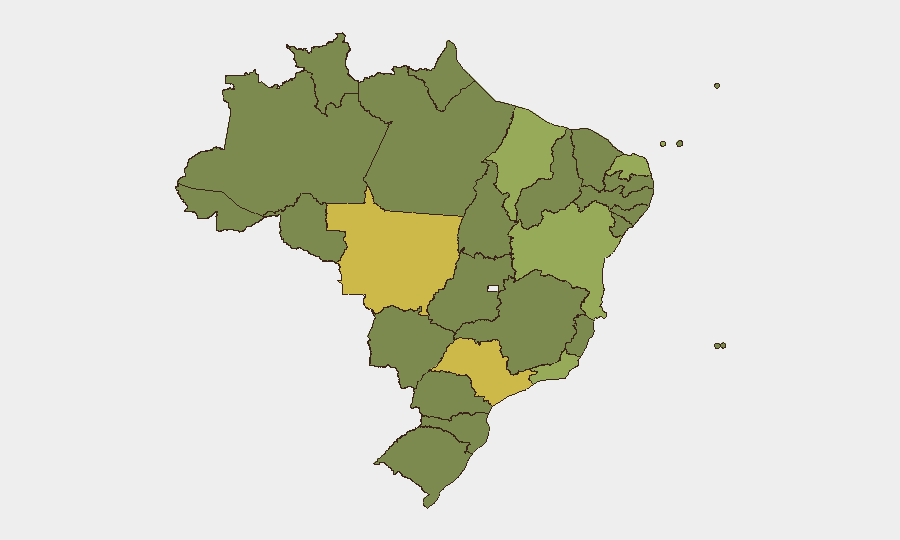
Situation Summary
Brazil remains a moderate-threat operating environment (global rank #36, composite score 52) with concentrated risks in São Paulo and Mato Grosso states. A suspected cyberattack on the national mobile emergency alert system overnight 23–24 June, followed by network shutdown and Federal Police investigation, signals emerging critical-infrastructure vulnerability and potential for coordinated disruption of public safety systems. Concurrent protest activity, police-reform pressure, and criminal-justice proceedings create a complex civil-security backdrop.
Key Developments
- Nationwide emergency alert system cyberattack (23–24 June, overnight) – Brazil's Civil Defense reported a suspected cyberattack targeting the national mobile emergency alert network that triggered false "Extreme Alert" notifications (including anomalous language such as "misanthropy") across multiple regions. The system was immediately shut down pending Federal Police investigation and security upgrades, leaving emergency communications suspended and creating operational uncertainty for public safety agencies and private security coordinators.
- Public statements by companies, judiciary, investors, and legal actors (23–24 June) – Multiple corporate, judicial, and legal-professional statements signaled institutional reactions and stakeholder concern regarding unspecified governance or enforcement matters; exact content requires additional corroboration but indicates sustained institutional attention.
- Police accountability investigation and protest (22 June, nationwide) – Public disapproval of police conduct triggered demonstration/rally activity on 22 June, accompanied by a Congressional investigation into criminal conduct; indicates tension in civil-police relations and potential for future organized protest or pressure campaigns.
- Prison violence incident (23 June) – A physical assault incident occurred within a correctional facility, consistent with ongoing prison-security pressures in high-incarceration states.
- Neighborhood-level criminal investigation (23 June) – A neighborhood-level investigation into criminal activity signals localized enforcement action; geo-specific context required to assess operational impact.
Highest-Risk Areas
São Paulo (66.5) and Mato Grosso (65.8) drive the national threat profile, followed by a secondary tier including Maranhão (49.4), Bahia, and Rio de Janeiro (both 44.4). São Paulo's ranking reflects chronic organized-crime, narcotics-trafficking, and now critical-infrastructure-cyber exposure in Brazil's largest economic and population center. Mato Grosso's elevation reflects land-conflict, illegal-extraction, and trafficking activity in the Amazon frontier. Mid-ranked states (Maranhão, Bahia, RJ) show consistent violent-crime, gang-competition, and prison-security challenges. Northern and northeastern states carry elevated crime-to-population ratios typical of trafficking corridors and resource-extraction zones.
How GeoBit Would Assist
Real-time Intel Sweep and multi-language OSINT (X/Twitter, Telegram, judicial/police announcements) would track emergency-alert system recovery, Federal Police investigation progress, and emerging copycat cyber-threats. AOI Monitoring & Early Warning on São Paulo, Mato Grosso, and secondary high-risk states would enable persistent watch for protest escalation, carceral violence spread, or criminal-market disruption. Network & Actor Analysis would map police-reform advocacy groups, institutional stakeholders, and threat actors coordinating cyberattacks or civil unrest, supporting duty-of-care assessment for personnel in protest zones or near critical infrastructure.
7-Day Outlook
The Federal Police cyberattack investigation is expected to dominate official communications through late June. Emergency alert system restoration timeline remains unclear; parallel public-safety contingencies (SMS, radio, traditional sirens) will likely be emphasized pending technical review. Police-accountability pressure and protest activity may persist or intensify if investigation findings point to systemic failures; corporate and NGO personnel in São Paulo should monitor official guidance and social-media indicators for spontaneous street activity.
Highest-Risk Areas — Ranked
| # | State / Region | Risk |
|---|---|---|
| 1 | São Paulo | 66.5 |
| 2 | Mato Grosso | 65.8 |
| 3 | Maranhão | 49.4 |
| 4 | Bahia | 44.4 |
| 5 | Rio de Janeiro | 44.4 |
| 6 | Rio Grande do Norte | 40.7 |
| 7 | Paraná | 38.8 |
| 8 | Rio Grande do Sul | 38.1 |
| 9 | Pernambuco | 38.1 |
| 10 | Minas Gerais | 37.8 |
| 11 | Piauí | 37.3 |
| 12 | Santa Catarina | 37 |
Sources
Previous Daily Briefs
A new Brazil brief is written every day — each with its own risk map and downloadable CSV. Here's the last week; use the calendar to go further back.
📅 Browse every day by calendar →
Highlighted days have a brief. Tap a day for that day's map & analysis, or “csv” for that day's dataset ($5).