Situation Summary
Estonia remains a stable NATO member state with composite threat score 7/100 (rank #118 globally), reflecting its position as a well-governed EU democracy with robust institutional capacity. The security picture is dominated by geopolitical and information-warfare dynamics tied to the Russia–Ukraine conflict and Baltic deterrence posture, rather than acute domestic instability or crime surges. Over the last 24–48 hours, no verified large-scale civil unrest, infrastructure attacks, or political crises have been reported; the threat environment is characterized by diplomatic friction, military posture adjustments, and routine localized incidents. Near-term risk remains elevated in border regions but contained within normal operational parameters for a NATO frontier state.
Key Developments
- Narva, Ida-Viru County (12 Jul) – Estonia advancing construction of a new NATO-aligned military base in its border city with Russia; part of planned deterrence and defense infrastructure expansion, not triggered by a new incident but reflects ongoing strategic posture adjustment.
- Tallinn, national level (10 Jul, reported 12 Jul) – Estonia, Latvia, and Lithuania delivered a joint demarche at Russia's Foreign Ministry, rejecting Russian accusations that Baltic airspace was used for Ukrainian drone strikes and characterizing the claims as "blatantly false"; reflects active information-warfare and diplomatic confrontation in the last 48 hours.
- Tõrva, Valga County (12 Jul) – Officials detailed causes of recent flooding and ongoing recovery measures; incident has transitioned from acute disruption to remedial phase with no new security complications reported in the last 24–48 hours.
- Pärnu, Pärnu County (12 Jul) – Police opened a criminal investigation following an assault on three minors by adults in the early hours of 12 July; localized violent crime with no indication of wider unrest.
- National level – festival security (12 Jul) – Volunteer safety teams and security operations in place at Beach Grind festival; no serious incidents reported and normal, orderly conditions maintained.
- Absence of cross-border spillover – No verified incidents of conflict escalation, infrastructure disruption, or civil unrest spreading from neighboring Latvia or other regional hotspots into Estonia in the last 24–48 hours.
Highest-Risk Areas
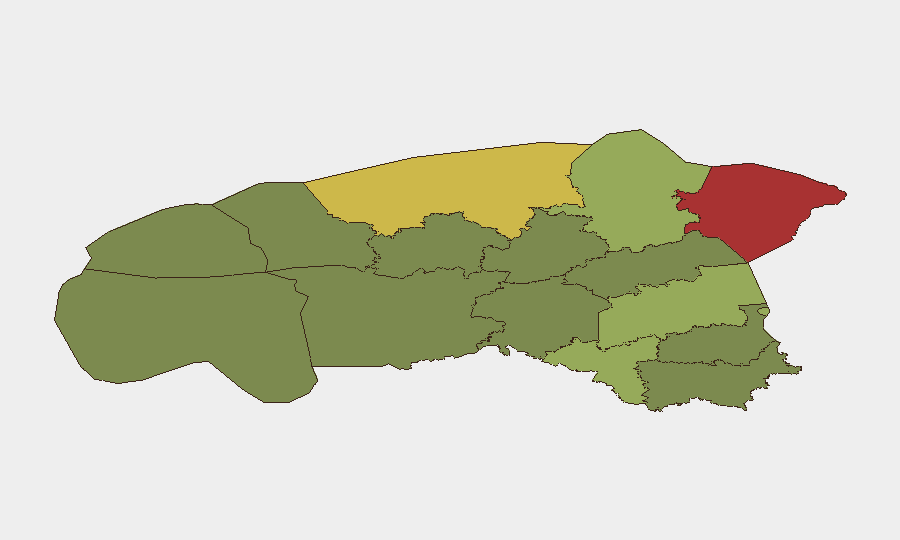
Ida-Viru County (risk 78) and Harju County (risk 68) dominate the sub-national ranking, driven primarily by their proximity to Russia and concentration of critical NATO and digital infrastructure. Ida-Viru's elevated score reflects its position as Estonia's northeastern border zone, hosting Narva and military installations; Harju encompasses Tallinn and the capital region's political, economic, and cyber-attack surface. Tartu County (58) and Valga County (55) follow, the latter recently affected by flooding and the former a secondary urban center; together these counties account for most of Estonia's asymmetric risk profile. Risk in peripheral counties (Võru, Põlva, Viljandi) remains minimal, reflecting Estonia's overall institutional stability and absence of organized insurgent or criminal strongholds.
How GeoBit Would Assist
Teams with assets or personnel in Estonia would deploy AOI Monitoring & Early Warning on Ida-Viru and Harju counties to detect emerging military, cyber, or protest activity near NATO installations and borders. Intel Sweep, X/Twitter & Telegram OSINT, and multi-language search would provide continuous ingestion of diplomatic statements, disinformation campaigns, and cross-border information-warfare signals—critical for early detection of escalation rhetoric or false-flag operations. GIS & Spatial Analysis paired with Satellite & Imagery analysis would support monitoring of military buildouts (e.g., the Narva base expansion) and infrastructure vulnerabilities in high-risk counties.
7-Day Outlook
Estonia's threat trajectory over the next seven days is likely to remain stable in the absence of major Ukraine-front shifts or Russian escalation. Diplomatic and information-warfare friction around airspace and sanctions will persist; border-region military activity will continue at planned pace. Risk of sudden localized incidents (crime, minor unrest) remains routine but non-systemic; no indicators suggest a shift toward crisis-level instability.
Highest-Risk Areas — Ranked
| # | State / Region | Risk |
|---|---|---|
| 1 | Ida-Viru County | 78 |
| 2 | Harju County | 68 |
| 3 | Tartu County | 58 |
| 4 | Valga County | 55 |
| 5 | Lääne-Viru County | 52 |
| 6 | Pärnu County | 35 |
| 7 | Rapla County | 32 |
| 8 | Jõgeva County | 30 |
| 9 | Järva County | 28 |
| 10 | Viljandi County | 25 |
| 11 | Põlva County | 22 |
| 12 | Võru County | 18 |
Sources
Previous Daily Briefs
A new Estonia brief is written every day — each with its own risk map and downloadable CSV. Here's the last week; use the calendar to go further back.
📅 Browse every day by calendar →
Highlighted days have a brief. Tap a day for that day's map & analysis, or “csv” for that day's dataset ($5).
Atlas — our AI intelligence desk — emails them this snapshot personally. Nothing else, no list.