Situation Summary
Georgia remains a low-to-moderate threat environment globally (rank #63; composite score 20), but risk is heavily concentrated in breakaway territories and border regions rather than core urban areas. Recent 24–48 hour activity shows scattered street crime (homicide, property crime linked to social-media trends) and routine law-enforcement actions in urban and rural zones, alongside emerging public-health concerns affecting multiple states. The threat picture is fragmented—no systemic instability signals—but warrant heightened awareness in high-risk northern and eastern regions and standard urban-crime precautions in metro Atlanta.
Key Developments
- Homicide in Atlanta (Zone 6, Old Fourth Ward). Four gunshot victims reported near Boulevard NE on July 10, ~5:20 p.m.; one 18-year-old male fatality, three in stable condition. Homicide Unit investigating; suspects detained for questioning.
- Property-crime surge linked to social-media trend (South Georgia, multiple locations). More than a dozen arrests reported July 11 for a coordinated string of break-ins explicitly tied to online activity encouraging burglary. Specific town names withheld by authorities; geographic footprint unclear.
- Cyclosporiasis outbreak spanning 30+ U.S. states, including Georgia. 1,700 confirmed cases nationwide as of July 11; gastrointestinal-illness advisory issued for residents and travelers. Primary exposure routes foodborne; ongoing public-health risk.
- Law-enforcement officer charged with battery (Waycross/Blackshear area). GBI charged Waycross Police Officer Marc Horne, 30, and Blackshear resident Kisha Music, 51, with simple battery on July 11. Indicates active criminal investigation involving uniformed personnel.
- Card-skimmer fraud at retail outlets (Lee and Dougherty Counties, South Georgia). Multiple skimmers detected at Dollar General locations very recently; regional advisory issued for account-holder vigilance.
- Expanded patrols on Atlanta BeltLine (Atlanta). APD announced intensified safety operations on the multi-use trail corridor within the last 48 hours, reflecting heightened crime-prevention posture in a key commuter/recreational zone.
- Police-stop public-service announcement (Lilburn, Georgia). Lilburn PD released compliance and safety guidance via social media, signaling proactive community messaging on officer–civilian interactions.
Highest-Risk Areas
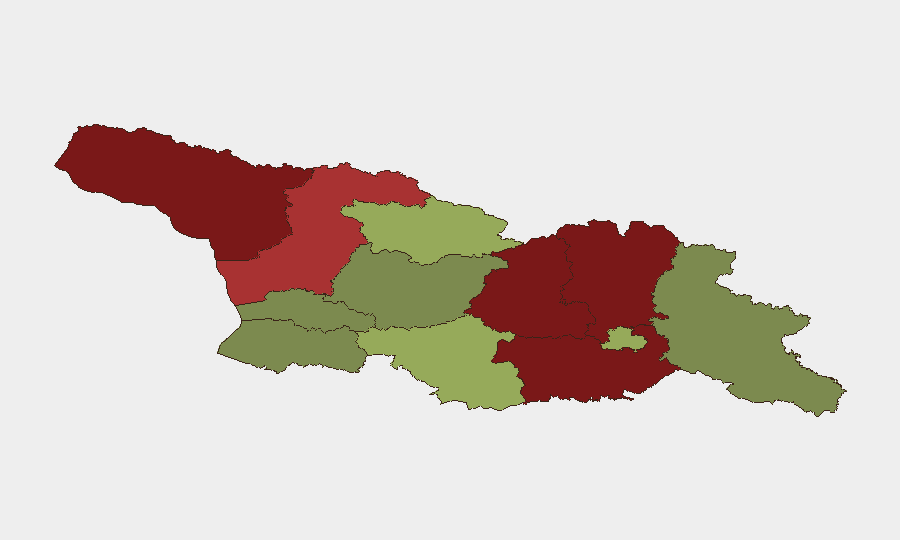
Northern and eastern border-zone regions—particularly Abkhazia (risk 95), Shida Kartli (88), and Lower Kartli (85)—dominate Georgia's sub-national threat ranking, driven by frozen conflict dynamics, disputed sovereignty, and persistent military/political volatility. Mtskheta-Mtianeti (82) and Samegrelo-Upper Svaneti (78) also carry elevated scores reflecting proximity to contested areas and cross-border pressures. By contrast, core urban centers and western lowland regions (Tbilisi 45, Imereti 32, Guria 28) present substantially lower composite risk, though localized street crime and public-order incidents remain routine in Tbilisi and metro Atlanta. For duty-of-care teams, geographic separation of risk is critical: border-region operations warrant geopolitical monitoring; urban operations warrant standard urban-crime readiness.
How GeoBit Would Assist
Security teams should deploy AOI Monitoring & Early Warning on high-risk northern regions (Abkhazia, Shida Kartli, Lower Kartli) to detect cross-border military activity, political signaling, or humanitarian displacement in real time. Intel Sweep and multi-language OSINT fusion on Georgian government statements, ruling-party messaging, and armed-forces developments can surface regime-stability signals and protest escalation before they reach diaspora or international news. GIS & Spatial Analysis paired with Routing & Network Analysis enables dynamic re-routing of personnel and supply chains away from emerging hotspots—critical if social-crime trends or civil unrest spread beyond initial South Georgia clusters.
7-Day Outlook
No imminent destabilization signals are evident, but the convergence of street crime, social-media-driven property offenses, and public-health alerts warrants sustained situational awareness. Continued monitoring of Tbilisi-area incidents and north-region political activity over the next week will clarify whether current scattered events represent noise or early correlation. Standard travel advisories for border zones remain in effect; Atlanta and lowland Georgia remain routine-risk environments.
Highest-Risk Areas — Ranked
| # | State / Region | Risk |
|---|---|---|
| 1 | Autonomous Republic of Abkhazia | 95 |
| 2 | Shida Kartli | 88 |
| 3 | Lower Kartli | 85 |
| 4 | Mtskheta-Mtianeti | 82 |
| 5 | Samegrelo-Upper Svaneti | 78 |
| 6 | Samtskhe-Javakheti | 48 |
| 7 | Tbilisi | 45 |
| 8 | Racha-Lechkhumi and Kvemo Svaneti | 42 |
| 9 | Kakheti | 38 |
| 10 | Autonomous Republic of Adjara | 35 |
| 11 | Imereti | 32 |
| 12 | Guria | 28 |
Sources
Previous Daily Briefs
A new Georgia brief is written every day — each with its own risk map and downloadable CSV. Here's the last week; use the calendar to go further back.
📅 Browse every day by calendar →
Highlighted days have a brief. Tap a day for that day's map & analysis, or “csv” for that day's dataset ($5).
Atlas — our AI intelligence desk — emails them this snapshot personally. Nothing else, no list.