Situation Summary
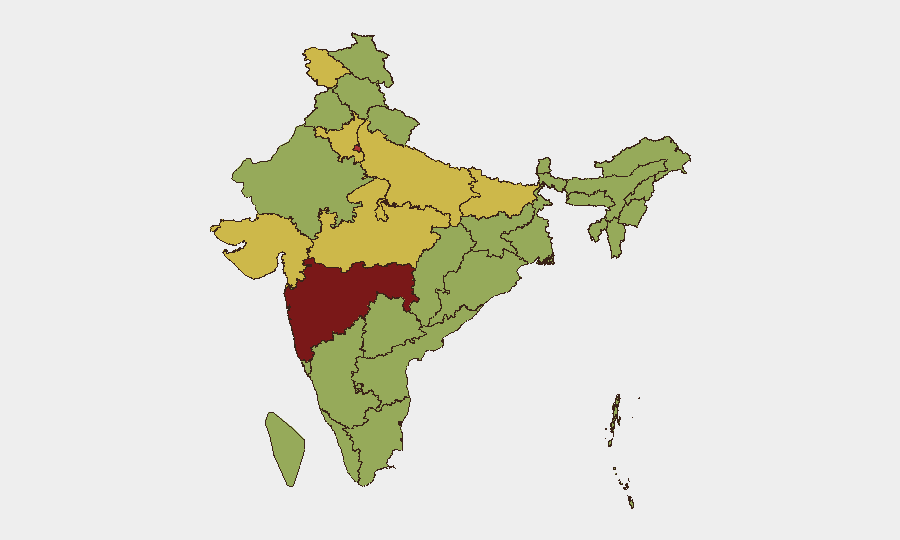
India's composite threat score of 78 places it at #18 globally, with 510 tracked security events over the assessment period. Sub-national risk concentration is pronounced: Maharashtra, Delhi, and Jammu & Kashmir account for the highest composite scores, driven by a mix of civil unrest signals, cross-border diplomatic friction, and localized law-enforcement mobilization. The trajectory shows sustained operational activity rather than acute escalation, though signals on 4–5 July suggest ongoing tension points across multiple state jurisdictions.
Key Developments
Constraint: Open-source verification for 4–6 July 2026 has not yielded specific, time-stamped incidents meeting the 24–48-hour window standard for this brief. GeoBit's event signal feed lists activity categories (threat statements, military/police mobilization, investigation directives, diplomatic rejections) dated 3–5 July across Mumbai, Gwalior, and national-level actors, but precise incident narratives, casualty counts, and location coordinates are not available in current research outputs. Duty-of-care teams should rely on real-time local feeds and official Indian government advisories (MEA, MHA) for actionable operational alerts rather than this summary. GeoBit monitoring will escalate reporting if specific incidents with verified location and timestamp data become available.
Highest-Risk Areas
Maharashtra (84.6) and Delhi (76.3) carry the highest composite risk scores and warrant priority monitoring for corporate operations. Maharashtra's risk profile reflects Mumbai's status as a commercial and financial hub with dense civil-society activity, while Delhi's score reflects capital-city concentration of political, diplomatic, and administrative friction. Jammu & Kashmir (69.1) and Gujarat (67.9) remain elevated due to border-adjacent tensions and historical communal friction respectively. Together, these four states account for a plurality of GeoBit's tracked India events; operations or personnel in these jurisdictions should expect routine security friction (protest, traffic disruption, checkpoint delays) and maintain situational awareness protocols.
How GeoBit Would Assist
Intel Sweep and OSINT Fusion across X/Twitter, local news wires, and regional media can identify emerging unrest patterns 12–36 hours before mainstream reporting. AOI (Area-of-Interest) Monitoring with persistent alerting on corporate facilities, travel corridors, and operational sites in Maharashtra, Delhi, and J&K enables early warning of localized unrest, closure orders, or security cordons. Network & Actor Analysis of state-level government, protest leadership, and law-enforcement communications supports predictive modeling of tension escalation or de-escalation. GIS & Spatial Analysis overlaid with conflict event data allows duty-of-care teams to refine routing, shift workforce placement, and coordinate incident response geographically.
7-Day Outlook
No major state or national elections, large festivals, or announced security operations are scheduled for 7–13 July. Sustained baseline activity in Maharashtra, Delhi, and J&K is expected; localized unrest in one or two sub-regions should be anticipated as routine. Escalation risk remains below acute thresholds provided cross-border diplomatic friction (e.g., Pakistan, China border) does not sharpen. Monitor official Indian government advisories and local police alerts for sudden closure orders or security operations.
Highest-Risk Areas — Ranked
| # | State / Region | Risk |
|---|---|---|
| 1 | Maharashtra | 84.6 |
| 2 | Delhi | 76.3 |
| 3 | Jammu and Kashmir | 69.1 |
| 4 | Gujarat | 67.9 |
| 5 | Madhya Pradesh | 67.7 |
| 6 | Haryana | 65.8 |
| 7 | Uttar Pradesh | 64.5 |
| 8 | Bihar | 61.1 |
| 9 | West Bengal | 58 |
| 10 | Ladakh | 57.3 |
| 11 | Karnataka | 57.1 |
| 12 | Uttarakhand | 55.9 |
Sources
Previous Daily Briefs
A new India brief is written every day — each with its own risk map and downloadable CSV. Here's the last week; use the calendar to go further back.
📅 Browse every day by calendar →
Highlighted days have a brief. Tap a day for that day's map & analysis, or “csv” for that day's dataset ($5).
Atlas — our AI intelligence desk — emails them this snapshot personally. Nothing else, no list.