Situation Summary
Liberia's security posture remains broadly stable at global rank #146 (composite threat score 7), with no tracked major incidents at the national level. However, the country faces acute near-term political and public-order pressures concentrated in Monrovia, driven by the high-profile detention of former Vice President Jewel Howard-Taylor on drug-trafficking charges and consequent protest activity. These developments carry localized risk to business continuity, movement, and asset security in the capital and secondary cities; provincial instability in Nimba, Lofa, and Grand Gedeh counties—driven by cross-border criminality and resource competition—remains a distinct structural risk for organizations operating outside the urban corridor.
Key Developments
- Monrovia, Capitol Hill area – 26 Aug 2026 (current): University of Liberia Progressive Students Alliance (PROSA) protests over class disruption escalated into clashes with Liberian National Police; protesters burned tires and threw stones near the Capitol Building, police deployed reinforcements and crowd-control measures, and a police booth was damaged. Order was later restored.
- Monrovia – 25–26 Aug 2026: Former Vice President Jewel Howard-Taylor was placed in pre-trial detention at Monrovia Central Prison on serious drug-trafficking charges following a court hearing; a request to release her on humanitarian grounds (citing a reported medical emergency during custody) was denied, intensifying political tensions and civil-society concern over due process.
- Gbarnga, Bong County – 25–26 Aug 2026: The Coalition of Bong Eminent Citizens held a public event demanding Howard-Taylor's release and accusing authorities of political persecution, signaling organized localized support and potential for secondary protest activity outside Monrovia.
- National – 25–26 Aug 2026: The Liberia Council of Churches publicly appealed for calm and adherence to due process in high-profile drug cases, implicitly acknowledging heightened public emotion and risk of politicization and unrest around narcotics prosecutions.
- Monrovia – 26 Aug 2026: Social media and news outlets circulated video of riot-control police deployment and restrained officer conduct during recent tensions, reflecting visible public-order policing and documentation of state response to protest activity.
Highest-Risk Areas
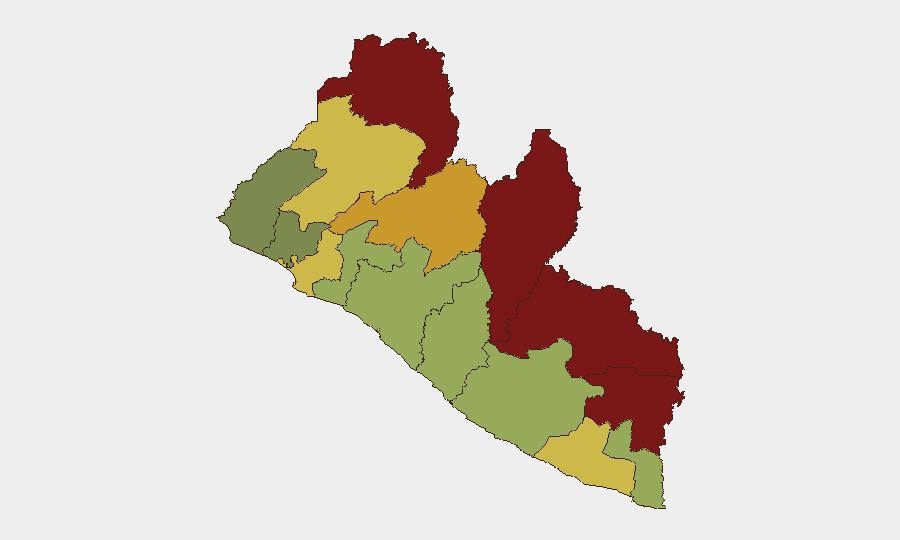
Nimba, Lofa, and Grand Gedeh counties (composite scores 92, 88, 85 respectively) drive Liberia's subnational risk profile, reflecting weak state presence, cross-border criminal networks, and resource-driven conflict dynamics in the forested border regions. Bong County (score 72) is elevated partly by the political dimensions of the current Howard-Taylor case and localized mobilization. Montserrado County (score 64)—which includes Monrovia—presents acute but typically episodic risk tied to urban protest, petty crime, and policing activity; current class-disruption and political-detention tensions elevate near-term public-order risk in the capital. Organizations with assets or personnel in Nimba, Lofa, or border areas face persistent threat from armed robbery, smuggling networks, and militia activity; those in Monrovia face short-term exposure to protest, checkpoint delays, and police presence.
How GeoBit Would Assist
Organizations can employ AOI Monitoring & Early Warning to track protest activity, police deployment, and checkpoint activity in Monrovia and secondary cities in real-time. Network & Actor Analysis and OSINT (including social media and news feeds) would enable continuous tracking of political actors, civil-society messaging, and sentiment around the Howard-Taylor case and narcotics prosecutions to anticipate secondary protests or unrest. Routing & Network Analysis would provide real-time alternative-route planning to avoid Capitol Hill, University of Liberia, and other flash-point areas during peak protest hours.
7-Day Outlook
Near-term risk is concentrated on the trajectory of the Howard-Taylor case and subsequent trial activity, which will likely trigger further organized and student-led protest in Monrovia and Gbarnga over the next 7–10 days. Police crowd-control capacity appears adequate to manage dispersal, but sustained detention and political messaging from opposition figures and civil-society bodies create conditions for recurring, if localized, civil unrest. Provincial insecurity in the north will remain a chronic threat independent of capital-city political dynamics.
Highest-Risk Areas — Ranked
| # | State / Region | Risk |
|---|---|---|
| 1 | Nimba County | 92 |
| 2 | Lofa County | 88 |
| 3 | Grand Gedeh County | 85 |
| 4 | River Gee County | 83 |
| 5 | Bong County | 72 |
| 6 | Gbarpolu County | 68 |
| 7 | Grand Kru County | 65 |
| 8 | Montserrado County | 64 |
| 9 | Rivercess County | 58 |
| 10 | Sinoe County | 55 |
| 11 | Margibi County | 52 |
| 12 | Grand Bassa County | 48 |
Sources
Previous Daily Briefs
A new Liberia brief is written every day — each with its own risk map and downloadable CSV. Here's the last week; use the calendar to go further back.
- August 24, 2026
- August 22, 2026
- August 20, 2026
- August 18, 2026
- August 16, 2026
- August 14, 2026
- August 12, 2026
📅 Browse every day by calendar →
Highlighted days have a brief. Tap a day for that day's map & analysis, or “csv” for that day's dataset ($5).
Atlas — our AI intelligence desk — emails them this snapshot personally. Nothing else, no list.