Situation Summary
Togo remains a lower-tier global security risk (rank #85, composite score 19) with no verified major incidents in the last 24–48 hours. The country's primary threat driver is persistent jihadist activity in the northern Savanes and Kara regions, where cross-border spillover from Burkina Faso and Mali continues to generate sporadic armed clashes and displacement. Recent administrative action—a military and security command reshuffle issued by President Faure Gnassingbé on 17 August—reflects ongoing government response to northern pressure, but does not represent a change in the underlying threat trajectory.
Key Developments
- Lomé, 17 August (evening) — President Faure Gnassingbé issued a major decree reshuffling armed forces, intelligence, and civil aviation leadership. This administrative action signals continued focus on security-sector readiness but is not an on-the-ground incident. [Financial Afrik, 18 Aug]
- No verified fresh civil unrest, attacks, or infrastructure disruption confirmed in Togo for 18–19 August. A detention of two French nationals (journalist-directors) reported on 18 August dates to 27 July; it is not a new 24–48 hour event.
- Northern Togo (Savanes region) — Jihadist pressure remains endemic since February 2024, but no specific new attack or casualty report was cross-verified for the past two days.
Highest-Risk Areas
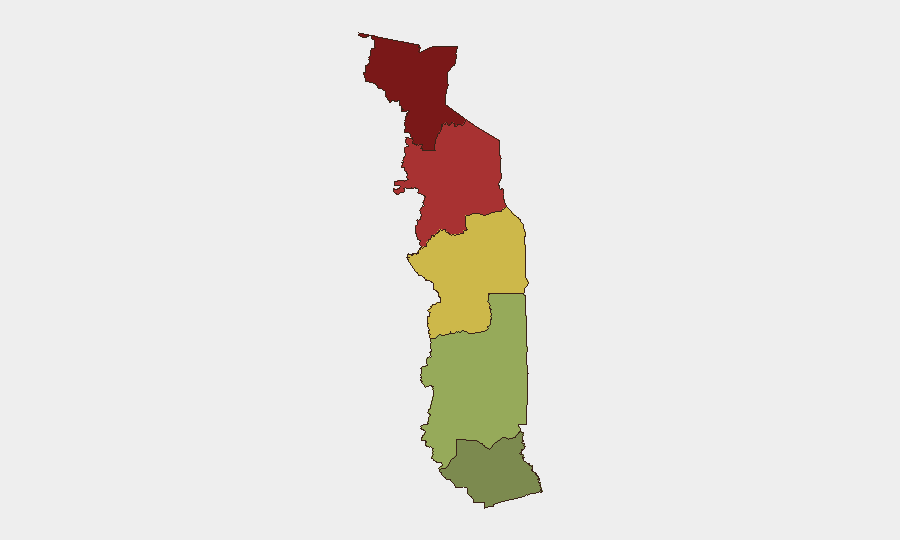
Savanes Region (risk score 92) and Kara Region (risk score 78) dominate Togo's threat landscape, driven by cross-border jihadist activity originating in Burkina Faso and Mali. Armed groups operating under ISIS-affiliated and al-Qaeda-affiliated banners conduct raids, ambushes, and IED attacks against military and civilian targets, generating displacement and limiting state control in remote areas. Maritime Region (risk score 28) and Plateaux Region (risk score 45) carry significantly lower but still-monitored risk profiles related to petty crime and localized communal tension. The southern coastal corridor (Maritime Region, Lomé) remains the most secure zone for international operations.
How GeoBit Would Assist
Security teams with people or assets in Togo should employ AOI Monitoring & Early Warning on Savanes and Kara regions to detect emerging attack patterns and displacement movements before escalation; Conflict & Military tracking to monitor force-structure changes and jihadist group movements; and OSINT fusion (Intel Sweep, X/Telegram, and multi-language search) to corroborate rumors of abductions, roadblocks, or curfews in real time. GIS & Spatial Analysis and alternative Route & Network Analysis enable contingency planning for staff movement around active hotspots, particularly along the Ghana and Burkina Faso borders.
7-Day Outlook
No major new incidents are expected to alter Togo's low-to-moderate global risk ranking in the coming week, barring a significant jihadist escalation in the north. The August reshuffle may improve security-sector coordination, but operational pressure on armed groups is unlikely to yield rapid results. Staff in Savanes and Kara regions should maintain heightened situational awareness; those in Lomé and Maritime areas face routine urban and petty-crime risks only.
Highest-Risk Areas — Ranked
| # | State / Region | Risk |
|---|---|---|
| 1 | Savanes Region | 92 |
| 2 | Kara Region | 78 |
| 3 | Centrale Region | 65 |
| 4 | Plateaux Region | 45 |
| 5 | Maritime Region | 28 |
Sources
Previous Daily Briefs
A new Togo brief is written every day — each with its own risk map and downloadable CSV. Here's the last week; use the calendar to go further back.
- August 17, 2026
- August 15, 2026
- August 13, 2026
- August 11, 2026
- August 9, 2026
- August 7, 2026
- August 6, 2026
📅 Browse every day by calendar →
Highlighted days have a brief. Tap a day for that day's map & analysis, or “csv” for that day's dataset ($5).
Atlas — our AI intelligence desk — emails them this snapshot personally. Nothing else, no list.