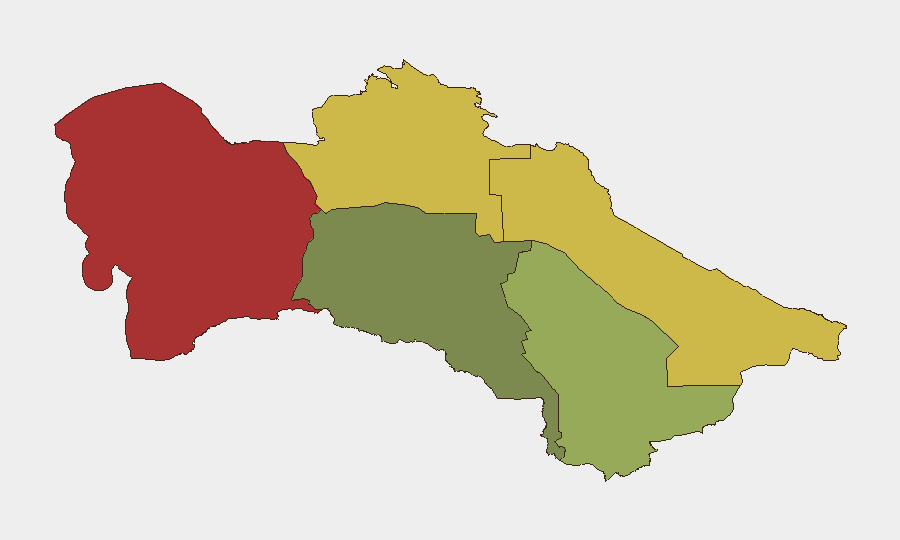
Situation Summary
Turkmenistan maintains a stable security environment with no acute incidents reported in the last 24–48 hours. The country ranks #193 globally on GeoBit's composite threat index, reflecting low frequency of tracked security events and minimal civil unrest or armed activity. Senior diplomatic engagement—including the national leader's attendance at ceremonies in Tehran—reflects normal state-level operations rather than crisis response or instability.
Key Developments
- Tehran, Iran – July 3, 2026: Turkmenistan's national leader attended funeral ceremonies for Iran's former Supreme Leader Ali Khamenei, meeting with Iranian President Masoud Pezeshkian and other officials. This high-profile diplomatic engagement occurred without reported security incidents affecting Turkmenistan's domestic or border operations.
- Vienna, Austria – June 29–30 (reported July 3, 2026): A Turkmen Mejlis representative participated in an OSCE Supplementary Meeting on the Human Dimension, addressing human rights and judicial-training topics. No domestic security fallout or civil reaction was reported in connection with this multilateral engagement.
- No acute domestic incidents reported: Cross-referenced open-source monitoring across the last 24–48 hours confirms absence of protests, demonstrations, armed clashes, terrorist attacks, border incidents, major crime events, or infrastructure failures within Turkmenistan.
- No new travel-advisory escalations: Foreign ministries and international travel-risk services have not issued updated warnings flagging acute security deterioration in Turkmenistan in the current reporting window.
Highest-Risk Areas
Balkan Region (risk score 78) and Lebap Region (risk score 68) are GeoBit's highest-flagged sub-national zones, likely reflecting historical border-management concerns, cross-border smuggling activity, and proximity to volatile neighboring areas. Dashoguz Region (risk 62) follows as a secondary concern, while Mary, Ahal, and Ashgabat City register significantly lower risk (42, 35, and 18 respectively). The concentration of elevated risk in northern and western border regions aligns with Turkmenistan's geographic exposure to Central Asian transit routes and its porous boundaries with Uzbekistan and Kazakhstan.
How GeoBit Would Assist
Security teams with personnel or assets in Turkmenistan can deploy AOI (Area-of-Interest) Monitoring & Early Warning on Balkan and Lebap regions to detect emerging unrest, criminal activity, or cross-border incidents before they escalate; multi-language Intel Sweep and X/Twitter OSINT to track civil sentiment and unofficial security reports in real time; and Routing & Network Analysis to identify alternative travel corridors and logistics pathways that avoid emerging hotspots. Persistent satellite and imagery analysis of border checkpoints and key infrastructure in high-risk zones provides ground truth on security postures and checkpoint activity.
7-Day Outlook
No significant security deterioration is anticipated in the near term. Turkmenistan's stable diplomatic posture and absence of triggering events suggest continued low-incident trajectory through the next reporting cycle. Duty-of-care teams should maintain routine monitoring of Balkan and Lebap regions and remain alert to any cross-border spillover from neighboring regional tensions, but no acute escalation indicators are present.
Highest-Risk Areas — Ranked
| # | State / Region | Risk |
|---|---|---|
| 1 | Balkan Region | 78 |
| 2 | Lebap Region | 68 |
| 3 | Dashoguz Region | 62 |
| 4 | Mary Region | 42 |
| 5 | Ahal Region | 35 |
| 6 | Ashgabat City | 18 |
Sources
Previous Daily Briefs
A new Turkmenistan brief is written every day — each with its own risk map and downloadable CSV. Here's the last week; use the calendar to go further back.
📅 Browse every day by calendar →
Highlighted days have a brief. Tap a day for that day's map & analysis, or “csv” for that day's dataset ($5).