Situation Summary
Turkmenistan remains a low-incident environment with no documented protests, major crime, civil unrest, or infrastructure attacks during 7–14 September 2026. The country ranks #183 globally in composite threat score (3/100). Current security posture is shaped by routine border management, regional cooperation frameworks, and domestic policy enforcement rather than acute crises. Near-term stability appears consistent with longer-term patterns.
Key Developments
- Border Travel Restrictions on Ex-Military – Multiple Border Points, Turkmenistan – Reported 8 Sep 2026
At least three cases of formally discharged military personnel denied exit at border checkpoints within approximately one month preceding 8 September suggest emerging restrictions on foreign travel for former servicemen on national security grounds. Implications for dual-national and expatriate departure procedures warrant monitoring.
- Afghanistan–Turkmenistan Border Security Coordination – Border Zone – 11 Sep 2026
Taliban Ministry of Defense confirmed a meeting between its 209th Army Corps commander and a Turkmen border commander to coordinate security operations, focusing on smuggling interdiction, militancy prevention, and unauthorized crossings. Indicates ongoing bilateral attention to frontier stability.
- Turkmen State Migration Service Participation in Global Security Forum – Lianyungang, China – 9–12 Sep 2026
A delegation led by the deputy chairman of Turkmenistan's State Migration Service attended the 2026 Conference of the Global Public Security Cooperation Forum, with sessions on migration control, crime prevention, and public security policy. Reflects current policy emphasis on border and travel procedure alignment.
- Turkic States Interior Ministers Cooperation Meeting – Regional – 10 Sep 2026
Interior ministers from Turkic states, including Turkmenistan, discussed expanded cooperation on transnational organized crime, cybercrime, extremism, terrorism, and fugitive/missing-persons location. Signals continued alignment with regional law-enforcement and counter-terrorism priorities.
- Iran–Turkmenistan Electricity Import Agreement – Cross-Border Infrastructure – 13 Sep 2026
Iran announced electricity-import contracts with Turkmenistan as part of power-supply diversification. While not a security incident, underscores regional energy interdependence and cross-border infrastructure resilience considerations relevant to contingency planning.
- Domestic Road Safety Campaign – Ashgabat and National – 8 Sep 2026
State-sponsored "Young Road Traffic Inspectors" competition and broader "Road Safety – the Tranquility" campaign continued. A preventive public-safety initiative; demonstrates ongoing state messaging on accident prevention.
Highest-Risk Areas
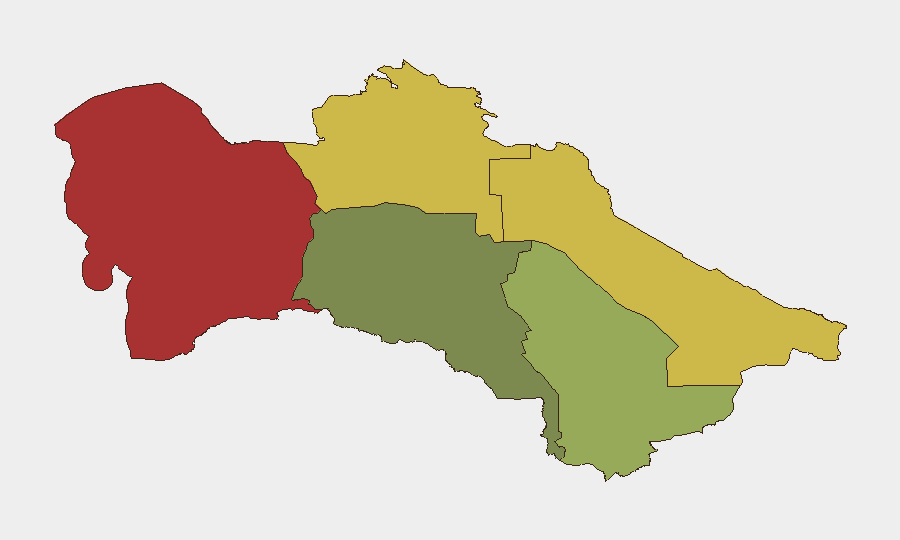
Balkan Region (risk 78) and Lebap Region (risk 68) drive the national composite risk score, likely reflecting proximity to conflict-adjacent areas (Afghanistan, Uzbekistan) and historical smuggling corridors. Dashoguz Region (risk 62) faces similar cross-border pressures. Conversely, Ashgabat City (risk 18) and Ahal Region (risk 35) register substantially lower risk, correlating with capital-city security infrastructure and relative isolation from land borders. Balkan's elevated score warrants prioritization in asset-protection and personnel-movement planning.
How GeoBit Would Assist
GeoBit's AOI (Area-of-Interest) Monitoring & Early Warning capability enables persistent watch on Balkan and Lebap regions to detect emerging unrest, border incidents, or trafficking activity before mainstream reporting. Intel Sweep and multi-language OSINT fusion tracks Turkmen state media, regional forums, and cross-border developments (e.g., Taliban coordination, migration-policy shifts) with automated alerting. Routing & Network Analysis supports alternative journey planning for personnel and supply chains, particularly around high-risk northern regions and Afghan border zones.
7-Day Outlook
No escalation indicators are present; security posture is expected to remain stable. Ongoing bilateral border coordination and regional law-enforcement cooperation suggest managed approach to frontier risks. Organizations with operations in Balkan or Lebap regions should maintain baseline monitoring of travel restrictions and border procedures, particularly for personnel with military backgrounds.
Highest-Risk Areas — Ranked
| # | State / Region | Risk |
|---|---|---|
| 1 | Balkan Region | 78 |
| 2 | Lebap Region | 68 |
| 3 | Dashoguz Region | 62 |
| 4 | Mary Region | 42 |
| 5 | Ahal Region | 35 |
| 6 | Ashgabat City | 18 |
Sources
Previous Weekly Briefs
A new Turkmenistan brief is written every Monday, covering the week — each with its own risk map and downloadable CSV. Use the calendar to go further back.
- September 7, 2026
- September 3, 2026
- September 2, 2026
- September 1, 2026
- August 31, 2026
- August 30, 2026
- August 29, 2026
📅 Browse past briefs by calendar →
Highlighted days have a brief. Tap a day for that day's map & analysis, or “csv” for that day's dataset ($5).
Atlas — our AI intelligence desk — emails them this snapshot personally. Nothing else, no list.