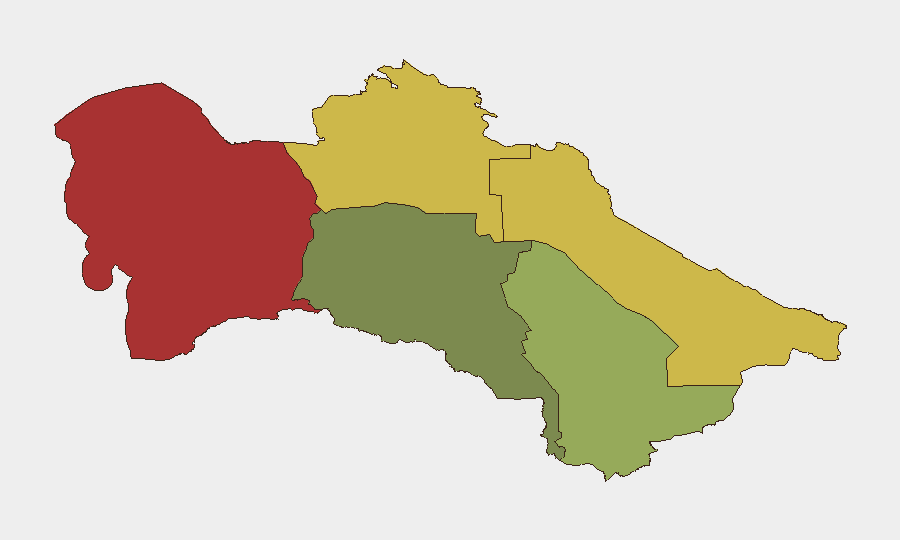
Situation Summary
Turkmenistan maintains a stable security posture with no confirmed acute incidents in the last 24–48 hours. The country's overall composite threat score remains low (rank 173 globally), with routine political and economic activity dominating official reporting and open-source monitoring. Regional risk concentration in the western Balkan and Lebap regions reflects chronic border-management challenges and smuggling networks rather than active conflict or instability within the capital or southern zones.
Key Developments
- Ashgabat, 18–19 July 2026: President Serdar Berdimuhamedov conducted a state visit to Georgia and held scheduled cabinet meetings on cultural and economic cooperation; no security incidents, protests, or infrastructure disruptions reported by state or international sources.
- Country-wide, 18–19 July 2026: No new travel advisories, protest activity, or law-enforcement operations confirmed by independent or international news wires affecting major cities or foreign-national populations.
- Border regions (Iran–Afghanistan corridors), 18–19 July 2026: Ongoing military activity and strikes in neighboring Iran and the Gulf region continue at scale; no confirmed spillover incidents, closure of Turkmen border crossings, or direct territorial impact reported in the same window.
- Telecommunications and utilities, 18–19 July 2026: No verified power outages, blackouts, or transport infrastructure failures documented.
- Ashgabat International Airport, 18–19 July 2026: Standard operations continue; no new NOTAMs or airline disruptions announced.
Highest-Risk Areas
The Balkan Region (risk score 78) and Lebap Region (risk score 68) dominate sub-national threat exposure, driven primarily by active smuggling networks, informal border-crossing activity, and limited state capacity in remote areas bordering Iran and Uzbekistan. Dashoguz Region (62) faces similar cross-border pressures and informal trade dynamics. By contrast, Ashgabat City (18) and southern zones (Ahal, Mary) exhibit substantially lower risk, reflecting higher state presence, economic infrastructure, and international engagement. For corporate assets or personnel, the capital and Mary Region remain substantially lower-risk operating environments; operations in or travel through western regions warrant enhanced due-diligence and local-partnership vetting.
How GeoBit Would Assist
Security teams monitoring Turkmenistan should deploy AOI (Area-of-Interest) Monitoring & Early Warning on the Balkan and Lebap border zones to detect trafficking patterns, informal crossings, or security-force movements before they escalate to wider incidents. OSINT Fusion across state media, social platforms, and regional news wires enables continuous detection of protests, infrastructure failures, or regime instability signals despite Turkmenistan's restricted independent media. Routing & Network Analysis supports alternative-route planning for personnel or supply chains vulnerable to border volatility or smuggling-related interdictions in the west.
7-Day Outlook
No acute threat escalation is anticipated in the next seven days absent major regional spillover from Iran–Gulf tensions. Routine economic and political activity is expected to continue. Monitoring of western border zones should remain persistent, as informal trafficking and cross-border movement patterns can shift rapidly without formal incident reporting in Turkmenistan's controlled information environment.
Highest-Risk Areas — Ranked
| # | State / Region | Risk |
|---|---|---|
| 1 | Balkan Region | 78 |
| 2 | Lebap Region | 68 |
| 3 | Dashoguz Region | 62 |
| 4 | Mary Region | 42 |
| 5 | Ahal Region | 35 |
| 6 | Ashgabat City | 18 |
Previous Daily Briefs
A new Turkmenistan brief is written every day — each with its own risk map and downloadable CSV. Here's the last week; use the calendar to go further back.
📅 Browse every day by calendar →
Highlighted days have a brief. Tap a day for that day's map & analysis, or “csv” for that day's dataset ($5).
Atlas — our AI intelligence desk — emails them this snapshot personally. Nothing else, no list.