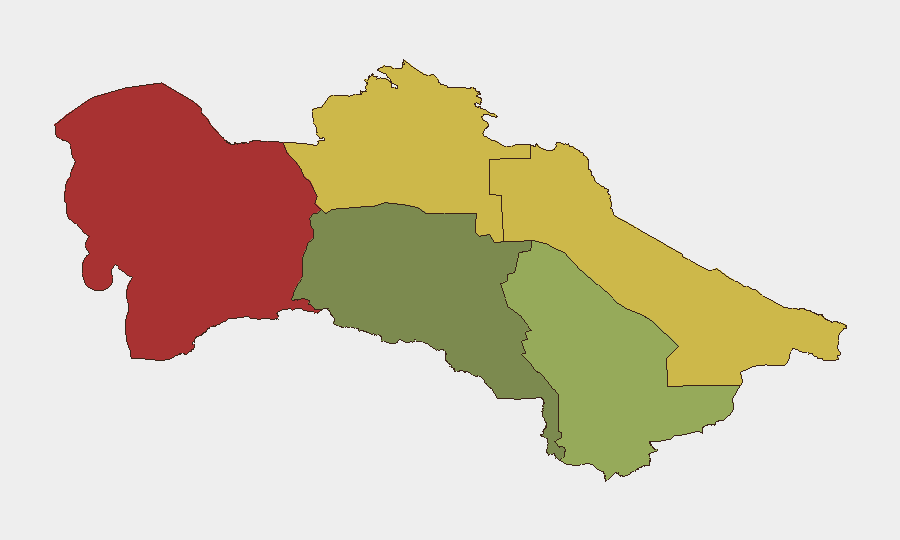
Situation Summary
Turkmenistan remains a low-threat environment globally (composite score 2) with no tracked security incidents in the current reporting window. The country's overall stability is underpinned by strong state control and limited civil unrest; however, sub-national risk concentrations persist in western border regions, particularly Balkan and Lebap. A regional maritime incident in the Caspian Sea—the 25 July attack on an Iranian commercial vessel—prompted official Turkmenistan condemnation on 27 July, but poses minimal direct domestic risk to personnel or assets within Turkmenistan proper.
Key Developments
- Caspian Sea (Regional) — 25 July 2026: Iranian commercial vessel attacked; one sailor killed, others injured. Incident reported across international maritime channels.
- Ashgabat (Foreign Ministry) — 27 July 2026: Turkmenistan's Foreign Ministry issued public statement condemning attacks on Caspian Sea vessels as "unacceptable," signaling diplomatic concern over regional maritime security but no escalation toward domestic action.
*No discrete domestic security, civil unrest, infrastructure, or crime incidents confirmed in Turkmenistan over the last 24–48 hours.*
Highest-Risk Areas
Balkan Region (risk 78) and Lebap Region (risk 68) account for the majority of sub-national threat concentration, reflecting border proximity, cross-border trafficking exposure, and limited state oversight in peripheral zones. Dashoguz Region (risk 62) follows, driven by similar geographic and governance factors along the Uzbekistan border. By contrast, Ashgabat City (risk 18) and Ahal Region (risk 35) reflect stronger government presence and lower incident frequency. Organizations with personnel or logistics operations in western Turkmenistan should prioritize border-zone awareness and local liaison channels.
How GeoBit Would Assist
Security teams managing Turkmenistan exposure would deploy AOI Monitoring & Early Warning to flag emerging unrest or border incidents in high-risk Balkan and Lebap regions in real time. Multi-language OSINT and social-media intelligence (X/Twitter, Telegram) would provide early signal of any political instability, labor actions, or cross-border tensions that might affect supply chains or staff mobility. Routing & Network Analysis capabilities help corporate teams identify alternative transport corridors and safe passage routes if western regions experience temporary disruption.
7-Day Outlook
No escalation is anticipated in the near term. The Caspian maritime incident reflects regional (Iran–Gulf actor) tensions rather than Turkmenistan domestic instability, and the government's measured diplomatic response suggests compartmentalized handling. Routine state-control operations and border-management activity are expected to remain the dominant security rhythm in Balkan and Lebap regions.
Report Generated: 2026-07-28
Next Scheduled Brief: 2026-07-29
GeoBit Threat Ranking: Turkmenistan — Score 2 (Low Global Tier)
Highest-Risk Areas — Ranked
| # | State / Region | Risk |
|---|---|---|
| 1 | Balkan Region | 78 |
| 2 | Lebap Region | 68 |
| 3 | Dashoguz Region | 62 |
| 4 | Mary Region | 42 |
| 5 | Ahal Region | 35 |
| 6 | Ashgabat City | 18 |
Sources
Previous Daily Briefs
A new Turkmenistan brief is written every day — each with its own risk map and downloadable CSV. Here's the last week; use the calendar to go further back.
📅 Browse every day by calendar →
Highlighted days have a brief. Tap a day for that day's map & analysis, or “csv” for that day's dataset ($5).
Atlas — our AI intelligence desk — emails them this snapshot personally. Nothing else, no list.