Situation Summary
Uruguay remains the most stable country in South America and ranks #152 globally in composite threat score, with no tracked acute security events in the past 48 hours. Crime remains concentrated in specific urban zones—chiefly Montevideo—rather than systemic across the country. The security environment is characterized by localized gang and street violence rather than political instability, terrorism, or infrastructure disruption.
Key Developments
- No independently corroborated acute incidents have been reported countrywide in the last 24–48 hours (2026-08-06 to 2026-08-07). Open-source monitoring, local news outlets, and travel-advice sources continue to report stability with no new civil unrest, conflict, or major crime spike.
- Montevideo: Ongoing police patrol activity and security measures remain in place; no fresh confirmed incident in the last 48 hours. Historical context: a shooting near Gran Parque Central on 2026-08-03 resulted in three wounded, but this falls outside the current reporting window.
- Soriano department (Mercedes): A customs (Aduanas) ammunition seizure was reported, though the exact timestamp is unclear and does not meet the 24–48 hour recency threshold for current development status.
Highest-Risk Areas
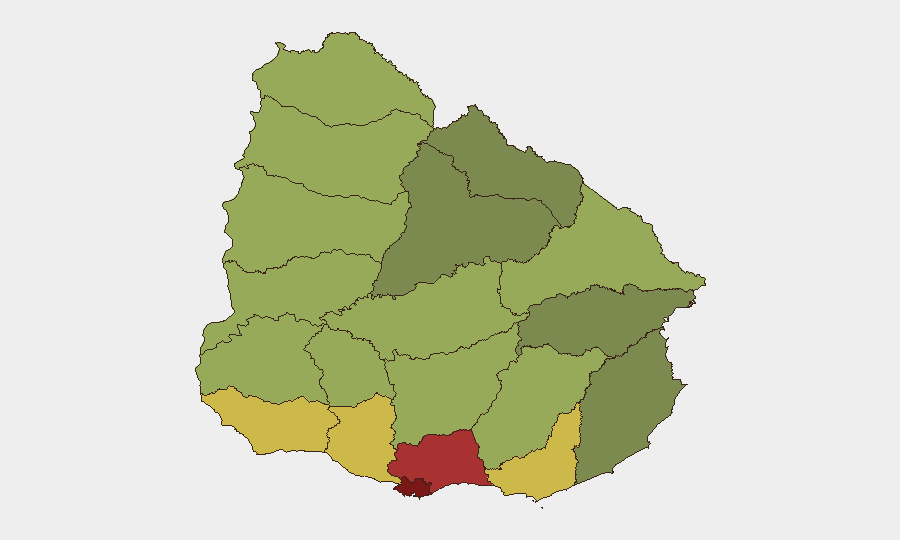
Montevideo (risk 92) and Canelones (risk 78) account for the majority of recorded threat activity, driven by street-level gang violence, armed robbery, and localized turf disputes in specific neighborhoods rather than organized insurgency or political conflict. Maldonado (risk 68) and San José (risk 64) follow, reflecting ongoing property crime and gang presence in their urban cores. Risk in interior departments (Soriano, Río Negro, Salto, Artigas, Paysandú) remains elevated but substantially lower than the capital region, typically linked to drug trafficking, smuggling corridors, and transnational organized crime activity along border zones. Corporate and NGO personnel should maintain heightened situational awareness in Montevideo's higher-crime barrios and exercise standard travel discipline in border departments.
How GeoBit Would Assist
A security team monitoring Uruguay should deploy AOI (Area-of-Interest) Monitoring & Early Warning on Montevideo's highest-risk neighborhoods and border departments to detect emerging violence spikes or gang activity in real time. OSINT fusion—combining X/Twitter, local news feeds, police radio signals (via radio SIGINT), and Telegram monitoring—enables rapid confirmation of incidents and fine-grained timeline corroboration. GIS & Spatial Analysis and Routing & Network Analysis support contingency planning, alternative journey routes around high-risk zones, and duty-of-care positioning of personnel away from active threat clusters.
7-Day Outlook
No indicators suggest an imminent deterioration in the security environment. Street-level crime in Montevideo and select interior zones will likely persist at current operational tempo, with sporadic violence tied to gang competition and drug-trafficking activity. Personnel and asset-security postures should remain aligned to baseline Uruguay threat levels, with event-triggered escalation protocols maintained for Montevideo and border departments.
Highest-Risk Areas — Ranked
| # | State / Region | Risk |
|---|---|---|
| 1 | Montevideo | 92 |
| 2 | Canelones | 78 |
| 3 | Maldonado | 68 |
| 4 | San José | 64 |
| 5 | Colonia | 62 |
| 6 | Soriano | 58 |
| 7 | Río Negro | 56 |
| 8 | Salto | 54 |
| 9 | Artigas | 52 |
| 10 | Paysandú | 50 |
| 11 | Florida | 48 |
| 12 | Flores | 46 |
Sources
Previous Daily Briefs
A new Uruguay brief is written every day — each with its own risk map and downloadable CSV. Here's the last week; use the calendar to go further back.
📅 Browse every day by calendar →
Highlighted days have a brief. Tap a day for that day's map & analysis, or “csv” for that day's dataset ($5).
Atlas — our AI intelligence desk — emails them this snapshot personally. Nothing else, no list.