Situation Summary
Uzbekistan remains a low-threat country globally (rank #186, composite score 3) with no credible reports of armed conflict, civil unrest, or acute infrastructure disruption in the last 24–48 hours. Security activity is concentrated in Tashkent city, where cybercrime enforcement and border-control operations represent routine law-enforcement operations rather than indicators of systemic instability. The broader security picture shows baseline activity across cybercrime, narcotics interdiction, and financial-sector cyber resilience, with no trajectory change suggesting imminent escalation.
Key Developments
- Tashkent city – cybercrime dismantling (9 July 2026). The Department for Combating Cybercrime and State Security Service announced the dismantling of two large international phishing call centres: one in Yashnabad district (business centre, 6th floor) and another in Yakkasaray district (11th floor). Authorities seized 136 computers, 320 mobile phones, and related equipment; arrested two managers and 18 suspects; and opened criminal investigations involving more than 100 additional individuals. The operation reflects routine criminal law enforcement rather than a spike in cybercrime activity.
- Afghanistan–Uzbekistan border – narcotics interdiction (date unspecified, recent). Uzbek border authorities intercepted a drone smuggling more than 2 kg of opium from Afghan territory. The incident illustrates persistent cross-border narcotics trafficking risk under Taliban-era conditions, but does not indicate a new threat vector or border-security failure; drone-assisted smuggling has been documented in Central Asia since 2023.
- Central Bank of Uzbekistan – cyber-risk advisory (policy communication, not incident). The Central Bank publicly identified rising cyberattacks as a key financial-stability threat and announced plans to deploy an AI-based transaction-tracking system. This is a regulatory and strategic communication, not a report of a specific attack or breach in the last 24–48 hours.
- Russian–Uzbekistan public statements (9 July 2026). Three public statements between Russian and Uzbek entities were recorded on 9 July. Open sources do not clarify the substance, outcome, or security implication; standard diplomatic and trade dialogue occurs regularly.
Highest-Risk Areas
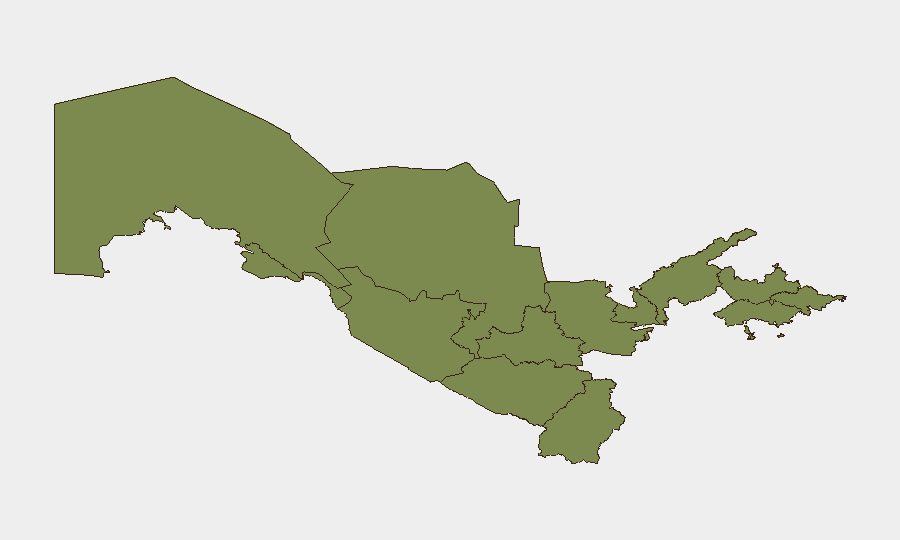
Tashkent city dominates Uzbekistan's risk profile (composite score 31.5), driven primarily by cybercrime activity and cosmopolitan exposure to international criminal networks. All other administrative regions score 1.5, indicating minimal differentiation in risk and absence of localized conflict, unrest, or infrastructure vulnerability. The stark concentration in Tashkent reflects urbanization, internet penetration, and international criminal targeting rather than political instability; regional uniformity suggests no acute geographical polarization or separatist/militant presence.
How GeoBit Would Assist
Teams with personnel or assets in Uzbekistan would employ Intel Sweep and multi-language OSINT to monitor cybercrime networks, financial-sector threats, and cross-border narcotics activity in near real-time. AOI Monitoring & Early Warning on Tashkent, border regions, and critical infrastructure would provide persistent watch and automated alerting for civil unrest, political instability, or security incidents. Network & Actor Analysis would map cybercriminal and trafficking organizations operating across or into Uzbek territory, enabling threat-informed duty-of-care and supply-chain decisions.
7-Day Outlook
No indicators suggest material change in Uzbekistan's security posture over the next 7 days. Cybercrime enforcement and border-control operations are expected to continue as routine functions. Monitoring of Russian–Uzbek bilateral communications and Central Asian regional developments (Afghanistan border stability, energy trade) should remain part of standard risk watch, but absent new conflict or unrest signals, risk trajectory is flat.
Highest-Risk Areas — Ranked
| # | State / Region | Risk |
|---|---|---|
| 1 | Tashkent | 31.5 |
| 2 | Qashqadaryo Region | 1.5 |
| 3 | Surxondaryo Region | 1.5 |
| 4 | Fergana Region | 1.5 |
| 5 | Republic of Karakalpakstan | 1.5 |
| 6 | Xorazm Region | 1.5 |
| 7 | Navoiy Region | 1.5 |
| 8 | Bukhara Region | 1.5 |
| 9 | Jizzakh Region | 1.5 |
| 10 | Tashkent Region | 1.5 |
| 11 | Namangan Region | 1.5 |
| 12 | Sirdaryo Region | 1.5 |
Sources
Previous Daily Briefs
A new Uzbekistan brief is written every day — each with its own risk map and downloadable CSV. Here's the last week; use the calendar to go further back.
📅 Browse every day by calendar →
Highlighted days have a brief. Tap a day for that day's map & analysis, or “csv” for that day's dataset ($5).
Atlas — our AI intelligence desk — emails them this snapshot personally. Nothing else, no list.