Situation Summary
Azerbaijan presents a low composite threat environment (score 7, globally unranked) with no credible reports of armed conflict, large-scale civil unrest, or critical infrastructure failure in the past 24–48 hours. Ongoing political and legal processes—including media trials, activist detention, and prison disciplinary actions—reflect longstanding governance pressures but do not currently translate to street-level instability or travel risk. Planned military exercises and high-level diplomatic engagement (EU–Azerbaijan energy partnership) dominate the current security signal; risk remains concentrated in Baku City, which accounts for the majority of the national composite score.
Key Developments
- Baku Serious Crimes Court (Jul 24–25): Trial of independent media outlet Meydan TV resumed following judicial composition change. Reflects continued legal/political pressure on press freedom; no associated public demonstrations reported, but court proceedings may draw targeted activist presence.
- Azerbaijani Ground Forces Training Areas (Jul 24–25): Ministry of Defense announced large-scale operational exercises involving Ground Forces units across multiple unspecified locations. Planned activity; may involve live-fire, troop movements, and temporary restrictions near training grounds and adjacent airspace.
- Penitentiary Facility No. 17 (Jul 24–25): Trade-union activist Elvin Mustafaev placed in punishment cell and declared hunger strike in protest. Indicates tension in prison conditions for political detainees; no spillover unrest reported.
- Appellate Court, Location Unspecified (Jul 24–25): Court partially granted activist Zamin Zaki's appeal, reducing prison term by three months. Judicial development in political-detention cases; no civil disturbances reported.
- Baku–European Commission Meeting (Jul 24–25): President Aliyev and EC President von der Leyen affirmed EU–Azerbaijan energy, transport, and digital infrastructure partnership. Strategic cooperation announcement; no security incidents around high-level visit reported.
- Cross-Border Electricity Agreement (Jul 24–25): President Aliyev approved agreement formalizing electricity supply and transit to Georgia. Infrastructure trade; no disruptions or sabotage reported.
Highest-Risk Areas
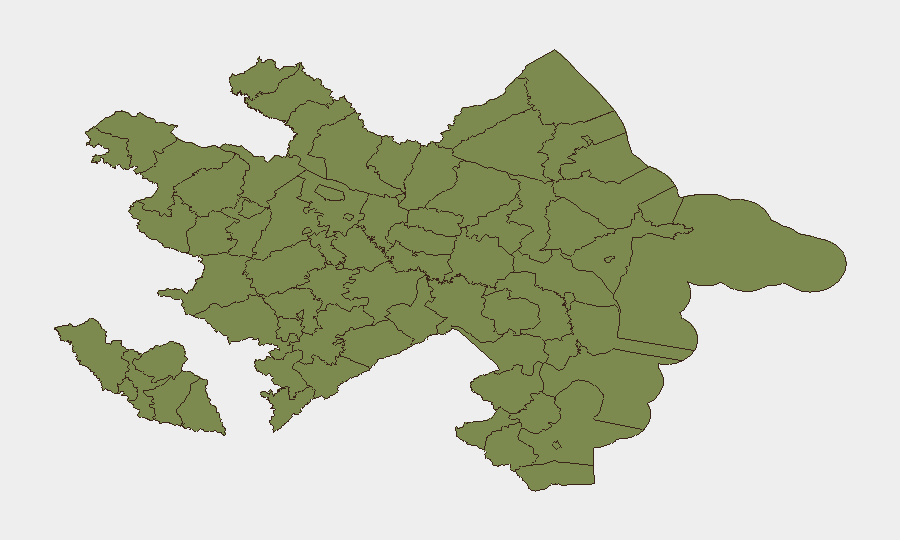
Baku City dominates the risk profile at 7.3 times the national average (31.3 vs. 7), reflecting concentration of political activity, legal proceedings, activist detention, media operations, and diplomatic engagement in the capital. Bilasuvar District ranks second (7.3) but at a distant margin; all remaining sub-national areas score 1.3, indicating relatively uniform low risk outside the capital. Baku's elevated score reflects process risk (trials, protests around courts, activist networks) rather than acute violence or unrest. Travelers and assets in the capital should monitor court hearings and remain aware of potential small-scale activist gatherings; provincial Azerbaijan presents negligible differentiated threat.
How GeoBit Would Assist
Corporate security teams should employ Intel Sweep and multi-language OSINT (Azerbaijani-language hyperlocal channels, Telegram, local media) to detect under-reported incidents and emerging legal/political flashpoints before they escalate to operational impact. AOI Monitoring & Early Warning on key court complexes, detention facilities, and diplomatic venues in Baku would provide persistent visibility into event clustering around high-risk processes. Network & Actor Analysis of activist, media, and opposition networks enables anticipatory positioning and duty-of-care readiness for staff in proximity to sensitive legal or political events.
7-Day Outlook
No major escalation in civil unrest or security incidents is anticipated. Routine military exercises will continue; media trials and activist detention cases will remain focal points for low-level activist attention but are unlikely to generate organized mass protest. Risk trajectory remains stable; monitoring cadence should remain elevated for Baku City but can remain baseline for provincial operations.
Highest-Risk Areas — Ranked
| # | State / Region | Risk |
|---|---|---|
| 1 | Baku City | 31.3 |
| 2 | Bilasuvar District | 7.3 |
| 3 | Sadarak District | 1.3 |
| 4 | Qazakh District | 1.3 |
| 5 | Sharur District | 1.3 |
| 6 | Yevlakh District | 1.3 |
| 7 | Kangarli District | 1.3 |
| 8 | Nakhchivan Autonomous Republic | 1.3 |
| 9 | Aghstafa District | 1.3 |
| 10 | Tovuz District | 1.3 |
| 11 | Qakh District | 1.3 |
| 12 | Shaki | 1.3 |
Sources
Previous Daily Briefs
A new Azerbaijan brief is written every day — each with its own risk map and downloadable CSV. Here's the last week; use the calendar to go further back.
📅 Browse every day by calendar →
Highlighted days have a brief. Tap a day for that day's map & analysis, or “csv” for that day's dataset ($5).
Atlas — our AI intelligence desk — emails them this snapshot personally. Nothing else, no list.