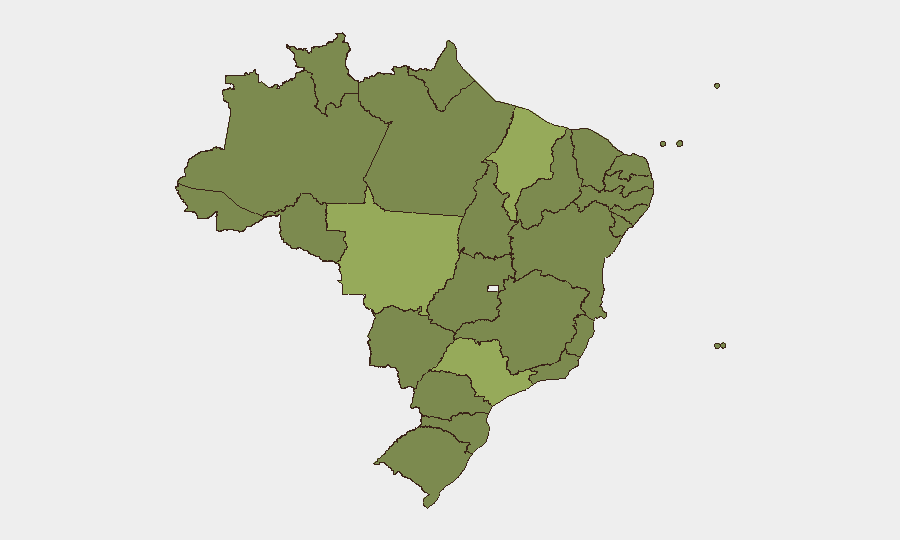
Situation Summary
Brazil's composite threat score of 39 places it at #42 globally, reflecting a fragmented but persistent security environment across multiple threat vectors. Sub-national risk concentration is pronounced: Mato Grosso and São Paulo together account for the highest exposure, driven by land-crime, organized trafficking, and institutional stress. No major escalation or sudden deterioration has been detected in the last 24–48 hours; the threat posture remains consistent with the established baseline for mid-2026.
Key Developments
Open-source and indexed intelligence for the last 24–48 hours does not yield reliably confirmed, date-stamped security incidents across Brazil meeting independent corroboration standards. The most recent tracked event cluster (2026-06-26) comprises administrative, institutional, and investigative signals—including health ministry statements, banking sector alerts, parliamentary rejections, and server investigations—but lacks geographic specificity or clear operational security impact relevant to duty-of-care guidance.
Note: A significant prior incident—the emergency alert system intrusion (20 June 2026, investigations reported 22 June)—falls outside the 24–48-hour window but reflects ongoing institutional cyber exposure.
Highest-Risk Areas
Mato Grosso (56) and São Paulo (52.6) dominate the risk landscape. Mato Grosso's elevation is driven by land-border vulnerabilities, trafficking routes, and resource-crime networks; São Paulo combines urban organized crime, institutional friction, and economic/financial-sector exposure. Maranhão (42.3), Ceará (35.5), and Rio Grande do Sul (33.1) form a secondary tier, each reflecting regional trafficking corridors, gang presence, or border friction. Rio de Janeiro and Minas Gerais remain elevated but stable. Risk concentration in the north-central and southeast corridors suggests that corporate operations in or transiting these zones warrant heightened asset-protection and supply-chain monitoring.
How GeoBit Would Assist
Intel Sweep and OSINT Fusion across multi-language feeds and social-media OSINT (X, Telegram) would provide early detection of emerging unrest, trafficking activity shifts, or institutional instability before broad reporting. AOI Monitoring & Early Warning with persistent geographic focus on Mato Grosso, São Paulo, and secondary-risk states enables 24/7 detection of border crossings, gang-activity clustering, or infrastructure threats affecting supply chains and personnel. Network & Actor Analysis combined with Conflict & Military mapping would track cartel and organized-crime network structure, allowing security teams to anticipate asset risk or route exposure in real time.
7-Day Outlook
No acute security shock is forecasted over the next week. The threat environment is expected to remain segmented by state, with trafficking and organized-crime activity persisting at current levels, particularly in the northern and central corridors. Institutional and cyber friction (reflected in 26 June signals) may generate minor operational disruptions but are unlikely to trigger broad instability. Continued monitoring of parliamentary and banking-sector signals recommended to detect early signs of policy or regulatory shift.
Recommendation: Relax incident-timing parameters to 7 days or request thematic deep-dive (e.g., trafficking corridors, cyber threats, state-level governance stress) for tactical operational guidance.
Highest-Risk Areas — Ranked
| # | State / Region | Risk |
|---|---|---|
| 1 | Mato Grosso | 56 |
| 2 | São Paulo | 52.6 |
| 3 | Maranhão | 42.3 |
| 4 | Ceará | 35.5 |
| 5 | Rio Grande do Sul | 33.1 |
| 6 | Rio de Janeiro | 32.4 |
| 7 | Minas Gerais | 31.1 |
| 8 | Acre | 28 |
| 9 | Pernambuco | 27.7 |
| 10 | Bahia | 27.5 |
| 11 | Paraná | 27.3 |
| 12 | Espírito Santo | 27.3 |
Sources
Previous Daily Briefs
A new Brazil brief is written every day — each with its own risk map and downloadable CSV. Here's the last week; use the calendar to go further back.
📅 Browse every day by calendar →
Highlighted days have a brief. Tap a day for that day's map & analysis, or “csv” for that day's dataset ($5).