Situation Summary
Georgia maintains a composite threat ranking of #92 globally with a score of 18, reflecting moderate overall risk. However, recent violent crime in Tbilisi—including three fatal stabbings and one officer-involved shooting in the past 72 hours—signals a localized spike in street violence involving foreign nationals and cross-border perpetrators. The country's security posture remains stable at the national level, but concentrated criminal activity in the capital and elevated tensions in Russia-adjacent regions (Shida Kartli, Lower Kartli, Abkhazia) warrant targeted monitoring for people and assets in high-risk zones.
Key Developments
- 31 August 2026 – Tbilisi: Russian citizen killed in robbery-motivated homicide. A 37-year-old Russian dolphin trainer, Dmitry Sheremetyev, was stabbed multiple times and robbed in a poorly lit area; a 60-year-old Armenian suspect was detained at the Armenian border. Cross-border criminal investigation ongoing.
- 29–31 August 2026 – Tbilisi: Three fatal stabbings within 72 hours. A Russian arrival was fatally stabbed on Baratashvili ascent (30 Aug); a foreign national was fatally stabbed and struck with blunt object near Baratashvili Square following a Spar convenience-store altercation (28 Aug); an Abkhaz blogger (Daur Buava) was found dead in his apartment with a foreign woman detained on suspicion of abandonment in life-threatening circumstances (28 Aug). All incidents remain under criminal investigation.
- 29 August 2026 – Tbilisi: Officer-involved shooting outside Frozen Paradise Bar and Grill. An off-duty officer fired multiple rounds into a crowd; the shooter (Cashane Cadeem Calder) was subsequently shot by responding officers. Investigation by Georgian authorities ongoing.
- 1 September 2026 – National: Presidential pardon of Russian protest-related offender. President Mikheil Kavelashvili granted a pardon to Denis Kulanin, convicted for damaging an Interior Ministry vehicle during a Tbilisi protest. Decision reflects ongoing political-justice dynamics around protest cases.
- 31 August 2026 – National: Amnesty International statement on pardon program. AI welcomed nine protest-related pardons but called for independent investigation into possible law-enforcement violence during demonstrations and an end to misuse of legal mechanisms against demonstrators.
- 30 August 2026 – Batumi: Animal-rights protest and animal-cruelty investigation. Protesters gathered outside a restaurant demanding deportation of the foreign owner over alleged cruelty toward stray dogs; Georgia's Ministry of Internal Affairs opened a criminal investigation.
Highest-Risk Areas
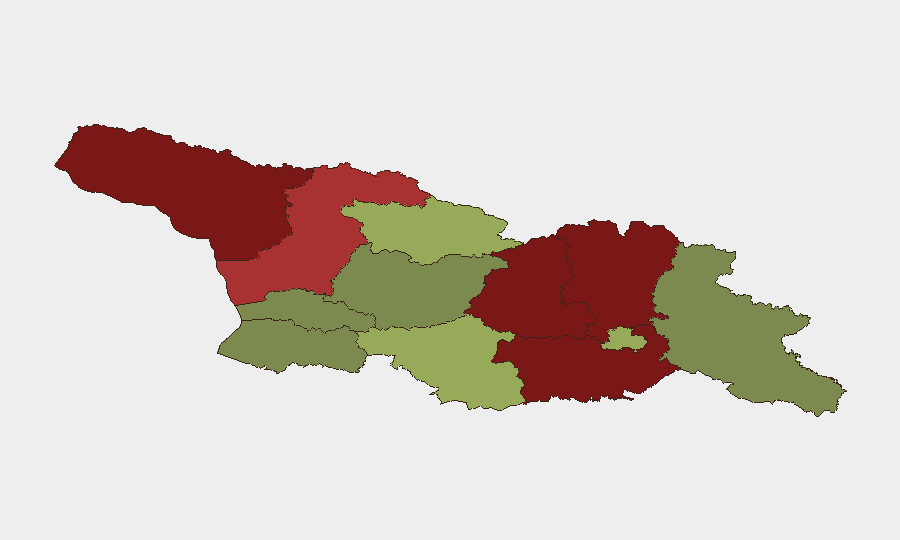
Abkhazia (risk 95), Shida Kartli (88), and Lower Kartli (85) remain the most volatile zones, driven by frozen-conflict dynamics, proximity to Russian military presence, and limited territorial control by Tbilisi. Tbilisi itself ranks #7 (risk 45) but has experienced a sharp tactical surge in street violence and transnational crime in the past 48 hours, suggesting localized criminal networks and transient foreign actors may pose immediate duty-of-care risks to corporate personnel. Samtskhe-Javakheti, Samegrelo-Upper Svaneti, and Mtskheta-Mtianeti (risks 48, 78, 82 respectively) remain elevated due to historical instability and border volatility; lower-risk zones (Imereti, Guria, Adjara) are safer for operations but should not be treated as zero-risk.
How GeoBit Would Assist
Corporate security teams should employ AOI Monitoring & Early Warning to track emerging violence patterns in Tbilisi and border regions (Shida Kartli, Lower Kartli) with near-real-time alerting. Intel Sweep and OSINT fusion across local police reports, Telegram channels, and regional media would detect cross-border perpetrator movements and criminal-network activity before incidents escalate. Routing & Network Analysis can identify safer travel corridors in Tbilisi and contingency evacuation routes in high-risk provinces. Conflict & Military tracking of Russian and breakaway-region force posture provides strategic early warning for geopolitical escalation.
7-Day Outlook
Tbilisi street violence is likely to stabilize once active investigations conclude and suspects are processed, but transient criminal actors and porous border control suggest sporadic repeat incidents. Political tensions around protest handling and pardons may generate localized demonstrations but are unlikely to escalate into citywide unrest. North-facing provinces (Abkhazia, Shida Kartli) warrant continued heightened vigilance for cross-border incidents or military posturing.
Highest-Risk Areas — Ranked
| # | State / Region | Risk |
|---|---|---|
| 1 | Autonomous Republic of Abkhazia | 95 |
| 2 | Shida Kartli | 88 |
| 3 | Lower Kartli | 85 |
| 4 | Mtskheta-Mtianeti | 82 |
| 5 | Samegrelo-Upper Svaneti | 78 |
| 6 | Samtskhe-Javakheti | 48 |
| 7 | Tbilisi | 45 |
| 8 | Racha-Lechkhumi and Kvemo Svaneti | 42 |
| 9 | Kakheti | 38 |
| 10 | Autonomous Republic of Adjara | 35 |
| 11 | Imereti | 32 |
| 12 | Guria | 28 |
Sources
Previous Daily Briefs
A new Georgia brief is written every day — each with its own risk map and downloadable CSV. Here's the last week; use the calendar to go further back.
- August 31, 2026
- August 30, 2026
- August 29, 2026
- August 28, 2026
- August 27, 2026
- August 26, 2026
- August 25, 2026
📅 Browse every day by calendar →
Highlighted days have a brief. Tap a day for that day's map & analysis, or “csv” for that day's dataset ($5).
Atlas — our AI intelligence desk — emails them this snapshot personally. Nothing else, no list.