Situation Summary
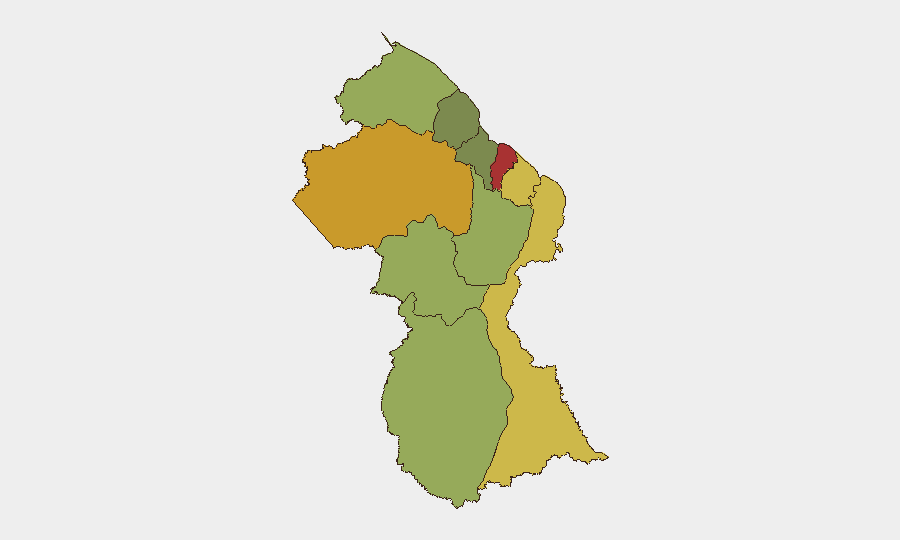
Guyana remains at composite threat rank #70 globally with a moderate security profile. Gold-mining regions and coastal urban centers—particularly Demerara-Mahaica—continue to drive elevated localized risk from informal-economy violence, territorial disputes, and armed robbery. The country faces no state-level instability or organized conflict, but criminal activity in remote interior and peri-urban zones remains a persistent duty-of-care concern for corporate operations and personnel.
Key Developments
- Monica Village, Upper Pomeroon River – 8 July 2026
A gold miner was fatally shot during an altercation at Sands backdam; a security guard was arrested in connection with the incident. This reflects ongoing tension and armed confrontation within Guyana's informal mining sector, where territorial and commercial disputes routinely escalate to lethal force.
- No other confirmed security incidents with precise timestamps in the past 24–48 hours have been corroborated across available open sources. Older incidents, general economic or political commentary, and undated social-media posts do not meet reporting criteria for current threat assessment.
Highest-Risk Areas
Demerara-Mahaica (risk 78) and Cuyuni-Mazaruni (risk 72) are the primary drivers of national composite threat score. Both regions combine informal gold-mining activity, limited law-enforcement presence, and high incidence of armed robbery and inter-gang violence. Demerara-Mahaica, which includes urban Georgetown and its periphery, concentrates commercial crime, kidnapping risk, and urban street violence; Cuyuni-Mazaruni's interior-mining zones are characterized by remote-location vulnerability, limited emergency response, and armed disputes over mining claims. Mahaica-Berbice and East Berbice-Corentyne (risk 65 and 62 respectively) present secondary concern, particularly along border zones and river corridors used for smuggling and informal labor movement.
How GeoBit Would Assist
Security teams managing personnel or assets in Guyana should deploy Intel Sweep and multi-language OSINT to monitor social media, local news, and radio SIGINT for emerging incidents in high-risk mining regions and border areas. AOI Monitoring & Early Warning services enable persistent watch over facilities, transport corridors, and personnel movement in Demerara-Mahaica and interior mining zones, with automated alerting on violence, protest, or roadblock activity. Routing & Network Analysis supports duty-of-care teams in identifying real-time alternative travel routes and safe corridors when primary roads or river passages face disruption or heightened criminal activity.
7-Day Outlook
No major escalation or systemic instability is anticipated. Gold-sector disputes and informal-economy violence will likely persist at baseline levels; seasonal rainfall and continued mining activity may increase remote-area personnel exposure. Coastal and Georgetown operations face standard urban crime risks without indication of heightened organized violence or political flashpoints in the near term.
Highest-Risk Areas — Ranked
| # | State / Region | Risk |
|---|---|---|
| 1 | Demerara-Mahaica | 78 |
| 2 | Cuyuni-Mazaruni | 72 |
| 3 | Mahaica-Berbice | 65 |
| 4 | East Berbice-Corentyne | 62 |
| 5 | Upper Demerara-Berbice | 58 |
| 6 | Potaro-Siparuni | 48 |
| 7 | Barima-Waini | 45 |
| 8 | Upper Takutu-Upper Essequibo | 42 |
| 9 | Pomeroon-Supenaam | 38 |
| 10 | Essequibo Islands | 35 |
Sources
Previous Daily Briefs
A new Guyana brief is written every day — each with its own risk map and downloadable CSV. Here's the last week; use the calendar to go further back.
📅 Browse every day by calendar →
Highlighted days have a brief. Tap a day for that day's map & analysis, or “csv” for that day's dataset ($5).
Atlas — our AI intelligence desk — emails them this snapshot personally. Nothing else, no list.