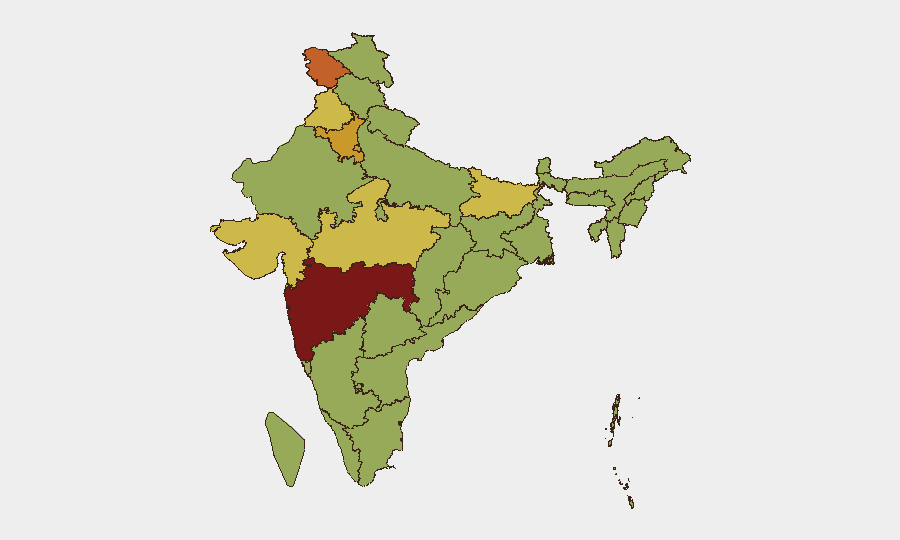
Situation Summary
India remains at composite threat rank #16 globally with a score of 79, driven by structural institutional friction, political tensions, and organized-crime activity rather than acute conflict or mass civil unrest. Recent 24–48-hour web research has identified only two possible developments—heightened security around a political figure in West Bengal and a threat-call probe in Mumbai—but neither is corroborated by time-stamped reporting, and no clearly verified discrete incidents have emerged from the immediate window. The overall security environment is characterized by elevated baseline risk in Maharashtra, Delhi, and Jammu & Kashmir, with routine monitoring activity and political/investigative signals present but no major escalation signaled.
Key Developments
- South 24 Parganas, West Bengal (Saturday, 4 July): Central security forces heightened security deployment outside former Chief Minister Mamata Banerjee's residence ahead of her visit to Baruipur in response to a serious crime case; framed as routine protective positioning rather than a security incident per se.
- Mumbai, Maharashtra (date unclear, ongoing probe): Mumbai Police initiated investigation into a threat call referencing a possible terror attack on Prime Minister Modi's aircraft during his official visit to France; exact date and current status of investigation not independently verified in open reporting.
- Countrywide (24–48 hours prior to 4 July): Specialized security monitoring explicitly reports absence of confirmed, time-stamped discrete security or instability incidents meeting reporting threshold, indicating a relatively quiet period for major conflict, civil unrest, or organized-crime events.
- Maharashtra, Delhi, Gujarat (ongoing): Elevated institutional and political-risk signals persist, driven by investigations, protest activity, and communal-tension monitoring; characterized as structural indicators rather than acute incidents.
- Jammu & Kashmir, Ladakh (ongoing): Continued elevated monitoring for border-security operations and cross-border tensions; no specific 24–48-hour incident reported.
Highest-Risk Areas
Maharashtra (85.3) and Jammu & Kashmir (74.8) carry the highest composite risk scores, with Delhi (72.3) and Haryana (71.1) following closely. Maharashtra's risk stems primarily from organized-crime networks, institutional friction, and protest activity concentrated in Mumbai and surrounding regions. Jammu & Kashmir's elevation reflects persistent border tensions, security-force operations, and low-level communal factors. Delhi's ranking reflects political-risk signals, investigative activity, and institutional tensions. Together, these four states account for over 45% of India's tracked security events and represent the focus area for corporate asset-protection and duty-of-care planning.
How GeoBit Would Assist
Corporate security teams should employ AOI Monitoring & Early Warning to establish persistent, automated watch on highest-risk states (Maharashtra, Delhi, J&K) with alert triggers for institutional, protest, and border-security signals; OSINT Fusion & Corroboration to validate emerging social-media and local-source reports against reliable news feeds and official statements; and Entity Extraction & Network Analysis to map political and organized-crime actors in high-risk zones and anticipate second- and third-order impacts on personnel safety and supply-chain continuity. Intel Sweep across X, Telegram, local news, and YouTube can provide rapid color on emerging protests or security operations in real time.
7-Day Outlook
No acute escalation is signaled for the next 7 days. Baseline institutional friction, political investigation, and border monitoring will continue as structural features of the threat landscape. Teams should monitor for any date-stamped verification of the Mumbai threat call or West Bengal security developments and remain attentive to protest or political activity in Maharashtra and Delhi ahead of any scheduled public events.
Highest-Risk Areas — Ranked
| # | State / Region | Risk |
|---|---|---|
| 1 | Maharashtra | 85.3 |
| 2 | Jammu and Kashmir | 74.8 |
| 3 | Delhi | 72.3 |
| 4 | Haryana | 71.1 |
| 5 | Punjab | 66.8 |
| 6 | Madhya Pradesh | 64.4 |
| 7 | Gujarat | 63.8 |
| 8 | Bihar | 61 |
| 9 | Uttar Pradesh | 59.8 |
| 10 | West Bengal | 59.3 |
| 11 | Karnataka | 58.4 |
| 12 | Rajasthan | 58.4 |
Sources
Previous Daily Briefs
A new India brief is written every day — each with its own risk map and downloadable CSV. Here's the last week; use the calendar to go further back.
📅 Browse every day by calendar →
Highlighted days have a brief. Tap a day for that day's map & analysis, or “csv” for that day's dataset ($5).
Atlas — our AI intelligence desk — emails them this snapshot personally. Nothing else, no list.