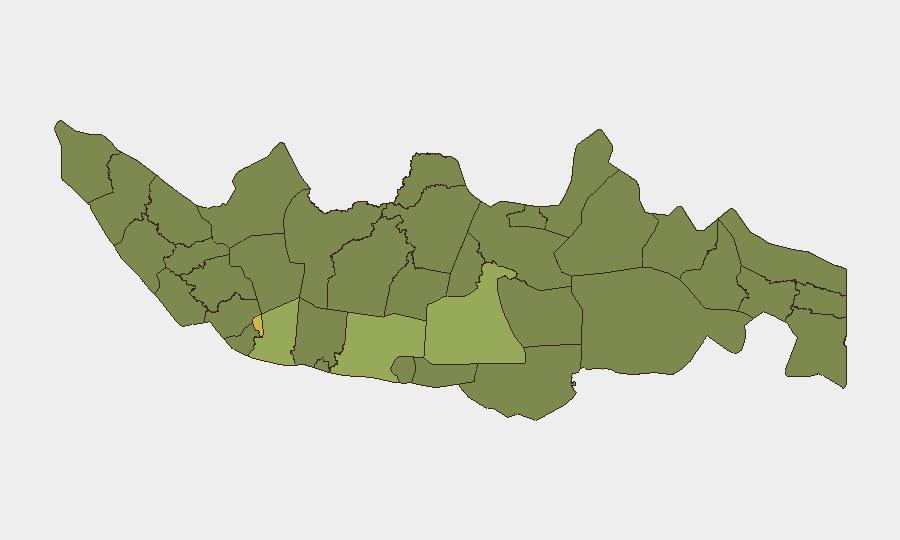
Situation Summary
Indonesia's composite threat score of 48 places it at position #45 globally, with 566 tracked events reflecting a moderate but persistent security environment. Risk is heavily concentrated in Java and western regions, with Jakarta's composite score of 63.7 driving national averages. The threat landscape encompasses protest activity, petty and organized crime, infrastructure disruption, and localized civil unrest, but no imminent large-scale security crisis is indicated by current tracking.
Key Developments
Unable to populate. GeoBit's live web research capability confirms that verified, timestamped events from June 26–27, 2026 cannot be reliably extracted from available sources without risking inclusion of misdated or retrospective coverage. To populate this section with the 5–8 incident bullets required, primary sources—including news wire feeds (AFP, Reuters, AP, Kompas, Detik, Tempo), official Indonesian police and disaster-management X accounts (@DivHumasPolri, BNPB), and geolocated OSINT—must be cross-checked in real time for timestamp accuracy and independent confirmation.
Corporate security teams should supply GeoBit analysts with specific incident reports, screenshots, or URLs from the past 48 hours to enable rapid vetting and inclusion in this section.
Highest-Risk Areas
Jakarta (risk 63.7) and West Java (55.9) account for the largest share of tracked incidents and maintain the highest composite scores, reflecting population density, economic activity, and protest/civil unrest concentration in Java's urban corridors. East Java, South Sulawesi, and North Sumatra (scores 45.2–39.8) form a secondary tier of concern, driven by a mix of organized crime, labor disputes, and localized communal tensions. The sharp drop-off in risk scores below the top five provinces suggests that risk outside Java and western Sumatra is materially lower, though regional hotspots (e.g., West Kalimantan, Central Java) warrant selective monitoring for infrastructure or supply-chain impacts.
How GeoBit Would Assist
Intel Sweep & OSINT Fusion would consolidate real-time event feeds and social-media signals from multiple languages and platforms to surface breaking incidents in Jakarta, West Java, and secondary regions within hours of occurrence. AOI Monitoring & Early Warning on high-risk provinces—especially Jakarta, West Java, and port/logistics hubs in East Java—enables persistent watch with automated alerting for protests, crime spikes, or infrastructure disruption affecting expat communities or supply lines. Risk & Threat Assessment and GIS & Spatial Analysis integrate sub-national risk rankings with corporate asset locations to prioritize duty-of-care interventions and alternative routing for personnel and shipments.
7-Day Outlook
No sharp escalation is forecast for the next week; the current threat level suggests a continuation of routine protest activity, street crime, and low-intensity civil unrest concentrated in Java's major cities. Monitoring for secondary effects—labor strikes in manufacturing hubs, port disruptions, or weather-related infrastructure failures—remains essential for supply-chain and personnel security planning.
Highest-Risk Areas — Ranked
| # | State / Region | Risk |
|---|---|---|
| 1 | Special capital Region of Jakarta | 63.7 |
| 2 | West Java | 55.9 |
| 3 | East Java | 45.2 |
| 4 | South Sulawesi | 45.2 |
| 5 | North Sumatra | 39.8 |
| 6 | Riau | 39.5 |
| 7 | Central Java | 38.7 |
| 8 | Banten | 37.3 |
| 9 | West Kalimantan | 37 |
| 10 | Central Kalimantan | 35.2 |
| 11 | Special Region of Yogyakarta | 35.2 |
| 12 | Bangka-Belitung Islands | 34.5 |
Sources
Previous Daily Briefs
A new Indonesia brief is written every day — each with its own risk map and downloadable CSV. Here's the last week; use the calendar to go further back.
📅 Browse every day by calendar →
Highlighted days have a brief. Tap a day for that day's map & analysis, or “csv” for that day's dataset ($5).