Situation Summary
Mauritania remains a low-frequency, dispersed-threat environment (global rank #132, composite score 7), with no tracked security events in the past 24–48 hours. Drug trafficking and cross-border criminal networks continue as chronic baseline risks, illustrated by recent gendarmerie operations against trafficking cells in Atar (Adrar region, early August) and cocaine seizures at the Guerguerat border crossing (28 July). The country's security posture is shaped by porous desert borders, limited state capacity in remote regions, and persistent transnational organized crime rather than acute political instability or active armed conflict in the present cycle.
Key Developments
- No confirmed security incidents in the last 24–48 hours. Live web research did not verify distinct operational security events (robbery, assault, kidnapping, armed clash, or terrorist activity) within the requested window. Weather reporting (rainfall across Adrar, Tagant, Inchiri, and Nouakchott districts on 10 August) is relevant to travel logistics but does not constitute a security incident.
- Drug-trafficking network dismantled in Atar, Adrar region (early August, date unconfirmed). Mauritanian gendarmerie arrested 13 individuals across two networks; no details on scale, nationality of suspects, or routes disrupted are yet available. This reflects ongoing enforcement against a baseline criminal pressure that has persisted since at least July.
- Diplomatic effort for detained Mauritanian citizens in Mali (context: 4–8 August). Mauritanian authorities negotiated the release of 21 citizens held near Kati; this cross-border detention issue underscores the region's instability and mobility risks for nationals, but falls outside the last 48 hours and does not directly threaten Mauritania's territory.
Highest-Risk Areas
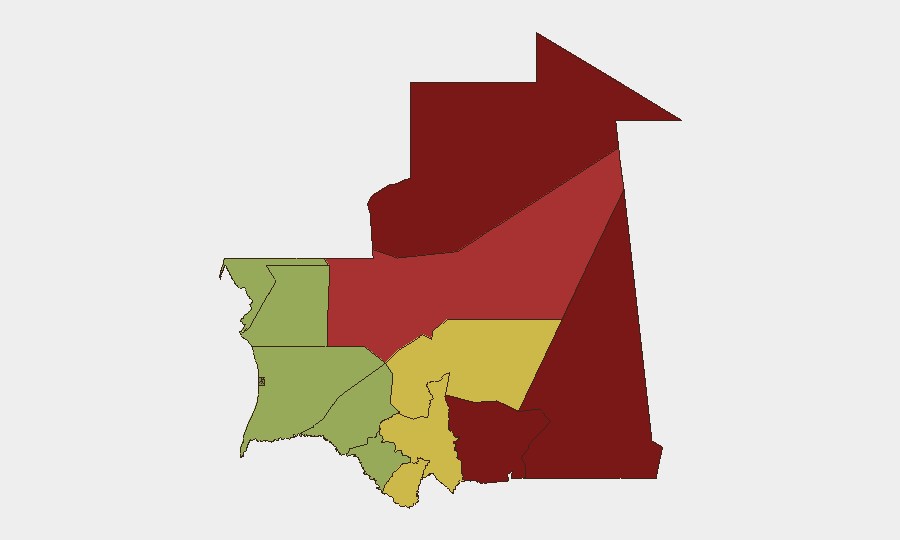
Tiris Zemmour (risk 95), Hodh Ech Chargui (85), and Hodh El Gharbi (80) dominate the sub-national ranking and reflect the country's eastern and southeastern exposure to transnational crime, militant infiltration, and state-capacity gaps. Adrar (78) and Tagant (68) follow, driven by smuggling corridors and remote terrain. These five regions form an arc of chronic undersecurity spanning the Algerian, Malian, and Western Saharan borders; criminal and extremist networks exploit weak customs enforcement and minimal police presence. Southern and coastal regions (Gorgol, Trarza, Brakna, Dakhlet Nouadhibou) carry moderate but measurable risk tied to trafficking and maritime piracy spillover. The capital and immediate surroundings (not separately ranked) remain the safest zones, though petty crime and opportunistic robbery are routine.
How GeoBit Would Assist
Organizations with personnel or assets in Mauritania should employ AOI Monitoring & Early Warning on high-risk regions (Tiris Zemmour, eastern Hodh zones, Adrar) to detect shifts in trafficking activity, militant movement, or cross-border incidents before they impact operations. Intel Sweep (global event feeds, X/Twitter OSINT, multi-language search) provides real-time detection of criminal network arrests, border disruptions, and security-sector developments. Routing & Network Analysis enables alternative journey planning around known trafficking chokepoints and bandit-prone corridors, while GIS & Spatial Analysis contextualizes risk hotspots against facility locations and personnel movement patterns.
7-Day Outlook
No acute escalation is anticipated. Drug-trafficking enforcement will likely continue at a low operational tempo, with sporadic arrests in border and transit zones. Personnel security risks remain diffuse (petty theft, robbery) rather than targeted; organized kidnapping and militant activity remain marginal. Operational planning should assume baseline transnational crime and porous borders as the primary threat drivers over the coming week.
Highest-Risk Areas — Ranked
| # | State / Region | Risk |
|---|---|---|
| 1 | Tiris Zemmour | 95 |
| 2 | Hodh Ech Chargui | 85 |
| 3 | Hodh El Gharbi | 80 |
| 4 | Adrar | 78 |
| 5 | Tagant | 68 |
| 6 | Guidimaka | 65 |
| 7 | Assaba | 62 |
| 8 | Gorgol | 58 |
| 9 | Trarza | 55 |
| 10 | Inchiri | 52 |
| 11 | Brakna | 48 |
| 12 | Dakhlet Nouadhibou | 45 |
Sources
Previous Daily Briefs
A new Mauritania brief is written every day — each with its own risk map and downloadable CSV. Here's the last week; use the calendar to go further back.
📅 Browse every day by calendar →
Highlighted days have a brief. Tap a day for that day's map & analysis, or “csv” for that day's dataset ($5).
Atlas — our AI intelligence desk — emails them this snapshot personally. Nothing else, no list.