Situation Summary
Moldova faces a converging hybrid threat environment spanning drone incursions, critical cyberattacks against government systems, and alleged destabilization plots. Over the past week, attackers compromised national digital infrastructure affecting millions of records, while Russian unmanned aerial vehicles repeatedly crossed Moldovan airspace during operations against Ukraine. The country's air-defense gaps and cybersecurity vulnerabilities have moved into urgent focus, driving bilateral cooperation with Ukraine and government resource allocation.
Key Developments
- 22 October — National digital-government systems: Cyberattackers generated approximately 11 million access requests against public online services, prompting authorities to disconnect affected platforms and escalate to police and data-protection authorities.
- 19–23 October — Government databases: Investigators documented queries of roughly one million national identification numbers; approximately 750,000 people may have had personal identification, family, benefits, pension, and potentially financial data exposed.
- 22–25 October — Business permit and application services: Multiple digital platforms for permit submission and issuance experienced cybersecurity disruptions; restoration was completed by 26 October.
- 23 October — Chistelnita village, Telenesti District: A drone crossed Moldovan airspace and crashed approximately 100 meters from a residence; police secured the area with no reported casualties.
- 24 October — National airspace assessment: Defence Minister Anatolie Nosatîi acknowledged that Soviet-era radar systems cannot reliably detect low-flying drones and that Moldova lacks comprehensive airspace-monitoring coverage.
- 24 October — Chișinău: Authorities disrupted an alleged destabilization operation planned for 25 October involving fake social-media recruitment (TikTok, Facebook, Telegram) and preparations for mass disorder and property damage.
- 26 October — Kyiv–Chișinău security cooperation: Moldova and Ukraine signed a military-technical cooperation agreement with emphasis on air-defense coordination following repeated drone transits.
- 27 October — Cybersecurity priority announcement: The government reaffirmed cybersecurity as a national priority amid escalating hybrid threats.
Highest-Risk Areas
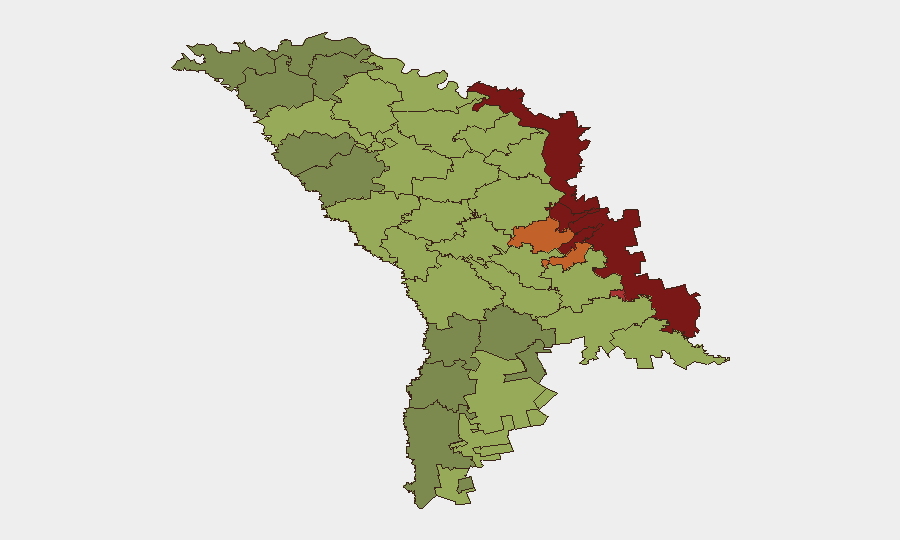
The Left Bank of the Dniester (risk 85), Dubăsari (82), and Bender (79) dominate the sub-national ranking—all located along or adjacent to the contested transnistrian border zone and the Ukrainian frontier. These areas face compounded exposure to drone activity, Russian-backed armed groups, and cross-border instability. Secondary risk concentrations in Criuleni, Rezina, and Taraclia reflect proximity to active conflict zones and airspace corridors. Even the capital, Chișinău (risk 49), registers elevated threat from cyber operations and alleged destabilization plots targeting urban order.
How GeoBit Would Assist
Security and risk teams monitoring Moldova should deploy AOI Monitoring & Early Warning capabilities on high-risk border districts and urban centers to track drone incursions, military movement, and civil unrest in real time. Intelligence & OSINT functions—including Telegram, social-media sentiment analysis, and multi-language search—enable early detection of recruitment campaigns and destabilization narratives before they mobilize. Network & Actor Analysis and cyber threat assessment would isolate attacker infrastructure and correlate the recent waves of government-system compromise with known adversary groups, informing protective measures for corporate digital assets and personnel data.
7-Day Outlook
Drone incursions will likely persist as Russian operations against Ukraine continue, with low-flying systems exploiting known air-defense blind spots. Cybersecurity incidents targeting government databases and business platforms appear to reflect sustained targeting of Moldovan state and commercial infrastructure, suggesting follow-on attacks should be anticipated. The disrupted 25 October destabilization plot indicates active adversary efforts to exploit civil unrest; heightened vigilance around public gatherings and social-media coordination is warranted.
Highest-Risk Areas — Ranked
| # | State / Region | Risk |
|---|---|---|
| 1 | Administrative-Territorial Units of the Left Bank of the Dniester | 85 |
| 2 | Dubăsari | 82 |
| 3 | Bender | 79 |
| 4 | Criuleni | 75 |
| 5 | Rezina | 58 |
| 6 | Taraclia | 55 |
| 7 | Gagauzia | 54 |
| 8 | Căușeni | 53 |
| 9 | Soroca | 52 |
| 10 | Ștefan Vodă | 51 |
| 11 | Orhei | 50 |
| 12 | Chișinău | 49 |
Sources
Previous Weekly Briefs
A new Moldova brief is written every Monday, covering the week — each with its own risk map and downloadable CSV. Use the calendar to go further back.
- October 20, 2026
- October 13, 2026
- October 6, 2026
- September 29, 2026
- September 22, 2026
- September 15, 2026
- September 8, 2026
📅 Browse past briefs by calendar →
Highlighted days have a brief. Tap a day for that day's map & analysis, or “csv” for that day's dataset ($5).
Atlas — our AI intelligence desk — emails them this snapshot personally. Nothing else, no list.