Situation Summary
Slovakia remains a low-threat environment globally (rank #129), but internal security pressures have intensified following two serious incidents involving violence against minors in educational settings. Police have responded with nationwide school-perimeter patrols and selective bag checks, while prosecutorial oversight of law-enforcement procedures has also come under scrutiny. Eastern regions—Košice and Prešov—carry substantially elevated risk profiles relative to the national average, driven by historical crime and socioeconomic factors. The security posture is stable but reactive rather than anticipatory at present.
Key Developments
- Nationwide Slovakia — 12 October: National police announced expanded patrols and security checks around schools, including discretionary backpack inspections, following recent school violence incidents in Slovakia and neighboring Poland.
- Staškov, northern Slovakia — October 1 (death); attack date unverified: A 13-year-old student injured in a September 29 stabbing attack at Staškov elementary school died from injuries on October 1, marking the second fatality from recent school violence. The exact timing of the original incident remains unconfirmed in available sources.
- Celadice, Nitra Region — 12 October: Slovakia's prosecutor-general publicly stated that law-enforcement authorities violated proper legal procedure in handling a criminal case involving axe-related threats made outside a primary school, signaling internal accountability gaps.
- Banská Bystrica, Faculty of Health Sciences — week of 5–12 October: Slovak and Czech police jointly conducted a full-scale active-shooter exercise, including tactical response, casualty treatment, and evacuation protocols, reflecting regional preparedness coordination.
- Bratislava–Moscow — 9–12 October: Slovakia confirmed restoration of military-attaché diplomatic contacts with Russia after a four-year suspension; two Slovak military officers were deployed to Moscow and a Russian attaché is expected in Bratislava, representing a significant geopolitical shift in bilateral military engagement.
- Bratislava — 7 October: Slovakia's Security Council convened amid public debate over threat reporting delays and institutional security-response protocols; broader scrutiny of state security coordination is ongoing.
Highest-Risk Areas
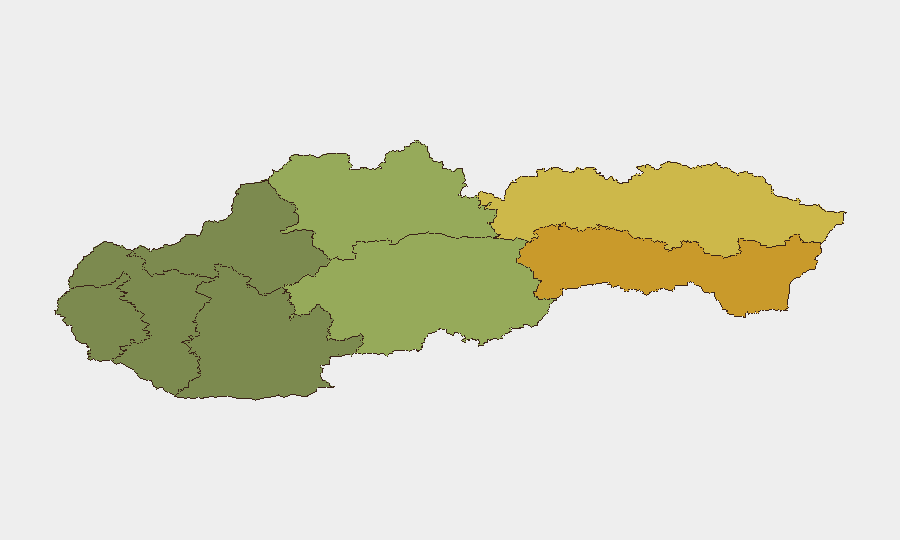
The Košice Region (risk 72) and Prešov Region (risk 68) collectively drive the national risk profile, with composite scores roughly five times higher than western regions. These eastern areas face entrenched organized-crime networks, higher rates of interpersonal violence, and socioeconomic drivers that correlate with property and personal-security incidents. Banská Bystrica (risk 55) occupies a middle tier. By contrast, Bratislava, Trenčín, and Trnava carry minimal risk scores (18–28), reflecting urban governance capacity and lower crime prevalence in the west. Corporate and expatriate populations concentrated in Bratislava face lower ambient threat but should remain aware of the regional disparity.
How GeoBit Would Assist
Security teams managing personnel or assets in Slovakia should employ Intel Sweep and multi-language OSINT to track school-safety incidents and police policy changes in real time, and AOI Monitoring & Early Warning with persistent watch on eastern high-risk regions (Košice, Prešov) to detect emerging crime or civil unrest. Risk & Threat Assessment combined with Network & Actor Analysis would provide early detection of organized-crime activity or violence clusters before they escalate to corporate-affecting incidents. Routing & Network Analysis supports duty-of-care duty by identifying safer transit corridors, particularly for personnel traveling between Bratislava and eastern Slovakia.
7-Day Outlook
School-security measures will likely remain elevated through October and into November as authorities assess the effectiveness of patrols and public confidence stabilizes. Military-diplomatic normalization with Russia may prompt secondary security-policy reviews but does not materially alter near-term civilian risk. Eastern regions will continue to require elevated monitoring posture.
Highest-Risk Areas — Ranked
| # | State / Region | Risk |
|---|---|---|
| 1 | Region of Košice | 72 |
| 2 | Region of Prešov | 68 |
| 3 | Region of Banská Bystrica | 55 |
| 4 | Region of Žilina | 42 |
| 5 | Region of Nitra | 35 |
| 6 | Region of Bratislava | 28 |
| 7 | Region of Trenčín | 22 |
| 8 | Region of Trnava | 18 |
Sources
Previous Weekly Briefs
A new Slovakia brief is written every Monday, covering the week — each with its own risk map and downloadable CSV. Use the calendar to go further back.
- October 5, 2026
- September 28, 2026
- September 21, 2026
- September 14, 2026
- September 7, 2026
- September 1, 2026
- August 30, 2026
📅 Browse past briefs by calendar →
Highlighted days have a brief. Tap a day for that day's map & analysis, or “csv” for that day's dataset ($5).
Atlas — our AI intelligence desk — emails them this snapshot personally. Nothing else, no list.