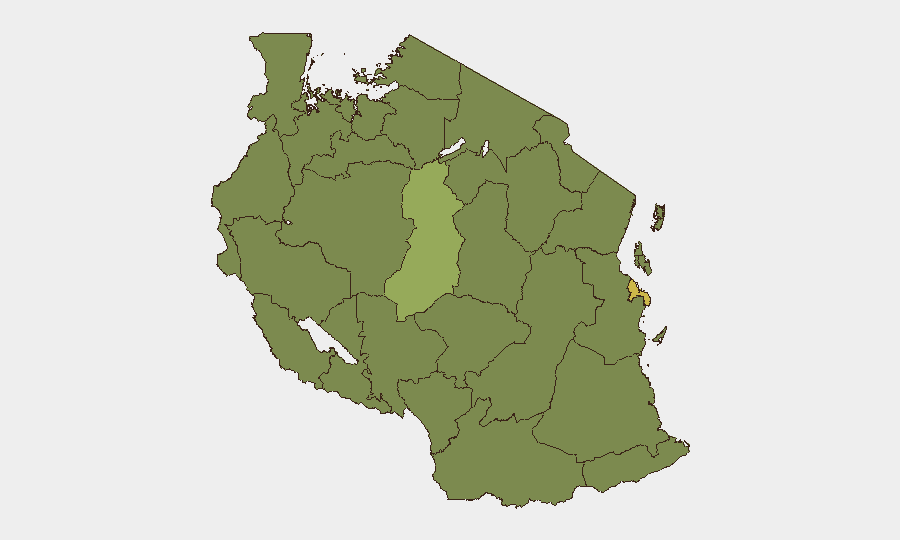
Situation Summary
Tanzania remains at moderate overall threat level (#47 globally) but faces a highly securitized political environment following suppressed pro-democracy protests on July 7, 2026. Dar es-Salaam accounts for the majority of tracked risk (61.8 composite score), driven by heavy police and military deployments, restricted assembly rights, and digital surveillance of protest mobilization. No major violence or infrastructure disruption occurred during the most recent protest cycle, but the security posture indicates elevated sensitivity to opposition activity and potential for rapid police response to any renewed demonstrations.
Key Developments
- Dar es-Salaam (central districts) – July 7, 2026: Security forces blocked opposition-organized pro-democracy marches demanding constitutional reforms and the release of jailed opposition leader Tundu Lissu. Authorities maintained a "zero-tolerance" stance, using heavy deployments as a deterrent rather than responding to active violence.
- Dar es-Salaam (citywide) – July 7, 2026: Police and military personnel conducted heightened deployments across central Dar es-Salaam to prevent planned protests linked to the July 7 anniversary. Security remained on high alert but no mass demonstrations materialized.
- Dar es-Salaam (Saba Saba Trade Fair, Mwalimu Nyerere Fairgrounds) – July 7, 2026: The annual trade fair continued under heavy police and military protection, with controlled access and crowd monitoring. The conspicuous security presence indicates elevated risk for gatherings and transit around the venue.
- Kilimanjaro Region (nationwide messaging) – July 7, 2026: Regional police issued public reassurances that security was "stable" and urged residents to disregard online protest calls, signaling official concern over potential unrest despite the absence of demonstrations.
- Nationwide (digital sphere) – July 7–8, 2026: Authorities monitored and publicly criticized online mobilization calls for protests. The Home Affairs Minister reiterated that citizens could not "dictate protest dates," signaling readiness to counter perceived threats to public order through both physical and digital means.
- Countrywide political environment – July 7–8, 2026: Rights organizations and regional observers documented ongoing restrictions on freedom of assembly and warned that renewed protest attempts will likely face similarly forceful police responses, elevating travel risk around political gatherings in major urban centers.
Highest-Risk Areas
Dar es-Salaam drives Tanzania's risk profile, with a composite score of 61.8—significantly higher than all other regions. The city's status as the commercial capital, combined with its role as the center of opposition activity and heavy security deployments, creates the primary threat vector. Singida Region (41.8) is the second-highest risk area; the remaining ten tracked regions cluster at 31.8, suggesting a secondary tier of concern including the border regions of Kigoma, Kagera, and Mwanza, where cross-border movement and smuggling-related crime may contribute to elevated scores.
How GeoBit Would Assist
Security teams should deploy AOI Monitoring & Early Warning capabilities to track Dar es-Salaam and opposition-sensitive zones for changes in police posture, gatherings, or digital mobilization signals. Intel Sweep and OSINT fusion (X/Twitter, Telegram, social media sentiment analysis) enable early detection of protest calls and online organizing, while Network & Actor Analysis identifies key opposition figures and their communication patterns. Routing & Network Analysis supports alternative journey planning for personnel around high-risk commercial and government districts during politically sensitive periods.
7-Day Outlook
The security environment is likely to remain constrained but stable in the near term, with police maintaining elevated deployments in Dar es-Salaam and key urban centers through the end of the week. Any spontaneous or organized opposition activity will likely face rapid police intervention. Continued monitoring of social media and opposition messaging is critical to detect early signals of renewed protest activity.
Highest-Risk Areas — Ranked
| # | State / Region | Risk |
|---|---|---|
| 1 | Dar es-Salaam | 61.8 |
| 2 | Singida Region | 41.8 |
| 3 | Kigoma Region | 31.8 |
| 4 | Kagera | 31.8 |
| 5 | Mwanza Region | 31.8 |
| 6 | Geita | 31.8 |
| 7 | Shinyanga Region | 31.8 |
| 8 | Tabora Region | 31.8 |
| 9 | Katavi Region | 31.8 |
| 10 | Rukwa Region | 31.8 |
| 11 | Songwe Region | 31.8 |
| 12 | Mara Region | 31.8 |
Sources
Previous Daily Briefs
A new Tanzania brief is written every day — each with its own risk map and downloadable CSV. Here's the last week; use the calendar to go further back.
📅 Browse every day by calendar →
Highlighted days have a brief. Tap a day for that day's map & analysis, or “csv” for that day's dataset ($5).
Atlas — our AI intelligence desk — emails them this snapshot personally. Nothing else, no list.