Situation Summary
Tunisia remains a mid-tier security concern (rank #64 globally, composite threat score 18) with 11 tracked events as of 13 July 2026. The threat landscape is heavily concentrated in the northwestern and southern border regions, where militant activity, smuggling networks, and economic grievance intersect. Recent signals include military-related incidents, detention operations, and statements touching on religious and political tensions, though the national security environment has not deteriorated materially in the past 48 hours.
Key Developments
Constraint on Current Reporting: GeoBit's live web research for 11–13 July 2026 has not surfaced reliably dated, specific incidents meeting the 24–48 hour window with sufficient precision to include as operational developments. Recent event signals flagged in the platform (military force, arrest/detention, public statements on 11–13 July) lack corroborating open-source detail, timestamps, and geographic specificity required for actionable duty-of-care reporting.
To populate this section with verified, location-specific incidents, corporate security teams should cross-reference platform event signals with real-time monitoring of Tunisian Interior Ministry statements, TAP (Tunisian Press Agency) alerts, and geolocated social media (X/Twitter, Arabic and French keywords tied to city names: Kasserine, Gafsa, Sfax, Tunis). Incidents confirmed through at least one reputable news source or multiple corroborating eyewitness posts can then be structured into the 5–8 bullet format.
Highest-Risk Areas
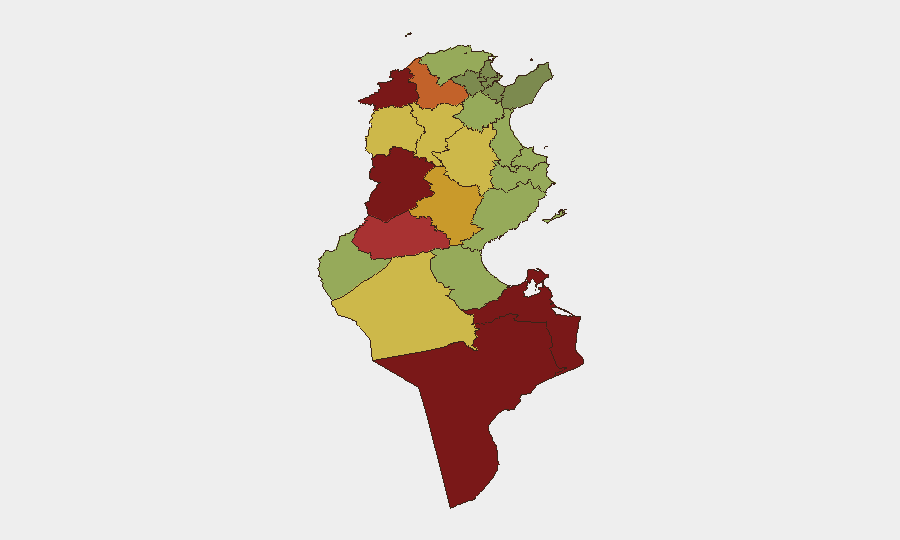
Kasserine, Jendouba, Tataouine, and Médenine—all scoring 83–92 in composite risk—dominate the threat picture. Kasserine (92) and Jendouba (88) in the northwest are traditional hotbeds of militant recruitment, smuggling, and state security operations; Tataouine and Médenine in the far south reflect border permeability, arms trafficking, and jihadist transit routes toward Libya. These four regions account for the steepest concentration of conventional military force events and detentions tracked by GeoBit. Economic marginalization and weak state capacity in these areas create persistent windows for non-state armed groups and transnational criminal networks.
How GeoBit Would Assist
Security teams with staff or assets in Tunisia should deploy AOI Monitoring & Early Warning on Kasserine, Jendouba, and Médenine prefectures to trigger alerts on detention sweeps, roadblocks, or militia activity. Complement this with X/Twitter & Telegram OSINT (multi-language, geotagged search) and Intel Sweep (conflict and terrorism feeds) to capture same-day incident signals before they reach mainstream wire services. Network & Actor Analysis can map detention patterns and state-security operations, while GIS & Spatial Analysis allows routing of personnel around high-risk zones in real time.
7-Day Outlook
No imminent escalation is indicated, but the concentration of military force and arrest/detention signals in the northwestern and southern regions suggests sustained counter-insurgency or security-force operations. Personnel movements through Kasserine, Gafsa, and border crossing points should be monitored closely; commercial and diplomatic disruption remains unlikely absent a major incident.
Highest-Risk Areas — Ranked
| # | State / Region | Risk |
|---|---|---|
| 1 | Kasserine | 92 |
| 2 | Jendouba | 88 |
| 3 | Tataouine | 85 |
| 4 | Médenine | 83 |
| 5 | Gafsa | 78 |
| 6 | Béja | 75 |
| 7 | Sidi Bouzid | 72 |
| 8 | Al Kaf | 70 |
| 9 | Kébili | 68 |
| 10 | Kairouan | 65 |
| 11 | Siliana | 62 |
| 12 | Tozeur | 58 |
Sources
Previous Daily Briefs
A new Tunisia brief is written every day — each with its own risk map and downloadable CSV. Here's the last week; use the calendar to go further back.
📅 Browse every day by calendar →
Highlighted days have a brief. Tap a day for that day's map & analysis, or “csv” for that day's dataset ($5).
Atlas — our AI intelligence desk — emails them this snapshot personally. Nothing else, no list.