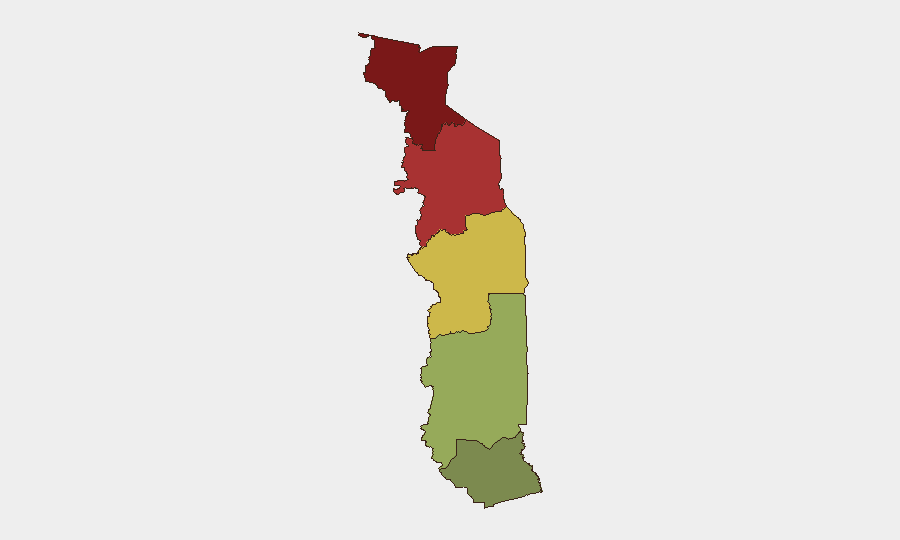
Situation Summary
Togo remains a low-threat environment globally (composite threat score 20; #94 world ranking) with no tracked security incidents in the past week. The country's security posture is being actively reinforced through governance measures—notably a Council of Ministers approval on 6 October for tightened explosives and chemical-agent controls—and through institutional capacity-building in maritime security and civil protection. Risk remains heavily concentrated in the northern Savanes and Kara regions, where composite threat scores (92 and 78 respectively) far exceed the national average and reflect the lingering effects of regional instability since 2021.
Key Developments
- Nationwide (6 October, reported during week): The Council of Ministers approved a legislative bill to strengthen controls over explosives, chemical agents, and other sensitive substances. The Defense Ministry will assume a coordinating role alongside ANIAC-Togo; the measure is aimed at preventing diversion for improvised explosive devices.
- Lomé and other cities (6–8 October): The National Police conducted a public-facing proximity-policing initiative, opening facilities to strengthen community cooperation and collective vigilance.
- Lomé (presidential diplomacy, 9–12 October): During President Faure Gnassingbé's visit to China, officials discussed maritime security cooperation, port-logistics enhancement, specialist training, and blue-economy initiatives—signaling diplomatic focus on securing Togo's maritime domain.
- National civil-protection system (reported 12 October): A connected national situation room was established to integrate disaster-risk information, improve early-warning systems, and strengthen interoperability with ECOWAS and African Union coordination mechanisms.
Highest-Risk Areas
The Savanes Region (risk score 92) and Kara Region (risk score 78) drive the vast majority of Togo's security threat profile, together accounting for more than half the country's composite risk. Both regions border Burkina Faso and remain affected by spillover from jihadist activity and armed-group presence that has persisted in the Sahel since 2021. The Centrale, Plateaux, and Maritime regions show progressively lower risk; Lomé and the Maritime Region, where most foreign nationals and international business activity concentrate, carry substantially lower threat levels (28) and remain the most secure operational zones for corporate activity.
How GeoBit Would Assist
Organizations with personnel or assets in Togo should employ AOI Monitoring & Early Warning on the Savanes and Kara regions to detect cross-border incursions or militant activity before they affect national security. Intelligence & OSINT (particularly multi-language event feeds and entity extraction) and Network & Actor Analysis enable continuous tracking of armed groups and governance actors influencing stability. Routing & Network Analysis supports safe-passage planning for personnel moving between Lomé and other regions, while GIS & Spatial Analysis and Satellite & Imagery analysis can validate persistent conditions in high-risk northern areas and support duty-of-care reporting.
7-Day Outlook
Togo's security trajectory remains stable over the near term, with no indicators of imminent escalation in the Maritime or central regions where most corporate activity occurs. Northern regions will continue to require elevated monitoring given cross-border Sahel dynamics, but the government's recent moves to strengthen explosives control and disaster-response capacity suggest incremental institutional strengthening. No major political or security events are signaled for the coming week.
Highest-Risk Areas — Ranked
| # | State / Region | Risk |
|---|---|---|
| 1 | Savanes Region | 92 |
| 2 | Kara Region | 78 |
| 3 | Centrale Region | 65 |
| 4 | Plateaux Region | 45 |
| 5 | Maritime Region | 28 |
Sources
Previous Weekly Briefs
A new Togo brief is written every Monday, covering the week — each with its own risk map and downloadable CSV. Use the calendar to go further back.
- October 6, 2026
- September 29, 2026
- September 22, 2026
- September 15, 2026
- September 8, 2026
- September 2, 2026
- August 31, 2026
📅 Browse past briefs by calendar →
Highlighted days have a brief. Tap a day for that day's map & analysis, or “csv” for that day's dataset ($5).
Atlas — our AI intelligence desk — emails them this snapshot personally. Nothing else, no list.