Situation Summary
Togo remains a low-threat environment globally (rank #93, composite score 20) with no discrete security incidents recorded in the past seven days. The country's primary vulnerability lies in its northern regions—Savanes, Kara, and Centrale—where recurring spillover from regional militant activity and cross-border trafficking create persistent but contained risk. National authorities are emphasizing security resilience and counterterrorism messaging ahead of the approaching transition season.
Key Developments
- Lomé, September 23: Togolese authorities held a 40th-anniversary commemoration of the 1986 armed attack on the capital, featuring official tributes to victims and commendations for defense and security personnel at Camp Général Gnassingbé Eyadéma. The ceremony framed national security as a continuity narrative.
- Lomé, September 23: Foreign Minister Robert Dussey publicly denied allegations of Russian private military (Africa Corps/Wagner-linked) deployment in Togo, while acknowledging the presence of Russian military trainers involved in equipment instruction. This clarification suggests external pressure or misreporting on foreign force posture.
- Multiple prefectures, September 23: Memorial ceremonies linked to the 1986 attack were conducted across several localities beyond the capital, characterized by officials as demonstrations of national resilience against current terrorism threats. The nationwide scope indicates coordinated messaging around security legitimacy.
- Lomé, September 17–23 (reported this week): A senior figure identified as Luc Beyam, reportedly connected to a Chadian armed movement, was detained in Lomé following a hotel complaint regarding an unpaid bill. The detention began September 17 and was reported during the current week; the security relevance to Togo's threat profile remains unclear pending further reporting.
Highest-Risk Areas
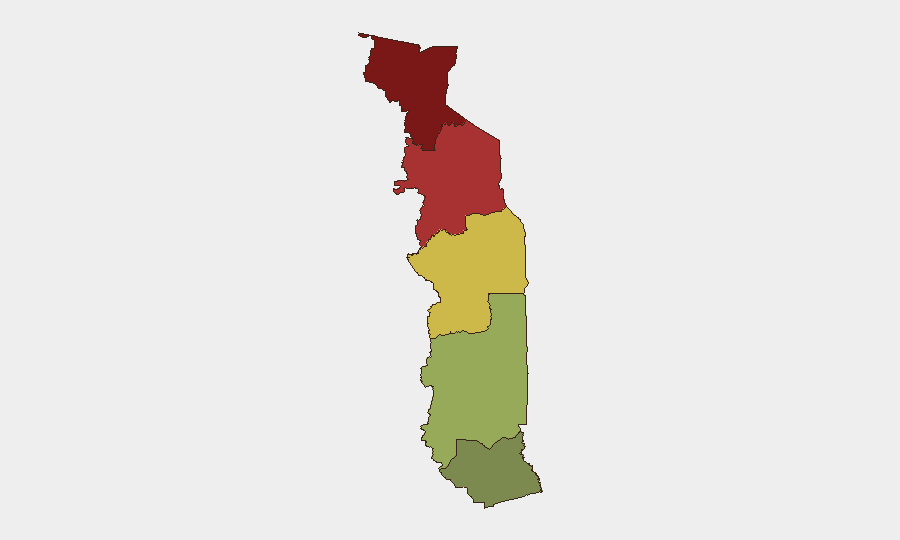
Savanes Region (risk 92) and Kara Region (risk 78) dominate Togo's sub-national threat landscape, driven by proximity to militant activity in Burkina Faso and Mali, porous border control, and trafficking networks. Centrale Region (risk 65) represents a secondary concentration point along overland transit corridors. Maritime and Plateaux regions carry substantially lower risk profiles, concentrating vulnerability in the north and reflecting the country's exposure to regional instability rather than domestic political fracture or criminal consolidation in urban centers.
How GeoBit Would Assist
Corporate security teams operating in Togo would employ AOI Monitoring & Early Warning to maintain persistent watch over Savanes and Kara regions for cross-border militant movement, coupled with OSINT fusion and multi-language search to detect emerging recruitment, trafficking, or weapons-movement signals in local media and social platforms. Routing & Network Analysis capabilities support duty-of-care planning for personnel transiting northern zones, while satellite and imagery analysis can corroborate border activity patterns and validate risk assessments on specific transportation corridors or operational sites.
7-Day Outlook
No discrete security incidents are anticipated in the immediate term. The emphasis on official security messaging and foreign-force clarification suggests authorities are managing reputational and operational narratives rather than responding to acute threat escalation. Monitoring should focus on northern cross-border dynamics and any shifts in regional militant activity in neighboring states, as Togo's security posture remains reactive to exogenous pressures.
Highest-Risk Areas — Ranked
| # | State / Region | Risk |
|---|---|---|
| 1 | Savanes Region | 92 |
| 2 | Kara Region | 78 |
| 3 | Centrale Region | 65 |
| 4 | Plateaux Region | 45 |
| 5 | Maritime Region | 28 |
Sources
Previous Weekly Briefs
A new Togo brief is written every Monday, covering the week — each with its own risk map and downloadable CSV. Use the calendar to go further back.
- September 22, 2026
- September 15, 2026
- September 8, 2026
- September 2, 2026
- August 31, 2026
- August 29, 2026
- August 27, 2026
📅 Browse past briefs by calendar →
Highlighted days have a brief. Tap a day for that day's map & analysis, or “csv” for that day's dataset ($5).
Atlas — our AI intelligence desk — emails them this snapshot personally. Nothing else, no list.