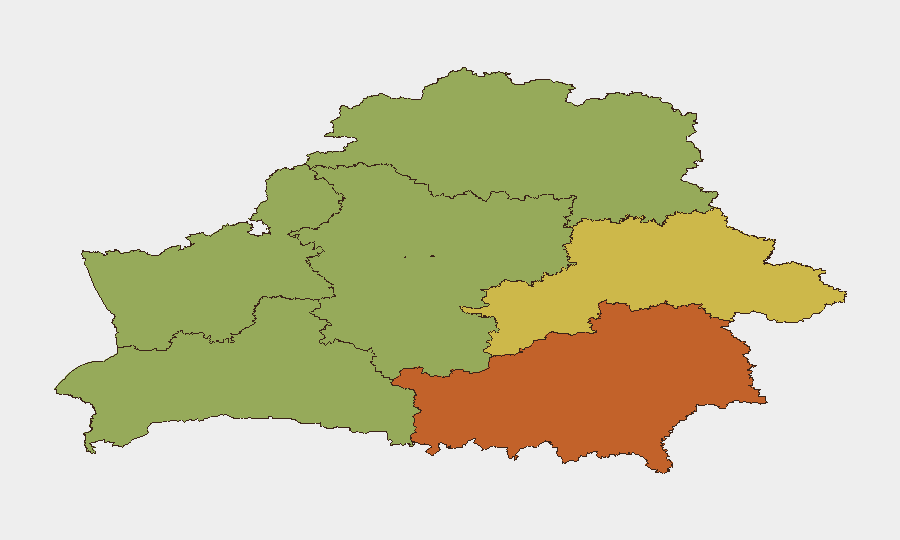
Situation Summary
Belarus remains a low-threat environment relative to global peers (rank #103, composite score 9), with no major civil unrest, conflict escalation, or infrastructure crises confirmed in the last 24–48 hours. Recent security activity is dominated by fraud and petty crime rather than political or military developments. The broader regional context—involving UK–Ukraine tensions, Poland–Belarus diplomatic messaging, and Russian military signaling—creates latent reputational and border risk, but has not yet manifested in direct Belarus-specific incidents within the reporting window.
Key Developments
- Nationwide, 15 July 2026: Interior Ministry reported 34 confirmed telephone fraud ("vishing") crimes in 24 hours; two cash couriers detained and over 30,000 Belarusian rubles seized. This reflects an uptick in ICT-enabled fraud rather than a one-off spike.
- Nationwide, 15 July 2026: Law enforcement reported sustained operations against fraud networks, with hundreds of scam call attempts blocked; successful cases treated as criminal offences, indicating active coordination between police and telecommunications carriers.
- Minsk, 15 July 2026: Heavy downpour and localized flooding disrupted traffic on multiple streets; property damage and pedestrian navigation hazards confirmed by media and social video. Infrastructure resilience concerns are non-urgent but operationally relevant for mobility planning.
- Regional (Poland, Slovakia, UK), 14–16 July 2026: Poland and Slovakia issued public statements and disapproval signals directed at Belarus and civilian contexts; UK and Russia exchanged coercive messaging focused on Ukraine and Moscow respectively. Direct Belarus involvement remains rhetorical rather than operational.
- Moscow/Russia, 14 July 2026: Russian authorities conducted investigations and threat-level messaging; President Putin issued public statements coinciding with Poland–Belarus diplomatic friction. No evidence Belarus is a primary actor or target in these communications.
Highest-Risk Areas
Homyel Region (score 75) and Minsk (score 68) lead sub-national rankings and warrant priority monitoring. Homyel's elevation likely reflects proximity to Russia and historical smuggling/border-control concerns; Minsk's risk is driven by concentration of state institutions, diplomatic presence, and ICT infrastructure susceptibility to fraud and cyber activity. Mahilyow (62) and Brest (55) represent secondary concern zones, likely tied to cross-border vulnerability and regional instability spillover. Risk tapering eastward and northward (Vitsebsk, Minsk Region) suggests border permeability and economic fragility, rather than active conflict, as the primary driver.
How GeoBit Would Assist
Intel Sweep and OSINT fusion across state media, Telegram, and social channels would track fraud-network recruitment, money-movement patterns, and potential links to organized crime or state-level actors. AOI Monitoring & Early Warning applied to Homyel Region and Minsk would flag border-crossing anomalies, checkpoint disruptions, or sudden diplomatic/military repositioning before mainstream reporting. Network & Actor Analysis would map relationships between vishing rings, cash-courier networks, and financial institutions, enabling duty-of-care teams to advise staff on fraud-targeting and travel-route safety.
7-Day Outlook
Fraud activity is likely to persist at current or elevated levels absent police enforcement surge; organizations with cash-handling or customer-service operations should anticipate continued targeting. Regional diplomatic friction (Poland, Slovakia, Russia) remains rhetorical and is unlikely to trigger direct Belarus military or police action within seven days. Weather-related disruption risks (flooding, seasonal storms) should be factored into logistics and staff mobility planning, particularly in and around Minsk.
Highest-Risk Areas — Ranked
| # | State / Region | Risk |
|---|---|---|
| 1 | Homyel Region | 75 |
| 2 | Minsk | 68 |
| 3 | Mahilyow Region | 62 |
| 4 | Brest Region | 55 |
| 5 | Hrodna Region | 52 |
| 6 | Minsk Region | 48 |
| 7 | Vitsebsk Region | 45 |
Previous Daily Briefs
A new Belarus brief is written every day — each with its own risk map and downloadable CSV. Here's the last week; use the calendar to go further back.
📅 Browse every day by calendar →
Highlighted days have a brief. Tap a day for that day's map & analysis, or “csv” for that day's dataset ($5).
Atlas — our AI intelligence desk — emails them this snapshot personally. Nothing else, no list.