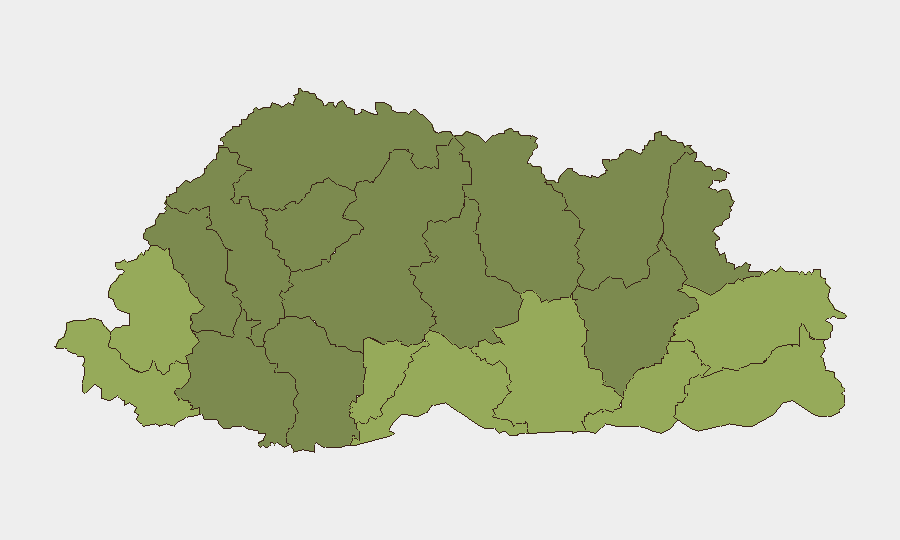
Situation Summary
Bhutan maintains a stable, low-threat security environment with no verified incidents or civil unrest reported in the last 24–48 hours. The country's composite threat score remains at 2 globally, reflecting minimal organized conflict, crime, or political instability. Risk concentration in border districts (Samtse, Sarpang, Haa, Pemagatshel, and Samdrup Jongkhar) appears consistent with historical patterns linked to cross-border dynamics and remote geography, rather than active acute threats.
Key Developments
- No verified security, civil-unrest, crime, or infrastructure incidents were identified in Bhutan during the 24–48-hour window ending 26 July 2026.
- A broadband and connectivity disruption occurred across multiple districts on 18–19 July 2026; service restoration was reported. This incident falls outside the current reporting window but remains relevant to logistics and duty-of-care planning for telecommunications-dependent operations.
- No corroborated reports of political instability, protest activity, or violence emerged in the requested period.
- No cross-border incidents or spillover events from neighboring India or Nepal were identified as directly affecting Bhutanese territory or nationals in the last 48 hours.
Highest-Risk Areas
Samtse, Sarpang, and Haa districts consistently rank highest (risk scores 58, 55, 52 respectively), followed by Pemagatshel and Samdrup Jongkhar in the south and east. These border districts face elevated residual risk primarily due to geographic isolation, limited state presence, and historical cross-border trafficking or informal trade corridors rather than active conflict or organized crime currently reported. Southern districts show marginally higher scores than northern and central districts (Lhuntse, Wangdue Phodrang), suggesting that proximity to Indian border regions and less-developed infrastructure remains a structural risk factor. Corporate and humanitarian operations in these areas should prioritize remote-area security protocols and route redundancy.
How GeoBit Would Assist
AOI Monitoring & Early Warning would enable persistent watch on high-risk border districts with automated alerting on civil unrest, cross-border movement, or infrastructure disruption, reducing response lag. Intel Sweep and multi-language OSINT (including Telegram, local media, and radio SIGINT) would capture early signals of political or crime developments before they escalate, particularly in remote areas with limited international reporting. Routing & Network Analysis would support duty-of-care teams in planning alternative transport routes and communication redundancies across districts prone to connectivity loss, as evidenced by the mid-July telecom disruption.
7-Day Outlook
No escalation in Bhutan's threat picture is anticipated over the next week. The stability outlook remains consistent with the country's low composite score and the absence of triggering events or political catalysts. Security teams should maintain standard monitoring protocols for border districts and prepare for potential seasonal weather-related infrastructure impacts; no acute security posture adjustment is warranted at this time.
Highest-Risk Areas — Ranked
| # | State / Region | Risk |
|---|---|---|
| 1 | Samtse District | 58 |
| 2 | Sarpang District | 55 |
| 3 | Haa District | 52 |
| 4 | Pemagatshel District | 50 |
| 5 | Samdrup Jongkhar District | 48 |
| 6 | Tsirang District | 45 |
| 7 | Zhemgang District | 42 |
| 8 | Trashigang District | 40 |
| 9 | Mongar District | 38 |
| 10 | Gasa District | 35 |
| 11 | Lhuntse District | 32 |
| 12 | Wangdue Phodrang District | 30 |
Sources
Previous Daily Briefs
A new Bhutan brief is written every day — each with its own risk map and downloadable CSV. Here's the last week; use the calendar to go further back.
📅 Browse every day by calendar →
Highlighted days have a brief. Tap a day for that day's map & analysis, or “csv” for that day's dataset ($5).
Atlas — our AI intelligence desk — emails them this snapshot personally. Nothing else, no list.