Situation Summary
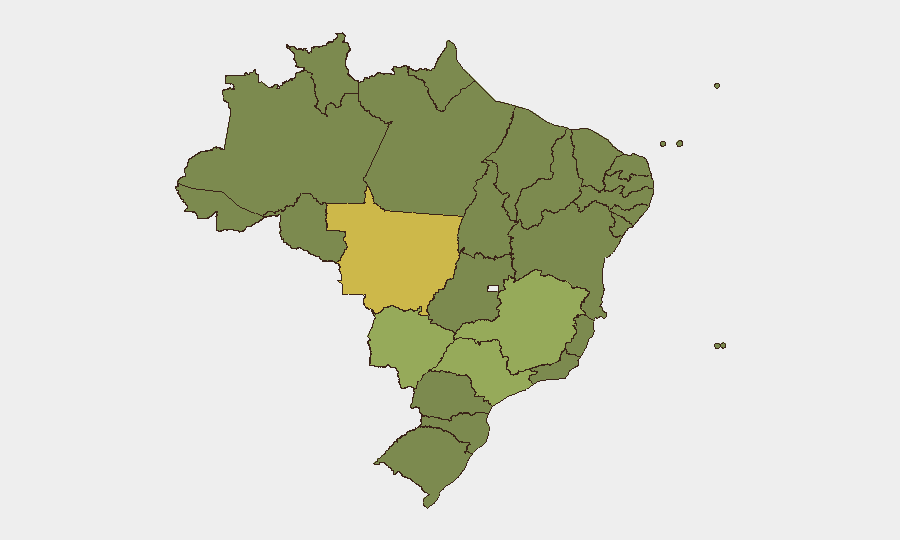
Brazil remains a moderate-risk environment (global rank #44, composite threat score 47) with persistent volatility concentrated in agricultural frontier states and major urban centers. Recent signals indicate institutional tension—including Senate rejections and gubernatorial disapproval actions on 28–30 June—alongside sporadic criminal violence and small-arms incidents. The security picture is fragmented by geography: high-threat zones cluster in Mato Grosso, São Paulo, and the central-west corridor, while coastal and southern states present lower but still-significant risk profiles. Current trajectory suggests continued localized instability rather than systemic national escalation.
Key Developments
Intelligence and law-enforcement activity signals dominate the most recent 48-hour event stream, though operational incident detail remains limited in open sources:
- 28–30 June | National level: Senate has rejected two consecutive motions (28 June and 30 June), and the Advocate General faced Senate rejection on 30 June, signaling institutional friction or procedural contests within federal governance.
- 28 June | Multi-agency: Magistrate, lawyer, and intelligence officials issued public statements on an unspecified matter, suggesting a coordinated or responsive communication cycle across judiciary, bar, and intelligence sectors.
- 28 June | Paraná: Firefighter-police operational event (classified as "Conventional Military Force" interaction) occurred; nature and outcome not yet clarified in available reporting.
- 29 June | Criminal violence: Small-arms combat incident involving criminal and retired personnel reported; geographic location not specified.
- 29 June | Government level: Government issued a demand (target and substance unspecified).
- 29 June | Diplomatic signal: Japan-Brazil public statement issued; context unclear from event classification alone.
Note: Open web research has not confirmed independent, time-stamped incident reporting for the last 48 hours with sufficient specificity to provide location-level or casualty-level detail. Cyberattack on Brazil's civil-defense alert system (fake "Extreme Alert" to Paraná, São Paulo, Rio de Janeiro) is documented as occurring "last week" and is therefore not current.
Highest-Risk Areas
Mato Grosso (risk score 63) remains the country's most volatile jurisdiction, driven by agricultural-frontier dynamics, land-dispute violence, and organized-crime presence in remote areas. São Paulo (49.2) concentrates urban crime, gang activity, and infrastructure vulnerability, while Mato Grosso do Sul (41.8) reflects similar frontier pressures. Minas Gerais (40.1) and Ceará (39.1) round out the top five, each hosting organized-crime networks and localized criminal conflict. Corporate and personnel security postures should prioritize these five states; operations in Paraná, Goiás, Pará, and the coastal strip (Rio de Janeiro, Espírito Santo, Santa Catarina) warrant elevated vigilance but do not command the same resource intensity.
How GeoBit Would Assist
Security teams would employ AOI (Area-of-Interest) Monitoring & Early Warning to track Mato Grosso, São Paulo, and secondary risk zones for criminal violence, land disputes, and institutional instability with sub-state precision. Network & Actor Analysis combined with OSINT fusion (X/Twitter, local media, judicial filings, intelligence statements) would disambiguate the institutional signals now appearing and assess whether they reflect procedural routine or substantive governance risk. Conflict & Military capability tracking and routing & alternative journey planning would support duty-of-care protocols for personnel and asset movement in high-risk corridors.
7-Day Outlook
Institutional tension is likely to persist, particularly if Senate motions and executive-judicial contestation continue. Criminal violence in frontier and urban zones will remain endemic. No evidence of imminent national escalation or systemic breakdown; risk profile should be monitored for shifts in frequency or geographic concentration of small-arms incidents, which could signal inter-cartel or state-police escalation in top-ranked states.
Highest-Risk Areas — Ranked
| # | State / Region | Risk |
|---|---|---|
| 1 | Mato Grosso | 63 |
| 2 | São Paulo | 49.2 |
| 3 | Mato Grosso do Sul | 41.8 |
| 4 | Minas Gerais | 40.1 |
| 5 | Ceará | 39.1 |
| 6 | Amazonas | 36.8 |
| 7 | Paraná | 33.5 |
| 8 | Goiás | 33.5 |
| 9 | Pará | 33.3 |
| 10 | Espírito Santo | 33.2 |
| 11 | Rio de Janeiro | 33.2 |
| 12 | Santa Catarina | 33 |
Sources
Previous Daily Briefs
A new Brazil brief is written every day — each with its own risk map and downloadable CSV. Here's the last week; use the calendar to go further back.
📅 Browse every day by calendar →
Highlighted days have a brief. Tap a day for that day's map & analysis, or “csv” for that day's dataset ($5).