Situation Summary
Estonia maintains a low baseline security risk profile with no verified major incidents or civil unrest in the last 48 hours. However, sustained pressure on eastern and southern borders—driven by irregular migration via Belarus and Latvia, combined with permanent restrictions on Russian border crossings—continues to elevate operational complexity for cross-border travel and logistics. The national security posture reflects heightened caution rather than acute crisis, with enforcement activity concentrated in border zones and transport hubs.
Key Developments
- Russian border crossing hours made permanent (30 July, 2026): Estonia's Ministry of Interior extended indefinitely the 12-hour operating schedule (04:00–16:00) at Narva-1, Koidula, Luhamaa checkpoints and rail crossing points, citing no improvement in eastern border security conditions. This formalizes constraints that will persist for cross-border travel and freight logistics.
- Irregular migrant detentions in Tallinn (past three days, late July): Estonian police detained 32 foreign nationals without identity documents across multiple Tallinn districts (Nõmme reception center, port, city center), linked to irregular migration via Belarus and Latvia. Enhanced enforcement around transport hubs is likely ongoing.
- Reinforced southern/eastern frontier policing (ongoing through late July): Estonia's Police and Border Guard Board continues rotating unit deployments to the Latvia–Belarus border sector, supporting detention operations and indicating sustained enforcement pressure in the southern corridor.
- Airspace restriction near Russian border (30 July, 2026): Estonian authorities temporarily closed flights along a section of the Russia–Estonia border until night-time in connection with border security management. No actual airspace violations reported; measure reflects heightened caution.
- Speed restrictions on national highways (regulatory announcement 28–30 July): Estonia's infrastructure ministry introduced a maximum speed reduction to 90 km/h on 1+1-lane roads without physical barriers, following a fatal multi-vehicle crash on the Tallinn–Tartu highway. Increased police presence on major inter-city routes is expected.
Highest-Risk Areas
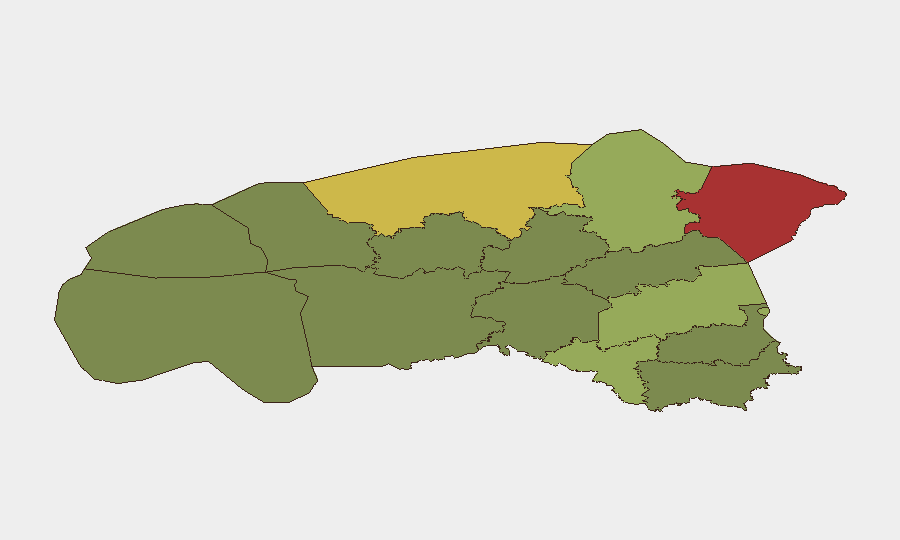
Ida-Viru County (risk 78) and Harju County (risk 68) account for the majority of composite threat exposure, driven by proximity to the Russian border, irregular migration pressure, and transport infrastructure concentration in Tallinn and the northeastern corridor. Tartu County (risk 58) and Valga County (risk 55) reflect secondary pressure from southern border migration flows via Latvia and Belarus. The eastern and southern frontiers are structurally more exposed to transnational movement, enforcement operations, and sustained border-security measures than the western and central counties, which remain substantially lower-risk.
How GeoBit Would Assist
Security teams with personnel or assets in Estonia should deploy AOI Monitoring & Early Warning on the Ida-Viru and Harju counties, with persistent watch on Tallinn transport hubs and eastern border checkpoints to detect shifts in detention activity or crossing delays. Routing & Network Analysis can identify alternative cross-border and inter-city pathways to avoid congestion or enforcement concentration around Narva, Koidula, and major highways. Multi-language OSINT and event-feed integration across Estonian media, Russian state outlets, and police announcements will provide real-time visibility into regulatory changes and migration-enforcement patterns that affect operational planning.
7-Day Outlook
Border crossing restrictions and migration-enforcement activity are expected to persist without near-term policy reversal, given the formalization of the Russian border schedule and ongoing Belarus-route pressure. Road safety enforcement will likely intensify following the new speed regulation, particularly on the Tallinn–Tartu corridor. No acute escalation is signaled, but operational friction around borders and compliance with new traffic restrictions should be incorporated into duty-of-care planning for Estonia-based staff and logistics.
Highest-Risk Areas — Ranked
| # | State / Region | Risk |
|---|---|---|
| 1 | Ida-Viru County | 78 |
| 2 | Harju County | 68 |
| 3 | Tartu County | 58 |
| 4 | Valga County | 55 |
| 5 | Lääne-Viru County | 52 |
| 6 | Pärnu County | 35 |
| 7 | Rapla County | 32 |
| 8 | Jõgeva County | 30 |
| 9 | Järva County | 28 |
| 10 | Viljandi County | 25 |
| 11 | Põlva County | 22 |
| 12 | Võru County | 18 |
Sources
Previous Daily Briefs
A new Estonia brief is written every day — each with its own risk map and downloadable CSV. Here's the last week; use the calendar to go further back.
📅 Browse every day by calendar →
Highlighted days have a brief. Tap a day for that day's map & analysis, or “csv” for that day's dataset ($5).
Atlas — our AI intelligence desk — emails them this snapshot personally. Nothing else, no list.