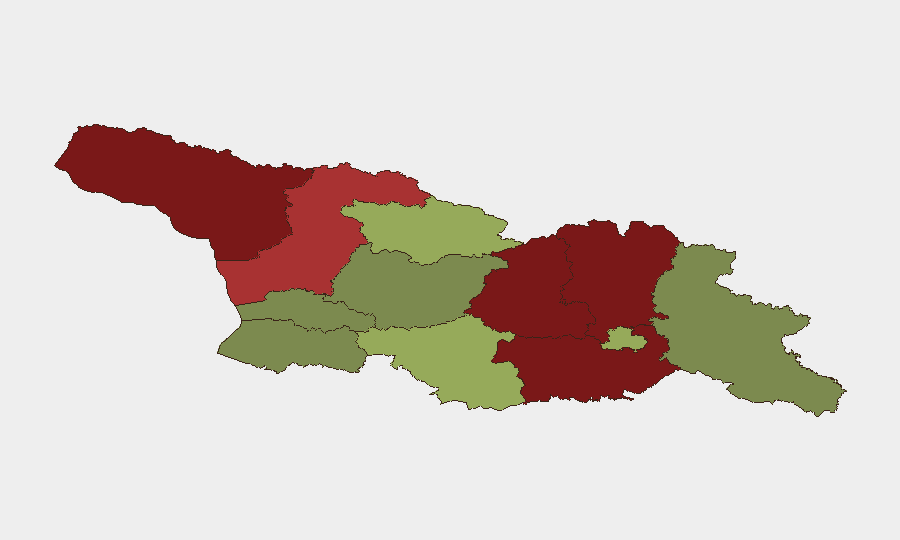
Situation Summary
Georgia faces a complex security environment marked by a sharp spike in street violence in Tbilisi over the past week, combined with emerging political tensions and weapons-related arrests. While the country's overall threat ranking remains moderate (92 globally), the concentration of homicides, armed incidents, and protest-related confrontations in late August–early September signals a deteriorating security posture in the capital and surrounding regions. The underlying drivers—Russian-Georgian tensions, domestic political friction, and organized crime—appear to be intersecting in real time.
Key Developments
- Batumi, 1 September 2026 – Anti-Russian street protest escalates to violence. Central Batumi witnessed a verbal clash between anti-Russian activists and local passers-by that turned physical; two female protesters were beaten (one struck with an umbrella) and required medical care. A separate incident the same day saw unidentified assailants attack demonstrators outside the Adjara regional government building, with injuries reported and investigations ongoing.
- Tbilisi International Airport, 1 September 2026 – Opposition protest at Russian arrivals. United National Movement activists staged a confrontation targeting Russian passengers arriving at Tbilisi International Airport, signaling sustained political hostility toward Russian nationals and heightened tensions at a critical transport hub.
- Tbilisi, 1 September 2026 – Businessman detained in firearms and threats investigation. Ministry of Internal Affairs officers detained businessman and dog-shelter founder Tamaz Elizbarashvili under administrative arrest in connection with an 30 August incident involving pro-government TV station staff; investigation includes charges under articles covering threats and illegal firearms possession, indicating ongoing politically sensitive criminal investigation.
- Tbilisi, 30 August–31 August 2026 – Escalation in street homicides. Three fatal stabbings of foreign nationals in or near Baratashvili Square (27–30 August) and shooting outside Frozen Paradise Bar and Grill (29 August, off-duty officer involved) collectively demonstrate a dramatic and concentrated spike in lethal street violence within the capital's central districts.
- Chitatskari village, 31 August 2026 – Petrol station explosion; two injured. An explosion at a local petrol station left two individuals in critical condition and transported to hospital; cause remains under investigation, ruling out neither accident nor deliberate action.
- Tbilisi, 27 August 2026 – Firearms arrest. Police arrested a male resident for illegal acquisition and possession of automatic firearms, ammunition, and explosives, indicating weapons trafficking or hoarding activity in the capital.
Highest-Risk Areas
The Autonomous Republic of Abkhazia (risk 95) and the contiguous breakaway-adjacent zones of Shida Kartli and Lower Kartli (88 and 85 respectively) drive Georgia's sub-national risk profile, reflecting unresolved frozen-conflict dynamics, limited state control, and cross-border criminal activity. Tbilisi itself, while lower-ranked at 45, is currently experiencing acute tactical risk: the August–September homicide cluster, officer-involved shooting, and politically charged protest activity indicate that the capital's day-to-day security environment is deteriorating faster than its historical baseline. Samegrelo-Upper Svaneti and Samtskhe-Javakheti, with scores of 78 and 48 respectively, remain structurally vulnerable to smuggling, informal armed groups, and ethnic tensions.
How GeoBit Would Assist
Security teams should deploy AOI Monitoring & Early Warning on Tbilisi city center (Baratashvili Square, Frozen Paradise area) and key protest sites in Batumi and the airport to detect gatherings and violence in near-real time. Intel Sweep (global event feeds, social-media OSINT, Telegram/X monitoring) will track anti-Russian sentiment, protest organization, and emerging criminal incidents before they escalate. Network & Actor Analysis would map connections among detained individuals, organized-crime factions, and political actors to anticipate secondary violence or revenge incidents.
7-Day Outlook
The convergence of street violence, political polarization, and weapons-related arrests suggests heightened volatility through early September. Risk is concentrated in Tbilisi and Batumi; foreign nationals and opposition activists face elevated exposure to confrontation and street crime. Monitoring for secondary incidents—retaliation, further protests, or weapons seizures—remains critical.
Highest-Risk Areas — Ranked
| # | State / Region | Risk |
|---|---|---|
| 1 | Autonomous Republic of Abkhazia | 95 |
| 2 | Shida Kartli | 88 |
| 3 | Lower Kartli | 85 |
| 4 | Mtskheta-Mtianeti | 82 |
| 5 | Samegrelo-Upper Svaneti | 78 |
| 6 | Samtskhe-Javakheti | 48 |
| 7 | Tbilisi | 45 |
| 8 | Racha-Lechkhumi and Kvemo Svaneti | 42 |
| 9 | Kakheti | 38 |
| 10 | Autonomous Republic of Adjara | 35 |
| 11 | Imereti | 32 |
| 12 | Guria | 28 |
Sources
Previous Daily Briefs
A new Georgia brief is written every day — each with its own risk map and downloadable CSV. Here's the last week; use the calendar to go further back.
- September 1, 2026
- August 31, 2026
- August 30, 2026
- August 29, 2026
- August 28, 2026
- August 27, 2026
- August 26, 2026
📅 Browse every day by calendar →
Highlighted days have a brief. Tap a day for that day's map & analysis, or “csv” for that day's dataset ($5).
Atlas — our AI intelligence desk — emails them this snapshot personally. Nothing else, no list.