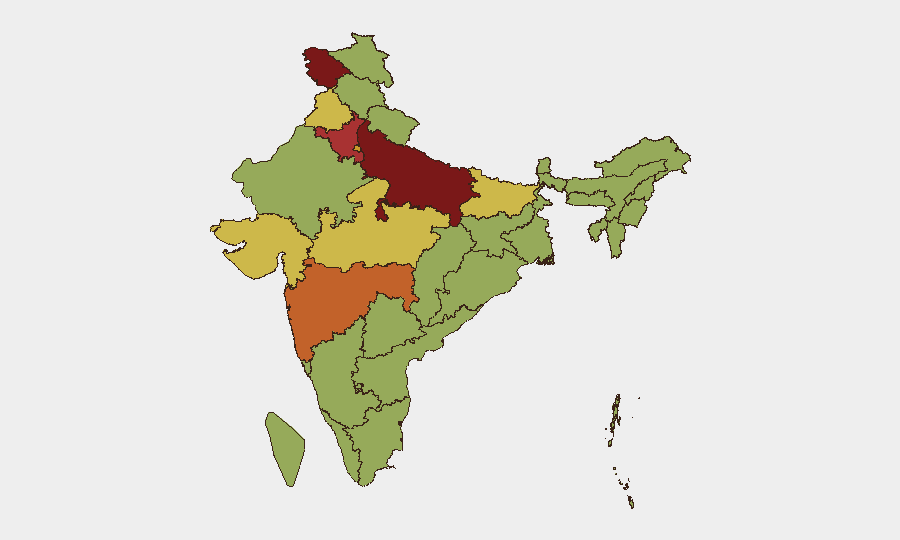
Situation Summary
India remains at composite threat rank #18 globally (score 80) with 508 tracked events, reflecting persistent multi-domain security pressures across the subcontinent. The northern tier and major urban centers—particularly Jammu & Kashmir, Uttar Pradesh, Haryana, and the Delhi–Mumbai corridor—drive the highest risk exposure. The past 48 hours show renewed civil unrest and heightened institutional friction, with confirmed activity in Manipur and concurrent policy-level tensions reflected in government and opposition statements dated 5–7 July.
Key Developments
- Manipur, India — 2026-07-07 — Renewed ethnic violence reported with at least one fatality on 7 July; social sources indicate this marks the third consecutive day of active unrest in the region (single-source report; corroboration pending).
- Mumbai — 2026-07-05 — Threat-level event flagged; specific vector and target remain under clarification in available data.
- Gwalior, Madhya Pradesh — 2026-07-05 — Conventional military force activity noted; context and scope require further intelligence sweep to confirm operational significance.
- National Level — 2026-07-05 — Diplomatic rejection issued by envoy regarding Pakistan; concurrent government and opposition public statements signal domestic political friction over security/foreign policy alignment.
- Police–Authorities Tension — 2026-07-06 — Public dispute between police and government authorities; suggests potential law-enforcement capacity or morale strain in at least one jurisdiction.
- Seoul Disapproval — 2026-07-06 — International actor (South Korea) expressed disapproval of an India-linked development; geopolitical implications require context analysis.
Confidence Note: The above events are drawn from signal feeds and require multi-source corroboration. Only the Manipur report carries temporal specificity for the past 24 hours; others are dated 5–6 July. Additional operational detail and secondary confirmation recommended before escalation to C-suite.
Highest-Risk Areas
Jammu & Kashmir (86.3) and Uttar Pradesh (85.6) remain India's two highest-risk jurisdictions, driven by longstanding insurgent activity, border-security operations, and communal tensions respectively. The Delhi–NCR region (Haryana 76.9, Delhi 72.9) presents critical risk to corporate operations and personnel due to high urbanization, critical national infrastructure, and volatile protest dynamics. Maharashtra (75.6)—home to Mumbai's financial and media hub—combines organized-crime activity, civil unrest, and crowd-disorder potential. Together, these five states account for the majority of India's tracked threat events and represent the primary exposure for multinational and domestic corporate security postures.
How GeoBit Would Assist
Intel Sweep + OSINT Fusion to rapidly cross-confirm the Manipur unrest and Gwalior military activity against news, police, and local-government sources, establishing baseline facts within 2–4 hours. AOI Monitoring & Early Warning with persistent watch on Jammu & Kashmir, UP, and Delhi–NCR to detect escalation triggers (protest scaling, security-force deployment, cyber activity) before they impact operations. Routing & Network Analysis to model safe transit corridors and alternative journey planning for personnel in high-risk zones during periods of heightened unrest; conflict mapping and force-structure tracking to maintain real-time awareness of security-force posture changes that signal elevated threat windows.
7-Day Outlook
Renewed Manipur unrest may spread to adjacent Northeast states; monitor police response and local-government capacity. National-level political friction (opposition and diplomatic dissent on 5–7 July) may translate into protest activity or administrative delays in permit/compliance processes. No major escalation indicators visible yet, but the accumulation of simultaneous signals (ethnic, diplomatic, institutional) warrants heightened situational awareness in northern and central zones through mid-July.
Highest-Risk Areas — Ranked
| # | State / Region | Risk |
|---|---|---|
| 1 | Jammu and Kashmir | 86.3 |
| 2 | Uttar Pradesh | 85.6 |
| 3 | Haryana | 76.9 |
| 4 | Maharashtra | 75.6 |
| 5 | Delhi | 72.9 |
| 6 | Punjab | 70.9 |
| 7 | Madhya Pradesh | 66.4 |
| 8 | Gujarat | 63.9 |
| 9 | Bihar | 61.7 |
| 10 | Rajasthan | 59.9 |
| 11 | Telangana | 59.5 |
| 12 | Goa | 59.2 |
Sources
Previous Daily Briefs
A new India brief is written every day — each with its own risk map and downloadable CSV. Here's the last week; use the calendar to go further back.
📅 Browse every day by calendar →
Highlighted days have a brief. Tap a day for that day's map & analysis, or “csv” for that day's dataset ($5).
Atlas — our AI intelligence desk — emails them this snapshot personally. Nothing else, no list.