Situation Summary
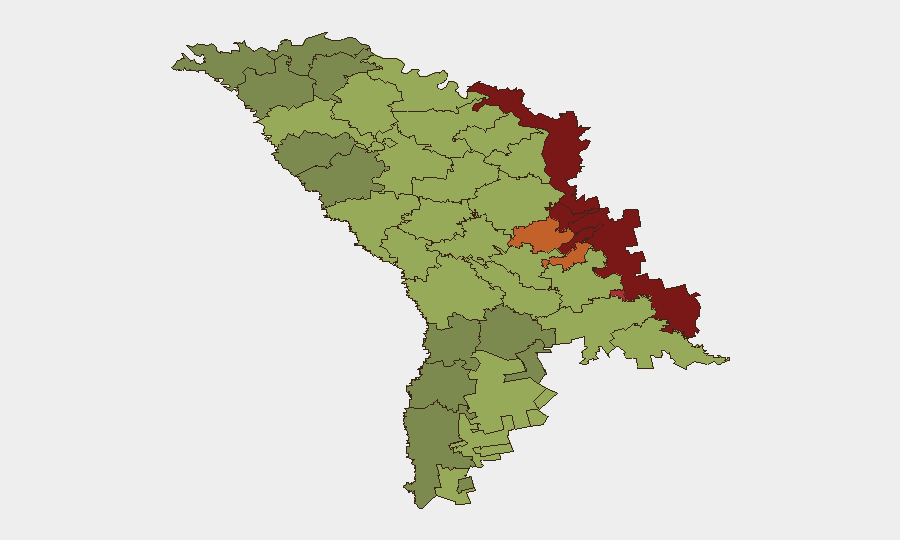
Moldova faces elevated cyber and airspace security pressure following a sophisticated state-sponsored cyberattack disclosed on 28 October that exposed approximately 750,000 personal identification numbers from government databases. Concurrent with cyber operations, the country recorded 19 airspace violations in October alone, including six drone impacts across multiple districts, signaling a broader pattern of hybrid-threat pressure. The government has responded with emergency legislative drafting and enhanced regional defense coordination, but underlying vulnerabilities in digital infrastructure and territorial air defense remain exposed. The composite national threat score (13) and #136 global ranking reflect contained but persistent risk, concentrated heavily in Transnistrian-adjacent and left-bank regions.
Key Developments
- Nationwide government systems | 28 October: Moldova's e-government authorities disclosed a major cyberattack targeting approximately one million personal identification records between 19–23 October; attackers successfully extracted data linked to 750,000 individuals. President Maia Sandu convened the National Security Council, with officials indicating attackers may have used artificial intelligence to identify system vulnerabilities.
- Chișinău | 28 October–2 November: In response to the cyberattack, Moldova's government approved draft legislation addressing non-cash-payment fraud and electronic identification standards. Authorities continued investigation into possible foreign-state attribution.
- Multiple districts | 2 November: The Defence Ministry reported 19 airspace violations recorded during October, including six drones that exploded on impact. Recorded drone locations spanned at least ten districts (Căușeni, Ștefan Vodă, Anenii Noi, Hânceşti, Ocniţa, Donduşeni, Teleneşti, Călăraşi, Ungheni, Edineţ) plus four Transnistrian localities.
- Chișinău–Bucharest | 2 November: Defence Minister Anatolie Nosatîi travelled to Bucharest to meet Romanian Defence Minister Ștefan-Radu Oprea; a formal military-cooperation agreement was expected to be signed, signaling accelerated bilateral defense coordination in response to hybrid threats.
Highest-Risk Areas
The Left Bank of the Dniester (Administrative-Territorial Units), Dubăsari, and Bender dominate the sub-national risk ranking (scores 85, 82, and 79 respectively), reflecting their proximity to Transnistrian military infrastructure and exposure to airspace violations and potential spillover from the unresolved territorial dispute. Criuleni, Rezina, and Taraclia (scores 75, 58, and 55) face elevated risk from cross-border drone activity and airspace incursions; all three recorded drone impacts in October. Even Chișinău (rank 12, score 49) remains a secondary target for cyber operations and must be considered vulnerable. Gagauzia and the northern and eastern border districts (Căușeni, Soroca, Ștefan Vodă, Orhei) all rank between 50–54, indicating sustained hybrid-threat exposure across the country's territorial perimeter.
How GeoBit Would Assist
Security teams should deploy AOI Monitoring & Early Warning on the highest-risk sub-national regions (especially Left Bank, Dubăsari, and Bender) to detect airspace violations and drone activity in near real-time. Conflict & Military force-structure and weapons-capability tracking, combined with Network & Actor Analysis, would support attribution of the cyberattack and ongoing threat actor identification. Intel Sweep, multi-language OSINT fusion, and Telegram/X intelligence would enable continuous monitoring of official statements, military-coordination signals, and foreign-state signaling that precedes escalation or coordinated hybrid operations.
7-Day Outlook
Cyber and airspace threats are likely to remain elevated through early November as Moldova completes legislative response and coordinates with Romania on defense posture. Attribution efforts and investigation into foreign-state involvement will shape diplomatic and military reactions over the coming weeks. Airspace violations may continue at current or elevated frequency given the pattern established in October.
Highest-Risk Areas — Ranked
| # | State / Region | Risk |
|---|---|---|
| 1 | Administrative-Territorial Units of the Left Bank of the Dniester | 85 |
| 2 | Dubăsari | 82 |
| 3 | Bender | 79 |
| 4 | Criuleni | 75 |
| 5 | Rezina | 58 |
| 6 | Taraclia | 55 |
| 7 | Gagauzia | 54 |
| 8 | Căușeni | 53 |
| 9 | Soroca | 52 |
| 10 | Ștefan Vodă | 51 |
| 11 | Orhei | 50 |
| 12 | Chișinău | 49 |
Sources
Previous Weekly Briefs
A new Moldova brief is written every Monday, covering the week — each with its own risk map and downloadable CSV. Use the calendar to go further back.
- October 27, 2026
- October 20, 2026
- October 13, 2026
- October 6, 2026
- September 29, 2026
- September 22, 2026
- September 15, 2026
📅 Browse past briefs by calendar →
Highlighted days have a brief. Tap a day for that day's map & analysis, or “csv” for that day's dataset ($5).
Atlas — our AI intelligence desk — emails them this snapshot personally. Nothing else, no list.