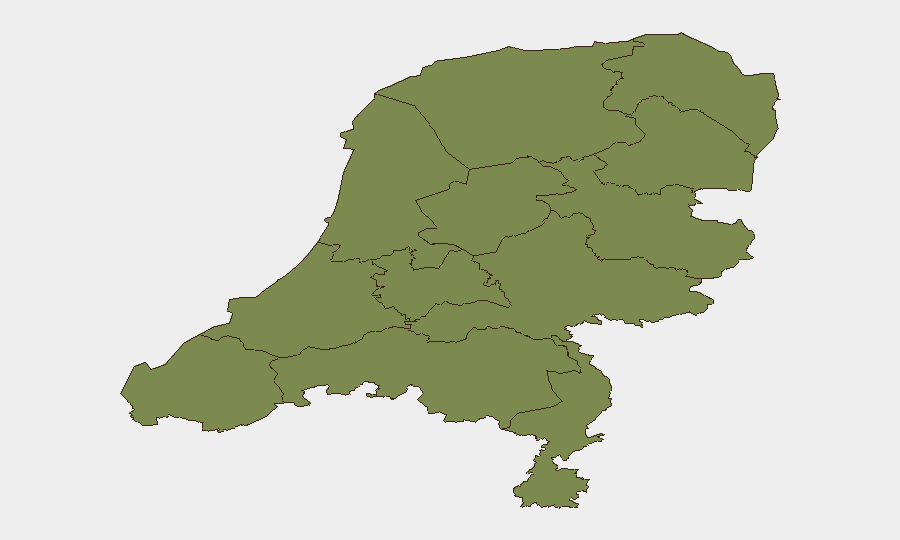
Situation Summary
The Netherlands maintains a composite threat ranking of 4 globally (#169), indicating a stable but monitored security environment. Recent signals reflect low-intensity administrative and civil friction rather than acute security crises: citizen-police sanctions, government disputes, and public demonstrations are registered but not indicative of systemic instability. Flevoland province presents an outlier risk profile (31.5) warranting focused investigation; all other regions remain at baseline or near-baseline threat levels.
Key Developments
- 2026-07-11 · Administrative Sanctions (Citizen vs. Police Officer) — Nature and location of incident not yet specified in available corroboration; suggests personnel-level accountability or complaint lodged with Dutch police or municipal authorities.
- 2026-07-11 · Administrative Sanctions (Citizen vs. Government) — Indicates formal complaint or legal action by individual(s) against government entity; specific ministry, department, and jurisdiction not yet identified.
- 2026-07-11 · Public Demonstration (Protester Activity) — Location and stated grievance(s) not confirmed in current research; scale and any public-order response remain undetermined.
- 2026-07-11 · Public Statement (Website) — A statement or advisory issued via official or institutional website; subject matter unclear without direct source review.
- 2026-07-10 · Public Statement (Scientist) — Scientific or research body commentary issued; likely unrelated to acute security threat but flagged by event monitoring for context.
- 2026-07-09 · Administrative Sanctions (School) — Educational institution subject to formal sanction or regulatory action; circumstances not yet clarified.
- Prior context (since 2026-07-09): Slovakia–Hungary diplomatic rejection signal and cartel-related disapproval flag remain under monitoring; no direct kinetic or imminent threat to Netherlands territory or nationals identified.
Note: Live web research has not corroborated specific locations, casualty figures, or confirmed timelines for any of the above events within the last 24–48 hours using multi-source news or social-media verification. Alerts reflect GeoBit event taxonomy classification; duty-of-care teams should treat as preliminary and await downstream corroboration.
Highest-Risk Areas
Flevoland's composite risk score (31.5) is substantially elevated relative to all other provinces and warrants urgent investigation into underlying drivers—whether industrial incident, environmental hazard, infrastructure vulnerability, or civil unrest. North Holland (8.3) shows secondary elevation; Utrecht (2.8) is minor. All remaining provinces cluster at 1.5, indicating homogeneous baseline risk and suggesting that national-level events (regulatory, diplomatic, or cyber) are the primary differentiators rather than regional instability. The Flevoland anomaly should be treated as an intelligence gap requiring AOI monitoring and on-the-ground confirmation.
How GeoBit Would Assist
Intel Sweep + OSINT Fusion on Flevoland, North Holland, and Utrecht to identify the specific incidents, actors, and timeline driving elevated scores. AOI Monitoring & Early Warning with persistent watch on Flevoland and North Holland to detect escalation or secondary events. X/Twitter & Telegram OSINT to capture real-time civil sentiment, protest activity, and enforcement responses. Network & Actor Analysis to map any cartel or organized-crime dimension flagged by the 2026-07-09 disapproval signal.
7-Day Outlook
No acute security escalation is forecast for the Netherlands over the next seven days. Administrative and civil friction signals are expected to remain at current baseline; monitoring should focus on Flevoland anomaly clarification and confirmation of protest scope/intent. Dutch participation in NATO and EU frameworks suggests external threats (regional conflict spillover, cyber operations) remain the primary duty-of-care concern rather than internal instability.
Highest-Risk Areas — Ranked
| # | State / Region | Risk |
|---|---|---|
| 1 | Flevoland | 31.5 |
| 2 | North Holland | 8.3 |
| 3 | Utrecht | 2.8 |
| 4 | Zeeland | 1.5 |
| 5 | South Holland | 1.5 |
| 6 | North Brabant | 1.5 |
| 7 | Frisia | 1.5 |
| 8 | Groningen | 1.5 |
| 9 | Drenthe | 1.5 |
| 10 | Gelderland | 1.5 |
| 11 | Overijssel | 1.5 |
| 12 | Limburg | 1.5 |
Sources
Previous Daily Briefs
A new Netherlands brief is written every day — each with its own risk map and downloadable CSV. Here's the last week; use the calendar to go further back.
📅 Browse every day by calendar →
Highlighted days have a brief. Tap a day for that day's map & analysis, or “csv” for that day's dataset ($5).
Atlas — our AI intelligence desk — emails them this snapshot personally. Nothing else, no list.