Situation Summary
Tunisia remains a moderate-risk jurisdiction (rank #57 globally, composite threat score 25) with a nationwide state of emergency and persistent vulnerability to terrorism, especially in border and mountainous regions. The country is currently experiencing severe environmental stress from a countrywide heatwave (temperatures to 47°C), which is destabilizing critical infrastructure—particularly the national power grid—and creating secondary risks (heat-related medical emergencies, sudden electricity outages, transport disruptions). No major discrete security incidents (attacks, riots, significant crimes) have been verified in the last 24–48 hours from multi-source open reporting; however, underlying structural fragility and ongoing security-force abuses in migration control operations remain documented concerns.
Key Developments
- Nationwide heatwave alert, 16 July 2026 – The National Institute of Meteorology (INM) placed 12 governorates under elevated alert due to extreme temperatures reaching 47°C through end of week. *Risk impact:* increased heat-related medical emergencies for personnel; elevated risk of outdoor activity disruption and dehydration.
- Unscheduled power cuts (STEG), nationwide, 16 July 2026 – Tunisia's state electricity company (STEG) announced that heatwave-driven demand is forcing sudden, unscheduled outages across multiple regions, with no advance notice. *Risk impact:* critical infrastructure instability affecting elevators, traffic signals, refrigeration, communications, and emergency-service response capability.
- EU–Tunisia migration funding dispute, 16 July 2026 – A 46-organization coalition of human rights and humanitarian groups issued a joint statement calling on the EU to halt funding for Tunisia's migration control operations, citing documented abusive practices by Tunisian security forces (violent interceptions, arbitrary detention, torture, sexual violence, collective expulsions). *Risk impact:* signals ongoing security-force abuses and heightened political pressure around border/coastal enforcement; raises risk profile for migrants and NGO personnel operating near borders.
- Persistent state of emergency, nationwide, ongoing – The nationwide state of emergency remains in force with frequent police checks, elevated terrorism threat (especially border and mountainous areas), and periodic demonstrations in Tunis with potential for demonstrator–security-force clashes. *Risk impact:* background civil-unrest potential and arbitrary enforcement; travelers and outdoor personnel should expect heightened police scrutiny and expect demonstrations in central Tunis.
Highest-Risk Areas
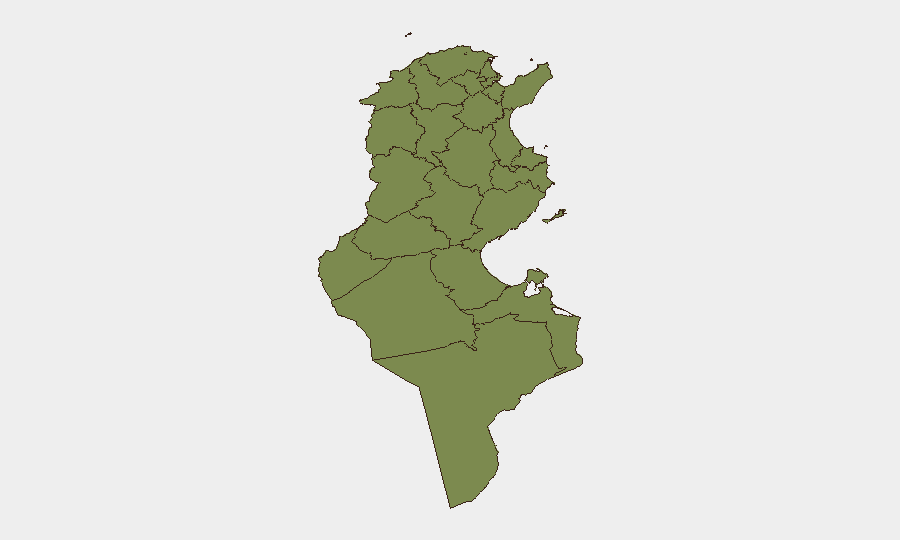
Tunis and Kébili dominate the sub-national risk ranking (both 31.8), driven by concentration of political activity, security operations, and migration/border-control enforcement. Tunis accounts for state-of-emergency policing, periodic demonstrations, and administrative checkpoints; Kébili's elevation reflects border proximity and migration-control intensity. All other governorates score 1.8 (minimal tracked events), indicating that risk is sharply concentrated in the capital and the southwestern border region rather than dispersed across the country.
How GeoBit Would Assist
Security teams with personnel or assets in Tunisia should employ Intel Sweep and multi-language OSINT (including X/Twitter, Telegram, and local-language sources) to monitor heatwave impacts on power-grid stability, sudden outages, and associated crime-opportunity windows. AOI Monitoring & Early Warning with persistent watch on Tunis (demonstrations, police checkpoints) and Kébili (migration operations, border incidents) would provide advance notice of escalations. Routing & Network Analysis can help identify alternative routes around likely power-outage zones and areas under elevated police enforcement.
7-Day Outlook
The heatwave is forecast to persist through the end of the week, sustaining power-grid stress and heat-health risks. No imminent security escalation is signaled by current open-source data; however, infrastructure instability and ongoing migration-control tensions create conditions for secondary incidents (medical emergencies, opportunistic crime during outages, potential border confrontations). Monitoring power-grid announcements and Tunis-area police activity remains essential for situational awareness.
Highest-Risk Areas — Ranked
| # | State / Region | Risk |
|---|---|---|
| 1 | Tunis | 31.8 |
| 2 | Kébili | 31.8 |
| 3 | Tataouine | 1.8 |
| 4 | Nabeul | 1.8 |
| 5 | Monastir | 1.8 |
| 6 | Sfax | 1.8 |
| 7 | Mahdia | 1.8 |
| 8 | Médenine | 1.8 |
| 9 | Jendouba | 1.8 |
| 10 | Béja | 1.8 |
| 11 | Bizerte | 1.8 |
| 12 | Ariana | 1.8 |
Sources
Previous Daily Briefs
A new Tunisia brief is written every day — each with its own risk map and downloadable CSV. Here's the last week; use the calendar to go further back.
📅 Browse every day by calendar →
Highlighted days have a brief. Tap a day for that day's map & analysis, or “csv” for that day's dataset ($5).
Atlas — our AI intelligence desk — emails them this snapshot personally. Nothing else, no list.